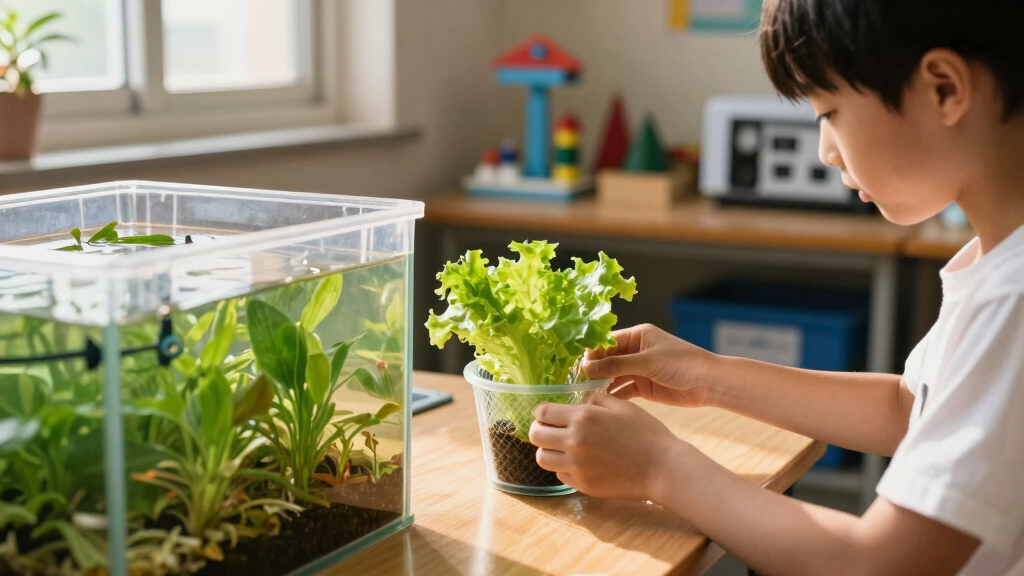

Choosing the best aquaponics system for a classroom setting involves balancing ease of setup, educational value, and scalability. The AquaSprouts Aquaponics Garden stands out for its compact design and self-sustaining features, making it ideal for smaller spaces and beginner educators. The Carolina Aquasprouts Garden offers a more customizable experience suitable for active student projects, though it requires more maintenance. The Back to the Roots Indoor Aquaponic Garden provides a fun, all-in-one kit that integrates microgreens and fish, perfect for younger students or those new to aquaponics. Each system has unique tradeoffs in complexity, cost, and educational depth, so understanding these differences helps determine which fits your teaching goals best.
Key Takeaways
- The AquaSprouts system is best for small classrooms or beginner setups due to its simplicity and self-sustaining design.
- Carolina’s system allows for more complex experiments and customization but demands more hands-on maintenance.
- Back to the Roots offers an engaging, all-in-one kit ideal for introducing younger students to aquaponics with instant gratification.
- Tradeoffs include ease of use versus customization, with simpler systems being less flexible but more accessible.
- All options support hands-on learning about ecosystems, nutrient cycles, and sustainable food production.
| AquaSprouts Aquaponics Garden, Self-Sustaining Desktop Aquarium Hydroponics Ecosystem Kit, fits Standard 10 Gallon Aquariums |  | Best Overall for Small Classrooms and Beginners | Tank Volume: 10 Gallons | Dimensions: 28″L x 8″W x 35″H | Weight: 18 Pounds | VIEW LATEST PRICE | See Our Full Breakdown |
| Carolina Aquasprouts Garden Aquaponics Desktop System, Black, Polypropylene Plastic, Aquarium, Fish, Educational, Indoor, Plant and Animal Housing |  | Best for Active, Hands-On Class Projects | Tank Volume: 10 Gallons | Dimensions: 10″ x 10″ x 17″ | Material: Polypropylene | VIEW LATEST PRICE | See Our Full Breakdown |
| Back to the Roots Indoor Aquaponic Garden – 3 Gallon Self Watering, Mess-Free Planter and Self-Cleaning Fishtank for Herbs, Microgreens, Bamboo, Succulents, and Houseplants, support Fish |  | Best for Younger Students & Introductory Learning | Tank Volume: 3 Gallons | Dimensions: 10.7″ x 12.9″ x 30.3″ | Material: Plastic | VIEW LATEST PRICE | See Our Full Breakdown |
More Details on Our Top Picks
AquaSprouts Aquaponics Garden, Self-Sustaining Desktop Aquarium Hydroponics Ecosystem Kit, fits Standard 10 Gallon Aquariums
The AquaSprouts Aquaponics Garden excels in simplicity and compactness, fitting easily on classroom desks or small spaces. Its self-sustaining nature means minimal water changes and no filter replacements, which reduces maintenance time. Compared to more complex systems, it’s highly accessible for teachers new to aquaponics or for classrooms with limited budgets. However, its smaller size limits the number of plants and fish, which might restrict longer-term experiments or larger student groups. Its plastic construction is lightweight but may feel less durable over time. This system makes a compelling choice for introducing fundamental concepts of ecology and sustainability without overwhelming complexity.
Pros:- Compact and fits standard 10-gallon aquariums
- Self-sustaining with minimal maintenance
- Great for introducing basic ecosystem concepts
- Includes pump, timer, and porous pebbles
Cons:- Limited plant and fish capacity
- Plastic material feels less sturdy
- Loud pump operation during cycles
Best for: Beginners and small classrooms seeking a low-maintenance, engaging introduction to aquaponics.
Not ideal for: Large classes or advanced experiments needing more scale and customization.
- Tank Volume:10 Gallons
- Dimensions:28″L x 8″W x 35″H
- Weight:18 Pounds
- Material:Plastic
- Includes:Pump, timer, pebbles
- Target Species:Fish, invertebrates
Bottom line: A user-friendly, space-efficient aquaponics system ideal for classroom intro projects with low maintenance.
Carolina Aquasprouts Garden Aquaponics Desktop System, Black, Polypropylene Plastic, Aquarium, Fish, Educational, Indoor, Plant and Animal Housing
The Carolina Aquasprouts Garden offers a more flexible platform suited for students interested in exploring nutrient cycling and ecosystem management. Its custom-molded garden fits standard 10-gallon aquariums, and the included pump, timer, and clay media create a well-rounded system. Compared with the AquaSprouts, it requires more active maintenance, such as water testing and plant management, which can enrich student learning but also increase workload for teachers. Its modular design allows for experimenting with different plant and fish combinations, making it ideal for more advanced science lessons. Its sturdy polypropylene construction adds durability, but the system’s complexity may challenge younger students or less experienced teachers.
Pros:- Customizable for different fish and plant species
- Durable polypropylene construction
- Supports active learning through maintenance tasks
- Includes pump, timer, and clay media
Cons:- Requires more hands-on management
- More maintenance and water testing
- Higher initial setup complexity
Best for: Intermediate to advanced classrooms aiming to deepen understanding of ecological processes and system management.
Not ideal for: Very small spaces or teachers preferring a set-it-and-forget-it approach.
- Tank Volume:10 Gallons
- Dimensions:10″ x 10″ x 17″
- Material:Polypropylene
- Includes:Pump, timer, clay medium
- Target Species:Fish, aquatic invertebrates
- Educational Use:Ecology, nutrient cycling
Bottom line: A flexible, durable system suited for active student engagement and more complex scientific experiments.
Back to the Roots Indoor Aquaponic Garden – 3 Gallon Self Watering, Mess-Free Planter and Self-Cleaning Fishtank for Herbs, Microgreens, Bamboo, Succulents, and Houseplants, support Fish
The Back to the Roots Water Garden combines aquaponics with microgreen growing, making it a highly engaging, all-in-one kit suitable for elementary or middle school classrooms. Its compact 3-gallon design is perfect for small desks or indoor spaces, and it includes everything needed to grow herbs, microgreens, and support small fish. Compared to larger systems, it’s less suited for long-term or large-scale experiments but excels in demonstrating the basic principles of ecosystem dynamics and sustainable food production. Its self-cleaning feature simplifies maintenance, and the included curriculum makes it an excellent educational tool for introducing aquaponics concepts in a fun, accessible way.
Pros:- Compact and mess-free design
- Includes microgreens and fish support
- Self-cleaning feature reduces maintenance
- Educational curriculum included
Cons:- Limited plant and fish capacity
- Less suitable for long-term or larger projects
- Requires careful monitoring of small ecosystem
Best for: Younger students, introductory science lessons, or as a gift to inspire curiosity about ecosystems.
Not ideal for: Advanced research projects or classrooms needing larger systems for multiple students.
- Tank Volume:3 Gallons
- Dimensions:10.7″ x 12.9″ x 30.3″
- Material:Plastic
- Includes:Fish, microgreens, water conditioner
- Educational Focus:Ecosystem, sustainability, food production
- Made in:USA
Bottom line: An accessible, all-in-one kit perfect for early learners to grasp basic ecology and aquaponics fundamentals.

How We Picked
In selecting these systems, I prioritized models specifically designed for educational environments, focusing on ease of setup, durability, and educational value. I compared user reviews, manufacturer specifications, and the versatility of each system’s features. Systems had to be suitable for classroom use—compact, safe, and capable of supporting a variety of aquatic and plant life. I also considered scalability, maintenance requirements, and whether they promote active student participation. Cost and accessibility of additional components or upgrades were factored into the final rankings to ensure each system offered a balanced mix of affordability and functionality.
Factors to Consider When Choosing Best Classroom Aquaponics System For Science Learning
When selecting an aquaponics system for classroom use, consider the age group, available space, and the level of scientific engagement desired. Simpler, self-sustaining systems are ideal for younger students or beginners, while more complex setups can support in-depth experiments and student-led research. The durability of materials, ease of maintenance, and availability of educational resources also influence your choice. Budget considerations should balance initial costs with long-term usability and educational value. This guide breaks down key features to help you identify the best fit for your classroom environment.
Ease of Use and Setup
For busy teachers or those new to aquaponics, systems like the AquaSprouts offer straightforward assembly and minimal ongoing maintenance. Larger or more customizable systems like Carolina’s may require more initial setup and ongoing management but provide richer learning opportunities for students to explore ecosystem dynamics and system management. Consider whether your classroom can support systems that demand regular water testing and plant care, or if a more automated, low-maintenance setup is preferable.
Educational Value and Scalability
All three options support hands-on learning, but their educational depth varies. The Back to the Roots kit introduces basic ecosystem concepts with microgreens, making it perfect for early education. The AquaSprouts and Carolina systems promote understanding of nutrient cycles, fish care, and system maintenance, suitable for middle school and beyond. Think about your curriculum goals and whether you want students to focus on observation, experimentation, or food production—each system aligns differently with these objectives.
Durability and Maintenance
Materials like polypropylene in Carolina’s system provide durability for active classroom use, while plastic in AquaSprouts is lightweight and easy to handle but may be less sturdy. The Back to the Roots system’s compact design simplifies cleaning but may require more frequent attention to keep the ecosystem healthy. Assess whether your classroom environment can support regular maintenance or if a self-cleaning, low-maintenance system is better suited.
Cost and Accessories
Initial investment varies, with simpler systems like AquaSprouts being more affordable but limited in scope. Carolina’s system is more scalable but may come with higher costs for additional components or upgrades. The Back to the Roots kit often includes everything in one package, making it easier to budget. Also, consider the availability of replacement parts, educational materials, and optional upgrades to extend the system’s usefulness over time.
Frequently Asked Questions
What is the ideal age group for each aquaponics system?
The AquaSprouts system is most suitable for elementary to middle school students due to its simplicity and compact size, providing an engaging introduction to ecosystems. The Carolina Aquasprouts Garden is better suited for middle school and high school students who can handle more detailed management tasks and explore ecological concepts in greater depth. The Back to the Roots kit is designed for younger students, typically elementary level, offering a fun, low-pressure way to understand basic principles of sustainability and plant growth.
How much maintenance do these systems require?
The AquaSprouts system requires minimal maintenance, mainly monitoring water levels and occasional plant trimming. The Carolina system demands regular water testing, plant care, and system adjustments, making it ideal for students learning about ecosystem management. The Back to the Roots kit is mostly self-cleaning, with periodic refilling and plant replacement, suitable for classrooms with limited maintenance capacity but less long-term scalability.
Can these systems support a variety of fish and plants?
Yes, but each system has different capacities. The AquaSprouts is best for small fish like tetras and herbs or greens. Carolina’s system supports a wider range of fish such as small cichlids or goldfish, and more diverse plants, offering greater experiment flexibility. The Back to the Roots is limited to small fish and microgreens, making it ideal for basic lessons rather than extensive ecosystem studies. Always check each system’s specifications for compatible species and plant types.
Are these systems suitable for long-term classroom projects?
The AquaSprouts is well-suited for short- to medium-term projects due to its simplicity and low maintenance. The Carolina system can support longer projects with proper management and upgrades, ideal for students to track ecosystem changes over time. The Back to the Roots is more of an introductory or demonstration tool, less suited for extended experiments but excellent for initial engagement and basic understanding of aquaponics principles.
What safety considerations should I keep in mind?
All systems should be placed away from high-traffic areas to prevent accidental tipping or damage. Ensure that electrical components like pumps and timers are properly installed and protected from water splashes. Use non-toxic, fish-safe plants and fertilizers, and supervise student interactions with the systems. Regularly check for mold, algae buildup, or leaks, especially in systems with more active maintenance requirements. Safety is paramount in ensuring a positive, accident-free learning environment.
Conclusion
For educators seeking a straightforward, low-maintenance introduction, the AquaSprouts system offers an excellent starting point, especially for small classrooms or beginners. Teachers interested in fostering active, in-depth ecological experiments may prefer the Carolina Aquasprouts Garden, which supports more complex management and student-led projects. For elementary or younger students, or those looking for an engaging demonstration of ecosystem principles, the Back to the Roots kit provides a fun, accessible experience. Ultimately, your choice should align with your curriculum goals, classroom size, and the level of student engagement you desire.