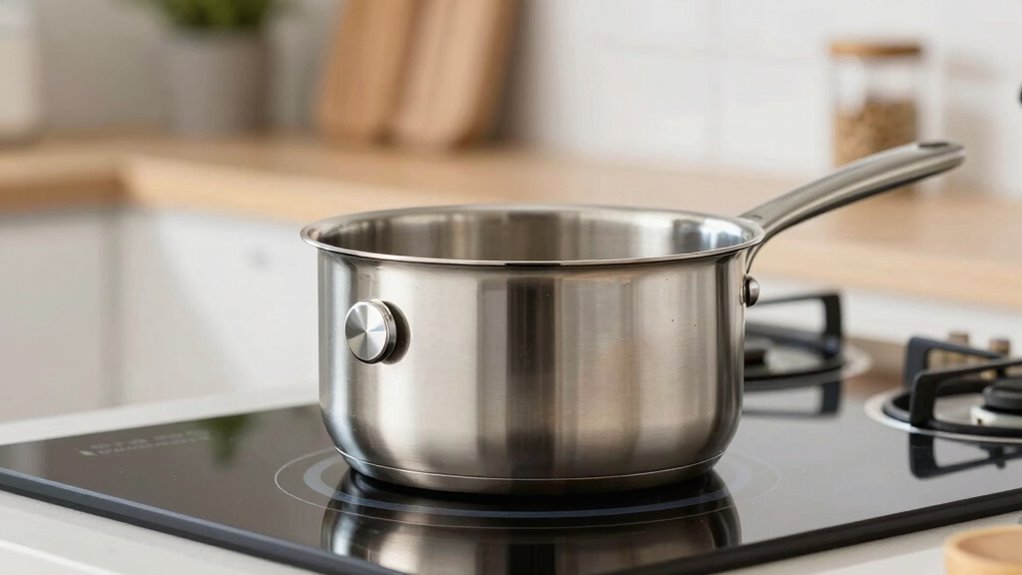
To check if your cookware is induction-ready, simply do the 10-second magnet test. Place a small magnet, like a fridge magnet, against the bottom of your pot or pan. If it sticks firmly, your cookware is compatible with induction cooktops. If it doesn’t, it’s not suitable. Be sure to verify other factors like material layers and bottom flatness for the best results. Want to learn more tips for perfect induction cookware? Keep going.
Key Takeaways
- Place a small magnet, like a fridge magnet, on the bottom of your cookware to test induction compatibility.
- A strong magnet adhesion indicates the cookware is suitable for induction cooking.
- No attraction means the cookware is not compatible with induction stoves.
- The magnet test is quick, simple, and can be performed in just seconds.
- Use this test to confirm if your cookware’s material and construction support induction heating.
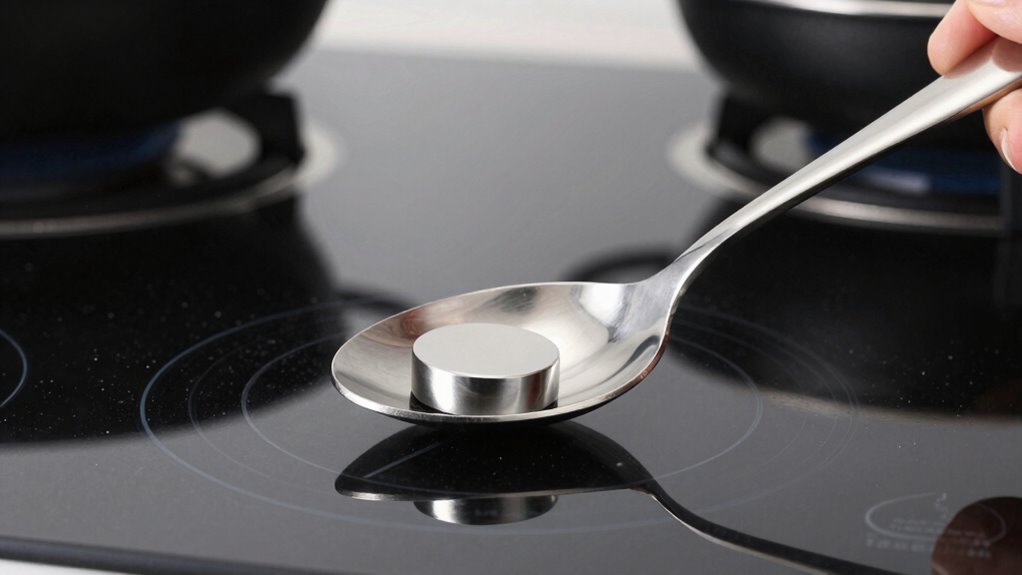
If you’re contemplating upgrading your kitchen, induction-ready cookware is a smart choice because it offers faster heating, precise temperature control, and energy efficiency. But before you invest, you need to determine if your current pots and pans are compatible with induction cooktops. The simplest way is the 10-second magnet test. Grab a small magnet—like the one on your fridge—and place it against the bottom of your cookware. If the magnet sticks firmly, your cookware is induction-ready. If it doesn’t, you’ll need to find suitable alternatives.
One key factor to consider when choosing induction-compatible cookware is the material. Many modern pots and pans feature ceramic coatings, which are popular for their non-stick properties and ease of cleaning. While ceramic coatings enhance cooking performance, they also influence the durability of your cookware. High-quality ceramic coatings are designed to withstand regular use without cracking or peeling, but cheaper versions may wear out faster. When shopping, look for cookware with a ceramic coating that’s reinforced for handle durability, ensuring the handles stay secure even after frequent use. Handles made from sturdy materials like stainless steel or heat-resistant silicone tend to last longer and provide better grip, which is vital when handling hot cookware on an induction stove.
The magnet test is straightforward, but it doesn’t tell you everything about cookware quality. For peak performance, your pots and pans should have flat, smooth bottoms to guarantee good contact with the induction surface. Uneven or warped bottoms can lead to uneven heating, which defeats the purpose of an induction cooktop’s precision. Besides compatibility, pay attention to the construction of the cookware. Good induction-ready pans often feature layers of metals, such as aluminum or copper, sandwiched between stainless steel or other durable materials. These layers help distribute heat evenly and improve overall cooking results. Material composition is a crucial factor in ensuring your cookware performs well on induction cooktops.

CAROTE 16pcs Pots and Pans Set, Nonstick Cookware Sets
- Nonstick Coating: Titanium nonstick for easy food release
- Durable Construction: Reinforced die-cast aluminum for longevity
- Even Heating: Rapid, uniform heat distribution
As an affiliate, we earn on qualifying purchases.
As an affiliate, we earn on qualifying purchases.
Frequently Asked Questions
Can Non-Metallic Cookware Be Induction-Ready?
Non-metallic cookware isn’t induction-ready because it lacks magnetic properties necessary for induction cooking. induction-compatible cookware must have material compatibility with magnetic fields, usually made of ferrous metals like cast iron or stainless steel. If your cookware isn’t magnetic, it won’t work with induction stoves. To check, perform the 10-second magnet test — if a magnet sticks, you’re good to go; if not, consider switching to compatible cookware.
Does the Magnet Test Work With All Types of Cookware?
The magnet test works best with cookware that has magnetic properties, but it doesn’t guarantee material compatibility with induction cooktops. If a magnet sticks firmly, your cookware likely has ferrous content suitable for induction. However, some non-metallic or mixed-material cookware may fail the test despite being induction-compatible. Always check manufacturer labels or conduct additional tests to verify your cookware’s material compatibility with induction cooking.
How Do I Identify Induction-Compatible Cookware Brands?
To identify induction-compatible cookware brands, check if they meet compatibility standards set by manufacturers. Look for labels or symbols on the packaging, such as a coil icon or the words “induction compatible.” Popular cookware brands like All-Clad, Calphalon, and Cuisinart often specify compatibility. You can also visit their websites to confirm if their products meet induction standards. Always verify these details before making a purchase to guarantee compatibility.
Is There a Way to Make Existing Cookware Induction-Compatible?
You can make existing cookware induction-compatible by adding an induction-compatible coating or attaching a magnetic base. For example, you might apply a special induction-ready layer to non-magnetic cookware or place a magnetic disc at the bottom. This transforms your cookware into magnetic base cookware, enabling it to work on induction stoves. Just verify the coatings are safe and durable, and the magnetic base provides a strong enough attraction.
Are There Specific Cookware Materials That Are Not Suitable for Induction?
You might be surprised to find that ceramic and glass cookware aren’t suitable for induction cooking. Imagine placing a beautiful glass pot on your stove, only to realize it’s powerless against the magnetic field. These materials lack ferromagnetic properties, so they won’t heat. Instead, they act as silent spectators, preventing your culinary plans from coming to life. For induction, stick to cookware made of cast iron or stainless steel.
Conclusion
Now that you know the secret magnet trick, you’re all set to select cookware that plays nice with your induction stove. No more guessing games—just a quick test to guarantee everything works smoothly. Think of it as your little shortcut to hassle-free cooking, making your kitchen experience even more enjoyable. With this simple tip, you’ll confidently choose the right pots and pans, turning every meal into a delightful culinary adventure. Happy cooking!