
TL;DR

Get garden gear delivered free with Prime
- Fast, free delivery on millions of items
- Prime Video, Amazon Music and more included
- Member-only deals all year
Solar outdoor string lights store daytime sunlight in a rechargeable battery and use it to power LEDs after dark. For a set that suits your space, check where its panel will get several hours of direct sun, compare runtime and weather ratings, and treat the glow as decoration rather than dependable task or safety lighting.
A patio can feel like a different place after sunset: warm bulbs above the table, a soft glow along the fence, and no extension cord crossing the lawn. Solar outdoor string lights can create that scene by charging during the day and using the stored energy to light up at night.
The trick is that the bulbs and the panel have different jobs. Your bulbs go where you want the atmosphere; the small photovoltaic panel needs a sunny place to charge the battery. In this guide, you’ll learn how to match a set to your layout, read performance and weather claims, install it without stressing the wire, and keep its glow going through the season.
That distinction matters. A set that looks lovely in a product photo may disappoint beneath a deep, shady balcony. A little planning helps you choose lights for the space you actually have—and know when you need a separate lamp for cooking, stairs, or safe footing.
Give the panel several hours of direct sun when possible; shade, clouds, and short winter days can reduce runtime.
Choose a separate-panel design when you want bulbs in a shaded area and the panel in a sunnier spot.
Compare battery details, bulb replaceability, lighting settings, and the conditions behind runtime claims.
Check the outdoor rating for the panel, battery enclosure, connectors, and string; their protection may differ.
Use string lights for atmosphere, and add dedicated lighting for cooking, stairs, and path safety.
How Solar Outdoor String Lights Turn Daylight into Evening Glow
Solar outdoor string lights use a panel to collect daylight, charge a rechargeable battery, and power bulbs after dark. Many use LEDs because they draw relatively little energy, but the time they stay lit depends on the panel, battery, sunlight, and settings. In plain terms: the panel fills the tank; the battery holds the charge; the bulbs spend it.
During the day, sunlight reaches the photovoltaic cells and the system stores energy. At dusk, a sensor on many sets switches the lights on automatically. For instance, a panel clipped to the sunny edge of a shed could charge a string draped around a shaded dining pergola, as long as its cable reaches and the maker’s instructions allow that placement.
Think of the battery like a small water bottle. A clear, sunny day fills it more than a cloudy afternoon, and high brightness drains it faster than a gentle setting. That’s why a headline such as “all-night lighting” can’t promise the same result in every garden.
These lights create ambient light: a welcoming wash across a table or fence. They don’t reliably light a sharp knife, a staircase, or a dark path. At a barbecue, let the strings set the mood, then use a dedicated task light over the grill.
Popular right now

Dyson Cool AM07 Bladeless Tower Fan, Iron/Blue

Bose QuietComfort Wireless Noise Cancelling Headphones, Twilight Blue

De'Longhi COM530M All-in-One Coffee and Espresso Machine, 47 oz
As an affiliate, we earn on qualifying purchases.
Choose a Panel Location That Keeps the Lights Shining
Solar outdoor string lights run longer when their panel receives several hours of direct sunlight, so plan the panel’s location before you hang the bulbs. Shade, cloudy weather, and short winter days can leave the battery with less charge and the lights dimmer or off sooner. A sunny panel spot often matters more than a perfect-looking bulb arrangement.
Walk the space around midday and notice where sun falls on the ground, railing, shed, or fence. If the bulbs belong beneath a roof, look for a set with a separate panel and cable. You can hang the lights beneath the eaves, then point the panel toward a sunnier patch of garden. Check the cable length first; a few extra feet can make the difference between a useful setup and a panel stuck in shade.
Imagine a narrow balcony that faces a courtyard. The rail gets bright sun for part of the afternoon, while the ceiling stays shaded all day. A panel fixed to the rail may charge better than one tucked beside the bulbs. In a garden with a sunny fence, the fence might do the job.
Cloudy days may still provide some charging, but usually less than direct sun. Winter brings another challenge: daylight hours shrink and the sun sits lower. If your lights run less in December than June, the season may be the reason, rather than a sudden fault.
Compare Runtime, Brightness, and Bulb Details Before You Buy
To choose solar outdoor string lights, compare their battery and lighting details alongside any advertised runtime. Runtime claims vary with charging conditions, battery capacity, brightness, and timer or mode settings. A long runtime on a box tells you little unless you know what setting and charge conditions produced it.
Look for the battery type and capacity where listed, whether the battery can be replaced, and whether the bulbs are replaceable or permanently integrated. Also check bulb spacing, size, shape, and color temperature. Warm white can give a patio a candlelike feel; cooler white may look crisp along a workbench but less cozy above dinner.
For example, compare two strings for a small balcony: one offers larger bulbs with replaceable parts, while another offers more lighting modes but sealed components. If you want to keep the set for several seasons, replacement options may matter more than a flashing mode you’ll never use. Some newer models offer USB charging as a backup, but that feature doesn’t make a weak panel or small battery stronger.
Use the maker’s runtime estimate as a guide, not a promise. A timer or lower-brightness setting can help stretch a charge. Product features differ by brand, so check the instructions and specifications rather than assuming every set behaves the same way.
Check Weather Protection Before You Leave the Lights Outside
Solar outdoor string lights are suitable for rain only when the product is rated for outdoor exposure and used within the limits of that rating. The string, panel, battery enclosure, and connectors may have different protections. “Water-resistant” does not mean safe to submerge or built to withstand every storm.
Before buying, find out which parts the rating covers and follow the maker’s instructions for positioning the battery enclosure and panel. A connection tucked beneath a sheltered eave has different exposure from one sitting in a puddle beside a flower bed. If severe weather is forecast, check the manual for storage guidance instead of guessing.
Picture a set draped over a fence beside a rain barrel. The bulbs may handle outdoor exposure, but a low connector could still collect water or mud. Raise it with suitable clips and keep the panel and enclosure positioned as instructed. After a storm, look for loose connections, damaged insulation, or shifted mounting points before switching the set back on.
Battery care also matters over time. Rechargeable batteries gradually lose capacity, which can shorten nightly runtime. Check whether your set has a replaceable battery and whether parts are available. When you store the lights for an extended period, follow the manufacturer’s charging and storage directions.
Install the String Neatly Without Pulling the Wire Tight
Install solar outdoor string lights by securing the wire with suitable clips or hooks, keeping the panel in sun, and leaving enough slack to avoid strain. A taut wire can pull on connectors or mounting points, especially when wind moves the string. Follow the product’s instructions and don’t puncture or crush the cable.
- Map the route. Lay the string out first and mark where hooks or clips should go. Check that the panel cable reaches a sunny position.
- Attach the supports. Use hardware suited to the mounting surface, such as outdoor clips on a fence or appropriate hooks under a beam.
- Hang with a little slack. Leave gentle curves between supports rather than pulling the wire like a clothesline.
- Position the panel and test. Set it where it can receive sun, then check the controls and dusk sensor according to the instructions.
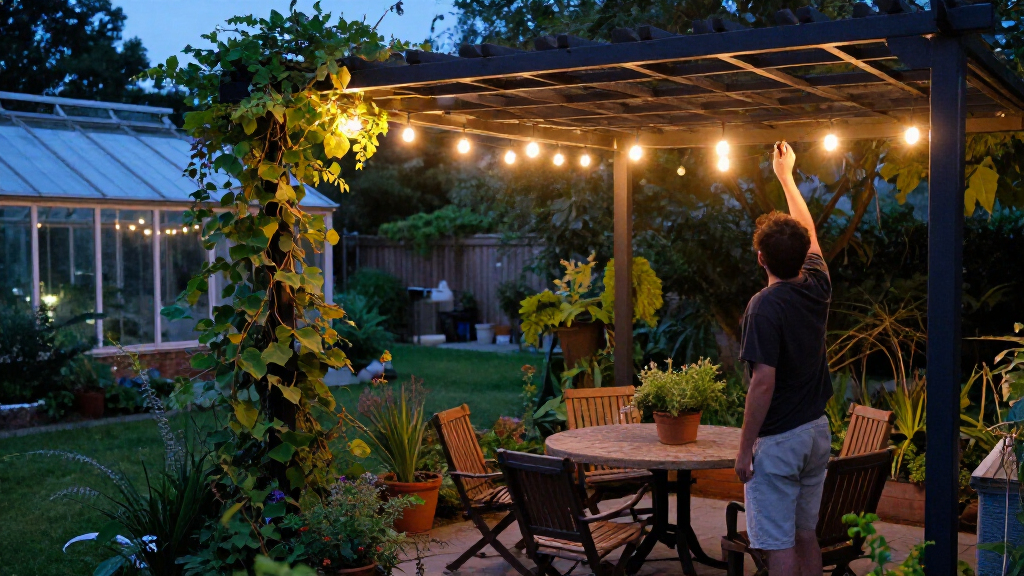
For instance, if you’re hanging lights above a dining table, place supports so the string forms a shallow, relaxed arc. That looks softer than a tight straight line and gives gusts of wind less leverage on the fittings. Keep cables clear of doors, walkways, and places where chairs might snag them.
Many sets include an on/off switch, dusk sensor, timer, or several lighting modes. Test those controls before the first dinner party, not while guests wait in the dark. If the lights sit over a grill or stairs, add dedicated task or safety lighting; decorative bulbs may not provide enough illumination for those jobs.
Get Better Results When the Weather or Season Changes
When solar outdoor string lights start fading early, first check the panel, charge conditions, settings, and battery rather than replacing the whole set at once. Dust, leaves, or bird marks can block part of the panel, while winter shade and cloud cover can reduce charging. A clean panel and a sunnier position may improve performance.
Try a simple routine: inspect and gently clean the panel as directed by the maker, confirm the switch and timer are set as intended, and check that connectors remain secure. If your lights dim after a run of cloudy days, give them a clearer stretch of daylight before judging their usual runtime. Then try a lower brightness setting or a timer if the set offers one.
Consider a balcony where the string used to shine through dinner but now goes dark before dessert. A nearby planter may have grown tall enough to shade the panel. Moving it a short distance onto the sunny rail could solve the problem without changing the bulbs.
If runtime remains shorter after you’ve checked sunlight and settings, battery wear may be the cause. Look up the battery type and replacement guidance in the product instructions. USB backup charging is available on some models, but treat it as a convenience feature and follow the maker’s directions for its use.
Frequently Asked Questions
How many hours of sun do solar outdoor string lights need?
Requirements vary by panel and battery, so use the product’s instructions as your guide. In general, several hours of direct sun charge better than a shaded location. For example, place a separate panel on a sunny railing if the bulbs hang beneath a roof.
Will solar string lights work on cloudy days or in winter?
They can charge in cloudy weather, but often less effectively than in direct sun. Short winter days and a low sun angle can also mean dimmer light or shorter runtime. If a set fades earlier in December, check its sun exposure before assuming it has failed.
Can solar string lights stay on all night?
Some sets are designed to run from dusk until the battery runs low, but actual duration depends on the charge, battery condition, and lighting settings. A timer or dimmer may help extend the glow. Check the maker’s runtime estimate and the conditions behind it.
Can I leave solar string lights outside in the rain?
Only use them outdoors within the limits of their weather rating and instructions. The bulbs, panel, battery enclosure, and connectors may not share the same protection. Keep connections positioned as directed and don’t treat “water-resistant” as safe for immersion.
Are solar outdoor string lights bright enough for a pathway?
They usually work best as decorative or ambient lighting, rather than dependable safety lighting. A string above a path can look welcoming but may not clearly show a step or uneven paving. Use lighting designed for visibility where safe footing matters.
Conclusion
Choose solar outdoor string lights by starting with the panel’s sunny spot, then check the battery, replaceable parts, controls, and weather guidance. Give the wire a relaxed route and use the glow for atmosphere, with a separate light where you need clear visibility.
When dusk settles and the bulbs cast a warm line across the garden, the best setup is the one that fits your space—and keeps shining because you planned for the sun.