TL;DR

Get garden gear delivered free with Prime
- Fast, free delivery on millions of items
- Prime Video, Amazon Music and more included
- Member-only deals all year
A Gardener’s Path report describes three methods for overwintering banana plants outside warm climates: move a container plant indoors, protect an in-ground plant with insulation, or dig up its rhizome for dormant storage. The best method depends on the plant, available storage space and winter temperatures; most bananas are cold-sensitive, while some varieties tolerate colder conditions.
Gardener’s Path has outlined three ways to overwinter banana plants where outdoor cold threatens their survival: bring a container-grown plant indoors, insulate an in-ground plant with mulch, or dig up its rhizome and store it in a cool place. The methods matter to gardeners in colder regions because most banana plants are sensitive to frost, but their underground growing parts can be protected and replanted when spring temperatures return.
The report says banana plants are herbaceous plants, not trees: what looks like a trunk is a pseudostem formed from tightly layered leaves. It gives approximate cold thresholds: leaf growth stops around 55°F, leaves can be damaged at 32°F, and rhizomes may die after sustained temperatures of 22°F or lower. These figures describe general sensitivity, not a guarantee for every cultivar or growing condition.
For container plants, the simplest approach is to move the pot indoors as outdoor temperatures fall. A sunny indoor location can support slow growth; the soil should stay moist but not waterlogged, and the report suggests misting leaves to provide humidity. For a dormant-storage option, gradually reduce watering, cut the stem to about six inches, and keep the pot in a dark, cool place at roughly 40–50°F. Water sparingly enough to stop the soil pulling away from the container.
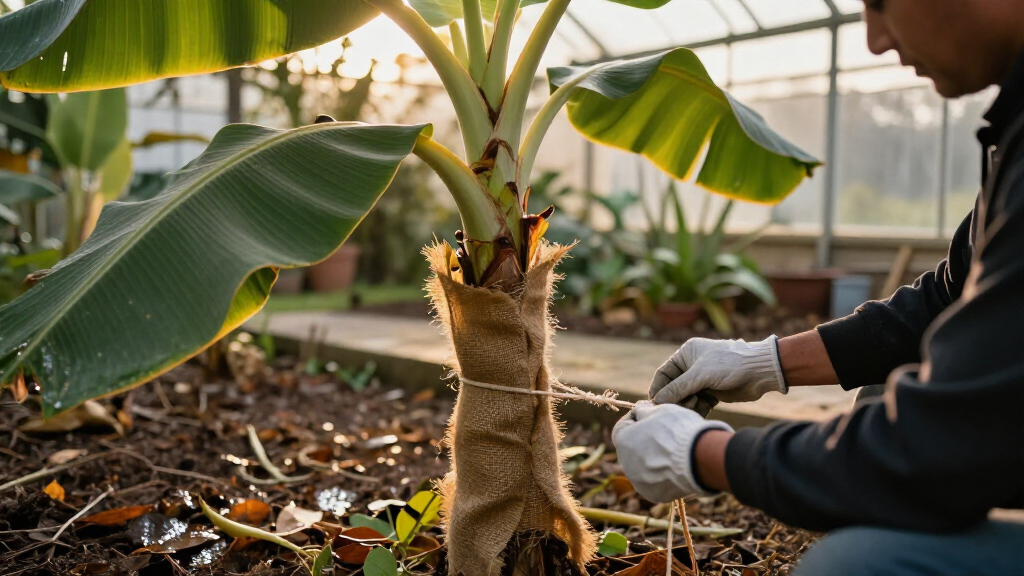
For an in-ground plant, the report advises cutting it to about four to six inches above ground and covering the base with at least a foot of leaves, straw or similar mulch. Alternatively, a wire cage around an uncut pseudostem can be filled with insulation; some exposed growth may be lost. A third option is to dig up the rhizome and roots before frost, store them in slightly moist sand at about 45–50°F, and keep them dry and dark while dormant. The plant can be replanted after frost danger has passed.
Choosing a Winter Protection Method
The choice affects how much of the plant is kept and how much work is required in spring. Container growing allows a gardener to move the whole plant indoors, while mulching in place can protect the underground rhizome without requiring indoor space. Digging and storing the rhizome offers another option where outdoor protection may not be reliable, but it requires careful handling and suitable storage conditions.
These methods are aimed at preserving the plant so it can regrow, not necessarily keeping its leaves or pseudostem intact. Gardeners should match the approach to local winter conditions and the banana variety. A cold-tolerant cultivar may need a different level of protection than a typical tropical type.
As an affiliate, we earn on qualifying purchases.
Cold Sensitivity and Cultivar Differences
The source describes roughly 70 Musa species, native to tropical parts of India, Southeast Asia and northern Australia. Bananas are now grown in more than 135 countries, largely for their fruit. Their tropical origins help explain why many types struggle with cold, though tolerance varies between varieties.
As an exception, the report identifies Japanese fiber banana (Musa basjoo) as cold-tolerant and says it can be hardy in USDA Zones 5 or 6 with protective mulch and cutting back. That example should not be taken to mean all banana plants can survive those zones. The article’s general guidance is that gardeners below Zone 9 may need to protect most types or grow them in containers.
Local Conditions Affect Survival
The report provides general temperature ranges and techniques, but does not establish a single method as best for every garden. The result can depend on the cultivar, how long cold lasts, soil moisture, exposure and the quality of insulation or storage. The stated zone hardiness for M. basjoo is also tied to providing winter protection, rather than an assurance that every plant will survive without it.
It is also not possible to know from the guidance alone whether an individual plant’s rhizome remains viable after winter. The source does not give a specific calendar date for uncovering or replanting; gardeners must wait for local frost danger to pass and watch for signs of new growth.
Spring Replanting and Regrowth
When warm weather returns, remove mulch or the protective cage and check the plant for signs of regrowth. Trim dead material and resume watering for plants that stayed in the ground or in pots. Rhizomes held in storage can be replanted once all danger of frost has passed; the report recommends watering them to help restart growth.
For the next winter, gardeners can use the plant’s performance and local conditions to decide whether to repeat the same method or move to a more protective one. The source does not specify a universal date for that decision: the practical trigger is the approach of cold weather, before damaging frost reaches the plant.
Key Questions
Can banana plants survive winter outdoors?
Some can with protection, but most banana plants are cold-sensitive. The source says leaves can be damaged at 32°F and rhizomes may die after sustained temperatures of 22°F or lower. Tolerance depends on the variety and conditions.
How much mulch should I use around an in-ground banana plant?
Gardener’s Path recommends cutting the plant to about four to six inches above ground and piling on at least a foot of leaves, straw or similar material to protect the base.
Where should I store a dormant banana plant?
For a container plant, the report recommends a dark location at about 40–50°F. A dug-up rhizome can be stored in slightly moist sand at about 45–50°F. Dormant plants should not be kept wet.
When should I bring a potted banana plant indoors?
Move it indoors as outdoor temperatures begin to drop, before damaging cold arrives. The source does not give a fixed calendar date, since timing depends on local weather.
Which banana variety is described as cold-tolerant?
The report names Japanese fiber banana (Musa basjoo) and says it can be hardy in USDA Zones 5 or 6 when cut back and protected with mulch. This does not apply to all banana varieties.
Source: rss
Fall Picks
fall essentials
As an affiliate, we earn on qualifying purchases.