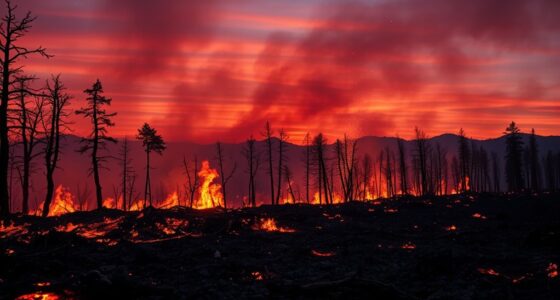
Permafrost melting is releasing a dangerous “carbon time bomb” as it releases huge amounts of greenhouse gases like methane and carbon dioxide stored deep underground. This process creates a feedback loop, where warming causes more thawing, which then accelerates global warming further. If this continues unchecked, it could lead to irreversible climate shifts. To understand how this cycle escalates and what you can do about it, keep exploring these critical impacts.
Key Takeaways
- Melting permafrost releases stored organic carbon as greenhouse gases, mainly methane and carbon dioxide, intensifying global warming.
- The process creates a positive feedback loop, where warming causes more thawing, leading to further greenhouse gas emissions.
- Methane released from permafrost has a higher warming potential than carbon dioxide in the short term.
- This release accelerates climate change, affecting weather patterns, sea levels, and ecosystems worldwide.
- Immediate mitigation and advanced monitoring are crucial to prevent irreversible climate impacts from permafrost destabilization.

As global temperatures rise, permafrost—the permanently frozen ground in Arctic regions—is melting at an unprecedented rate. This process doesn’t just expose previously hidden landscapes; it triggers a series of climate feedbacks that can accelerate global warming. When permafrost thaws, it releases vast amounts of greenhouse gases, mainly carbon dioxide and methane, into the atmosphere. These gases are potent contributors to climate change, trapping heat and raising temperatures further. The release of greenhouse gases from permafrost creates a dangerous cycle: as the ground thaws, more gases escape, amplifying the greenhouse effect and speeding up global warming even more.
You might not realize how significant this is, but permafrost contains nearly twice the amount of carbon currently in the Earth’s atmosphere. This carbon has been locked away for thousands of years, safely stored in frozen soil and organic matter. Now, as rising temperatures induce thawing, that stored carbon begins to convert into greenhouse gases that enter the atmosphere. Methane, in particular, is highly potent, with a warming potential many times greater than carbon dioxide over a short period. The release of these gases intensifies the greenhouse effect, further heating the planet and promoting even more permafrost melting.
This process becomes a self-perpetuating problem because of climate feedbacks. When greenhouse gases are released from permafrost, they add to the existing greenhouse effect, causing global temperatures to increase. That rise in temperature accelerates permafrost thawing, releasing more gases in a vicious cycle. It’s an example of a positive feedback loop, which makes climate change more unpredictable and harder to manage. The more greenhouse gases released from permafrost, the faster the Arctic warms, and the more permafrost melts, creating a cycle that’s difficult to halt.
You should understand that this isn’t just a localized issue; it has worldwide implications. The Arctic acts as a climate regulator, and its destabilization could dramatically alter weather patterns, sea levels, and ecosystems globally. AI-driven data analysis can help us better understand and predict the extent of these feedback mechanisms, making it a crucial tool in addressing this challenge. The potential for massive greenhouse gas emissions from permafrost is like a carbon time bomb waiting to explode, releasing centuries’ worth of stored carbon in a matter of decades. This makes it critical to monitor and mitigate climate feedbacks now, before the melting accelerates beyond our control. If we don’t address the root causes of warming, the consequences of permafrost melting could become irreversible, locking in a future of more intense climate disruptions.
Frequently Asked Questions
How Much Additional Carbon Could Be Released From Melting Permafrost?
You might wonder how much more carbon could be released from melting permafrost. Current feedbacks suggest that permafrost contains enough carbon to profoundly impact climate change, with estimates ranging from 150 to 900 gigatons. As warming accelerates, these feedbacks could trigger substantial carbon releases, amplifying global warming. Understanding these estimates helps you grasp the potential threat of permafrost melting, emphasizing the urgency to address climate change now.
What Regions Are Most at Risk of Permafrost Thawing?
You should understand that Arctic ecosystems and permafrost regions are most at risk of thawing. These areas, including parts of Siberia, Alaska, and northern Canada, face rising temperatures that threaten permafrost stability. Thawing can disrupt permafrost agriculture, affecting local communities and ecosystems. As temperatures climb, the risk of widespread permafrost thaw increases, making these regions particularly vulnerable to climate change impacts.
How Quickly Is Permafrost Melting Accelerating Globally?
Imagine a ticking clock speeding up—permafrost melting is doing just that, with permafrost feedbacks amplifying global warming. You’ll notice thawing indicators like rising temperatures and exposed landscapes, signaling acceleration. This process is happening faster than scientists initially predicted, as warming intensifies and permafrost responds quickly. Your awareness of these signs helps understand how climate change is not only progressing but also feeding into itself, creating a more urgent situation.
What Are the Potential Impacts on Indigenous Communities?
You should know that permafrost impacts indigenous communities by threatening their traditional ways of life and cultural resilience. As the permafrost melts, it causes land instability, disrupts hunting and fishing, and damages sacred sites. These changes challenge their ability to preserve cultural practices, languages, and identities. You can help by supporting efforts to address climate change and protect indigenous rights, ensuring their cultural resilience endures despite these environmental shifts.
Can Permafrost Melting Be Reversed or Halted?
Pondering problem-solving, you wonder if permafrost melting can be reversed or halted. While completely stopping it’s tough, you can explore geoengineering solutions and policy interventions to slow the process. Implementing stricter regulations and innovative techniques might buy time, but there’s no simple fix. You should advocate for proactive policies and cutting-edge climate actions, recognizing that reversing permafrost melting requires relentless research, responsible regulation, and global cooperation.
Conclusion
As you watch permafrost melt away, remember it’s not just ice turning to water, but a hidden vault of ancient carbon released into today’s world. While the surface warms and shifts, beneath lies a silent threat—time’s ticking bomb. You hold the power to act now, but if ignored, this frozen archive could accelerate climate change faster than we ever imagined, reminding us that what’s buried can also be liberated, forever changing our future.