
TL;DR

Get garden gear delivered free with Prime
- Fast, free delivery on millions of items
- Prime Video, Amazon Music and more included
- Member-only deals all year
Exposed roots are common as trees mature and may reflect shallow soil, compaction, watering patterns or a species’ natural growth. Arborists quoted by Country Living advise against cutting or repeatedly mowing over them; safer options include a thin layer of organic mulch or, cautiously, up to two inches of suitable soil. Roots lifting sidewalks or creating structural problems call for a certified arborist.
A Country Living report on exposed tree roots recommends leaving roots intact and using careful landscaping rather than cutting them, which arborists say can harm a tree. For homeowners dealing with roots that disrupt a lawn or lift a sidewalk, the report describes lower-risk options such as organic mulch and consulting a certified arborist.
Exposed roots are common, particularly as trees mature. Barbara Fair, a certified arborist and North Carolina State University associate professor and extension specialist, told Country Living that roots grow where they can most easily reach oxygen, water and nutrients. Blake Watkins, a master arborist, said shallow roots can also reflect compacted soil, frequent shallow lawn irrigation or a tree species that naturally develops surface roots.
The report advises against cutting exposed roots or repeatedly running a mower over them. Mary Carol Sheffield, a certified arborist and University of Georgia extension agent, said cutting can affect a tree’s long-term health; repeated mower damage can leave injuries that make it more susceptible to pests and disease. The source also cautions that grass may struggle beneath trees because turf and tree roots compete for water and nutrients.
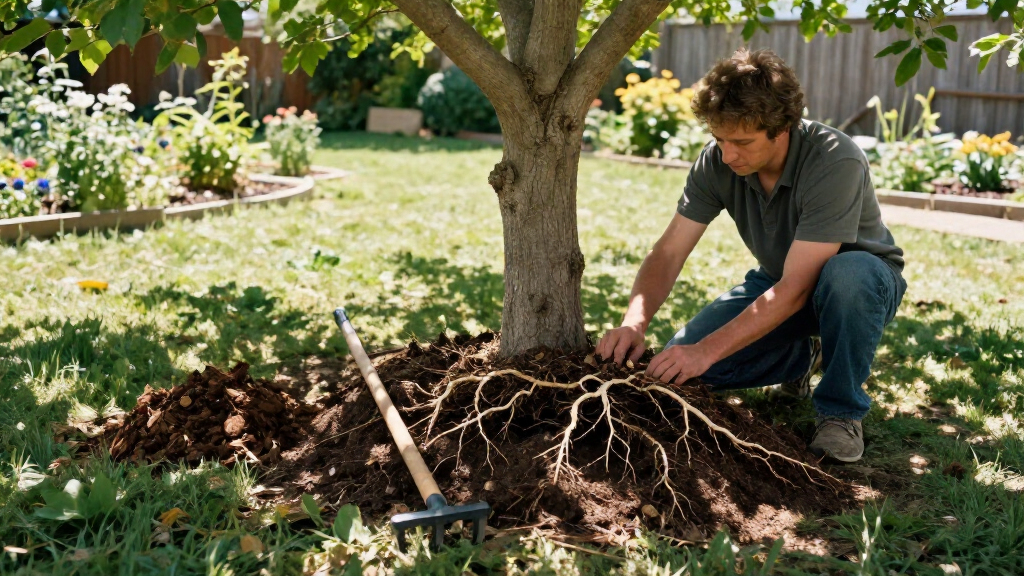
For coverage, the specialists recommend two to three inches of organic mulch, spread over the roots toward the tree’s drip line and kept a few inches away from the trunk so the root flare remains visible. Fair says a light top-dressing of sandy, loamy soil may be used, but no more than two inches; adding a deep layer can deprive roots of air. Shade-tolerant groundcover or perennials are another possibility, though planting should avoid damaging roots. Where roots lift sidewalks or cause other structural problems, Watkins recommends consulting a certified arborist.
Protecting Roots and Tree Health
Exposed roots can create tripping and mowing hazards and change the appearance of a yard, but treating them as a cosmetic problem alone can create a larger one. Cutting roots or covering them with too much soil may damage the tree, while repeated mower contact can injure the roots. The advice matters because a quick fix could trade a visible inconvenience for long-term harm to the tree.
That does not mean every surface root signals a sick tree. Watkins told Country Living that some species naturally have shallow roots and that growing conditions can also explain why roots appear at the surface. Homeowners can use mulch to tidy the area and protect roots, but roots that affect a walkway or other structure need an assessment tailored to the tree and site.
Popular right now

De'Longhi Magnifica Evo Automatic Espresso Machine with Milk Frother – Silver

Dyson Car+Boat Cordless Handheld Vacuum

Bose QuietComfort Wireless Bluetooth Headphones with Active Noise Cancellation, Mic, USB‑C Charging, Deep Bass, 24‑Hour Battery – White Smok
As an affiliate, we earn on qualifying purchases.
Why Roots Reach the Surface
According to Fair, most tree roots grow no deeper than about three feet and extend laterally beyond the canopy’s drip line. Larger supporting roots form a broad root plate; their position near the surface is not, by itself, proof that a tree is failing.
The report identifies compacted soil—sometimes left by construction—and frequent shallow watering of lawns as possible contributors. It also names redwoods, camphors, Southern magnolias and some maples among trees known for shallow roots, with sycamores, willows and some ash trees also listed. Watkins said deeper watering during drought may encourage roots to seek moisture lower in the soil, but the article does not present that as a guaranteed remedy for established exposed roots.
“It often says more about the soil and growing site than about the tree itself.”
— Blake Watkins, master arborist and director of plant health care at Monster Tree Service
When Roots Signal a Problem
The report does not establish that exposed roots alone indicate poor tree health, nor does it offer a single fix that works for every species or site. Whether roots are creating a structural hazard, and what intervention is safe, depends on the specific tree and conditions. Roots lifting a sidewalk warrant an on-site assessment; the article does not prescribe cutting or rerouting them as a general solution.
The source also does not say that deeper watering will reverse surface growth in mature trees. Its suggestions on watering and groundcover are conditional: drought watering may encourage deeper rooting, while planting near established roots requires care to avoid damage.
Choose a Safe Yard Fix
For roots that are exposed but not damaging structures, homeowners can start with a two- to three-inch layer of organic mulch, keeping it away from the trunk. If considering soil, keep the covering to two inches at most and use sandy, loamy soil, as Fair advises. Avoid rocks as a root covering, cutting roots, and repeated mower contact.
For a planting option, choose shade-tolerant groundcover or perennials and use a method that requires minimal digging; Fair suggests bare-root perennials as one possibility. If a root is lifting pavement or presents a structural concern, contact a certified arborist before taking action. The source provides no timetable for when an assessment or repair should occur.
Key Questions
Should I cut exposed tree roots?
No, not as a general fix. Arborist Mary Carol Sheffield warns that cutting roots can affect a tree’s long-term health and may contribute to decline. Seek an arborist’s advice if roots are causing a hazard.
How much mulch can I put over exposed roots?
The report recommends two to three inches of organic mulch, such as wood chips or pine straw. Keep it a few inches from the trunk so the root flare remains visible, and avoid using rocks.
Can I cover exposed roots with soil?
Fair says a light top-dressing of suitable sandy, loamy soil may help, but recommends no more than two inches. A deeper layer can suffocate roots.
Why are my tree’s roots growing above ground?
Possible reasons include the tree’s age or species, compacted soil and shallow, frequent lawn watering. Surface roots alone do not establish that a tree is unhealthy.
What should I do if roots are lifting a sidewalk?
Contact a certified arborist to assess the tree and site. The report advises professional guidance for structural problems rather than taking a potentially harmful action yourself.
Source: countryliving.com