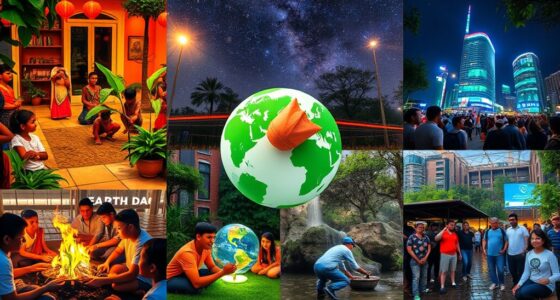
Project-based learning for sustainability involves actively engaging students in real-world issues that impact your community and environment. You’ll work on projects that connect across disciplines, encouraging collaboration and critical thinking. This approach fosters responsibility, problem-solving skills, and a sense of agency, motivating you to make a difference. By connecting your work to local needs and involving community members, you’ll see tangible impacts and develop essential skills for future challenges—keep exploring to see how you can make this happen.
Key Takeaways
- PBL for sustainability engages students in real-world environmental and social challenges, fostering responsibility and community impact.
- It emphasizes community involvement, connecting student projects to local needs and stakeholders for meaningful learning.
- Interdisciplinary collaboration in sustainability PBL integrates diverse knowledge, promoting holistic solutions to complex issues.
- Students develop essential skills such as critical thinking, communication, and adaptability through collaborative, project-based activities.
- Overall, sustainability PBL creates motivating learning experiences that prepare students for future challenges and responsible stewardship.

As the world faces urgent environmental and social challenges, incorporating project-based learning (PBL) focused on sustainability offers a powerful way to prepare students for the future. When you design PBL experiences centered on sustainability, you create opportunities for students to actively engage with real-world issues, fostering a sense of responsibility and agency. Central to this approach is community engagement, which allows students to connect their learning to local contexts, understand community needs, and develop solutions that have tangible impacts. By involving local organizations, residents, and stakeholders, you help students see the relevance of their projects and cultivate a deeper sense of stewardship. This direct interaction with communities enriches learning, making it more meaningful and motivating. Incorporating interdisciplinary collaboration ensures that students can draw on diverse knowledge and skills, which is vital for tackling complex sustainability problems.
Interdisciplinary collaboration plays a crucial role in these projects, encouraging students from diverse backgrounds and disciplines to work together. Sustainability challenges rarely fall within a single subject area; they require knowledge from science, social studies, economics, and more. When you promote interdisciplinary teamwork, students learn to synthesize different perspectives, communicate across disciplines, and develop holistic solutions. This collaborative process mimics real-world problem-solving, where multiple expertise areas converge. Students gain valuable skills such as critical thinking, adaptability, and effective communication—traits essential for addressing complex sustainability issues.

Fun Express Sorting Toys for Toddlers 1-3 – Color Sorting Educational Recycling Game with 54 Pieces | STEM Learning Activities for Preschool Science & Earth Day Projects | Eco-Friendly Teaching Kit
Complete sorting toys set for hands-on learning: Features 6 color-coded recycling bins with 48 realistic sorting items that…
As an affiliate, we earn on qualifying purchases.
As an affiliate, we earn on qualifying purchases.
Frequently Asked Questions
How Can PBL Be Adapted for Different Age Groups?
You can adapt PBL for different age groups by incorporating age-specific strategies and considering developmental considerations. For younger students, use hands-on activities and simple concepts to keep them engaged. Older students benefit from more complex projects that encourage critical thinking and independence. Tailoring tasks to their cognitive abilities guarantees the learning is challenging yet achievable, making PBL effective across all ages and fostering a deeper understanding of sustainability.
What Are Common Challenges in Implementing Sustainability Projects?
Think of implementing sustainability projects like steering a ship through stormy waters. You often face challenges like limited stakeholder engagement and resource allocation issues. These hurdles can slow progress or cause deviations from your course. To navigate effectively, you need clear communication, strong collaboration, and smart resource management. Addressing these challenges head-on helps keep your project afloat, ensuring you reach your sustainability goals smoothly.
How Do Assessments Work in Sustainability-Focused PBL?
You use assessment methods like rubrics and reflection journals to evaluate sustainability-focused PBL projects, focusing on both process and outcomes. Grading criteria emphasize students’ understanding of sustainability concepts, teamwork, problem-solving skills, and innovative solutions. You also consider real-world impacts and the ability to apply knowledge practically. This approach helps guarantee that assessments are thorough, fair, and aligned with learning goals, encouraging meaningful engagement with sustainability issues.
Can PBL Effectively Address Local Environmental Issues?
Think of PBL as a gardener nurturing a fragile seed; it can indeed bloom into solutions for local environmental issues. You can explore urban ecology and waste management by engaging directly with your community, designing projects that address specific challenges. Through hands-on activities, you learn about ecosystems and waste reduction strategies, transforming theory into tangible change. PBL empowers you to become a catalyst for sustainable growth in your local environment.
What Skills Do Students Develop Through Sustainability PBL?
You develop essential skills through sustainability PBL, including interdisciplinary skills and critical thinking. As you work on real-world projects, you learn to integrate knowledge from different fields, enhancing your ability to analyze complex issues. This active approach also sharpens your critical thinking, helping you evaluate solutions effectively. By engaging in hands-on tasks, you build problem-solving abilities and collaboration skills that prepare you for future challenges in sustainability and beyond.

Bridging Barriers: How a Community Changed Its Future with Help From Engineers Without Borders USA Volunteers
As an affiliate, we earn on qualifying purchases.
As an affiliate, we earn on qualifying purchases.
Conclusion
As you embrace project-based learning for sustainability, remember you’re planting seeds for a greener future. Like a compass guiding you through uncharted waters, this approach steers you toward innovative solutions and lasting impact. Your actions today shape tomorrow’s world, making a difference that echoes beyond the classroom. So, step forward with confidence—your journey toward a sustainable future is a story only you can write, one project at a time.

Learning Resources STEM Explorers Pixel Art Challenge – Science Kits & STEM Activities for Kids, Pattern Blocks, Fine Motor Skills, Math Manipulatives, Sorting and Counting, Gifts for Boys and Girls
HANDS-ON CRITICAL THINKING – Develops problem-solving and spatial reasoning as kids work through 40 creative challenges that increase…
As an affiliate, we earn on qualifying purchases.
As an affiliate, we earn on qualifying purchases.

Pasimy 6 Pcs Science Posters Ecosystems Teaching Posters Set Ecosystems Cycle Food Web Food Chain Energy Pyramids Bulletin Board for Primary Middle School Science Biology Classroom Decorations
Ecosystem Posters: This science biology poster set includes six quality biology posters that are wonderful for primary and…
As an affiliate, we earn on qualifying purchases.
As an affiliate, we earn on qualifying purchases.