
TL;DR

Get garden gear delivered free with Prime
- Fast, free delivery on millions of items
- Prime Video, Amazon Music and more included
- Member-only deals all year
Moving your rig out of your workspace into a closet or small room is the most effective way to cut noise. Proper placement, ventilation, and targeted acoustic treatment make small spaces work without sounding boxy or muddy. You can learn more about acoustic dampening and placement strategies.
Ever wonder why your closet rig sounds so reflective and muddy? The truth is, small rooms create a mess of echoes, and the usual fix—adding foam—often misses the real problem. The best way to tame noise and improve sound isn’t just about absorbing sound—it’s about strategic placement and controlling heat and vibrations.
If you want your closet or tiny workspace to function well as a recording or AI inference station, you need a different mindset: move the rig away from your ears, seal leaks, and treat the space smartly. This article reveals how to do that without turning your closet into a soundproof bunker or a box of echoes. For more insights, see indoor acoustic treatment tips.
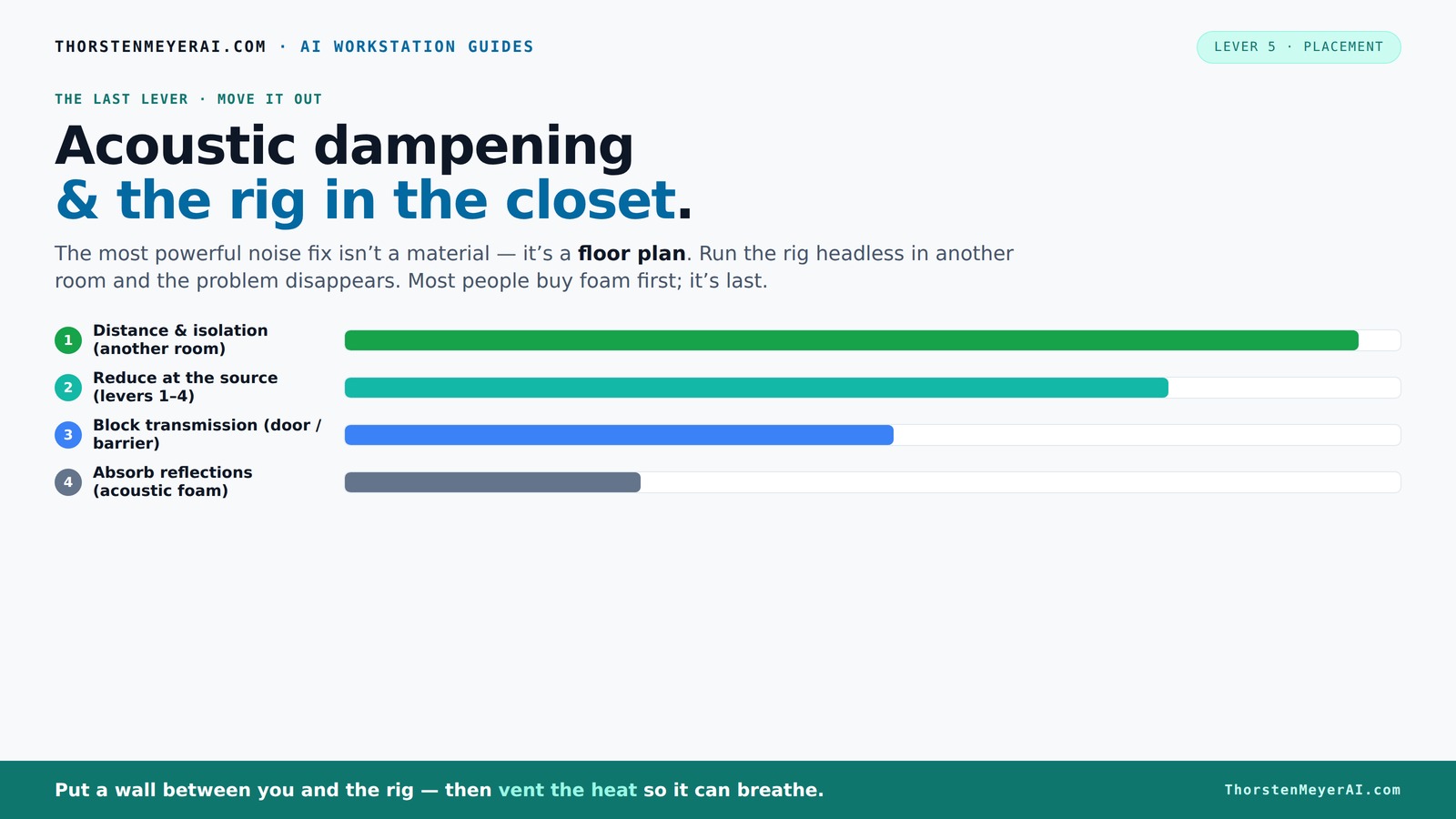
Acoustic dampening
& the rig in the closet.
The most powerful noise fix isn’t a material — it’s a floor plan. A rig you can’t hear because it’s in another room beats any amount of foam. Tap the approaches in Part 1 to see what actually works.
(another room)
(levers 1–4)
(door / barrier)
(acoustic foam)
Contain the noise, not the heat
Key Takeaways
- Moving your rig into a separate room or closet drastically reduces noise and echoes, often more than any foam paneling.
- Treat the first reflection points and corners with panels and bass traps for a natural, clear sound. You might find detailed acoustic treatment guides helpful.
- Sealing gaps around the door and adding rugs or blankets cuts down noise leaks fast and cheaply.
- Proper ventilation is essential—airflow prevents overheating and keeps noise levels down in enclosed spaces.
- Start small: focus on sealing and reflection control first, then expand coverage as needed.
As an affiliate, we earn on qualifying purchases.
Why Acoustic Treatment Is Not the Same as Soundproofing — And Why It Matters
Acoustic treatment and soundproofing are often confused, but they serve very different purposes. Acoustic panels absorb sound reflections inside a room, making it less echoey and clearer to listen to. Soundproofing, on the other hand, blocks sound from escaping or entering.
Understanding this distinction is crucial because it influences your approach. If your goal is to record clean audio within the closet, focusing on absorption at reflection points and sealing leaks is more effective than trying to completely block sound from escaping. Overestimating the need for soundproofing can lead to unnecessarily thick walls or complex setups, which are often impractical in small spaces. Instead, it’s about balancing absorption and leakage control to create an environment that sounds natural and minimizes echo, without the hassle of full soundproofing. This targeted approach also reduces costs and complexity, making it more accessible for DIY setups.
Most small-room problems stem from echoes and bass buildup, which are directly related to how sound waves reflect and resonate within confined spaces. Properly addressing these issues with strategic absorption and bass traps can dramatically improve clarity and reduce muddiness, often more effectively than attempting to soundproof the entire room.
Where to Place Acoustic Panels in a Tiny Closet — Get Results Fast
Placing your panels at the first reflection points is about targeting where sound bounces and causes flutter echoes, which can muddy your recordings. By intercepting these reflections, you prevent sound waves from bouncing freely and creating a reverberant, boxy sound. Using a mirror to locate these points is effective because it visually identifies where reflections originate, allowing you to treat precisely those spots.
In a tiny closet, the importance of placement becomes even more critical because space is limited, and reflections are more concentrated. Covering about 20-30% of the wall surface with 2-inch thick panels at these points can drastically reduce early reflections, leading to a clearer, more natural sound. For more detailed placement strategies, see acoustic panel placement tips. Additionally, bass issues—common in small spaces—are best addressed with bass traps in the corners, where low frequencies tend to accumulate due to boundary reinforcement. This strategic placement ensures that you’re attacking the most problematic reflections and resonances directly, rather than wasting effort on areas that contribute less to the overall sound quality. The result is a balanced treatment that improves clarity without making the space sound unnatural or overly dead.
The Mirror Trick for Finding Where Sound Bounces — Easy and Fast
The mirror trick is a practical method to identify the most critical reflection points in your small space. When you sit in your usual position, hold a small mirror against the wall and move it around until you see your speaker or microphone reflected in it. Mark those spots. These are the areas where sound waves first bounce off surfaces and can cause flutter echoes or muddiness.
This method is valuable because it turns an abstract acoustic problem into a visual task, making it easier to identify exactly where to place your treatment. Learn more about room acoustic optimization. By focusing on these reflections, you target the parts of the room that most significantly impact sound clarity. This approach is especially useful in tiny closets, where space constraints mean you need to be efficient with your treatment. Treating only these key spots can lead to a noticeable improvement in sound without the need for extensive coverage, saving you time and resources while achieving a more natural, less boxy sound.
Think of it as tuning your space—by dampening the spots that cause the most noise and flutter, you effectively 'tune' the room for better sound quality. This quick, visual method can make a big difference in how your closet rig sounds and feels during recording or AI work.
How Much Coverage Do You Need? The 20-30% Rule for Small Rooms
In small rooms, over-treating can make the space sound unnaturally dead, which is counterproductive. Instead, focusing on treating about 20-30% of the wall surface—particularly the side walls and ceiling—targets the most problematic reflections and bass issues without sacrificing liveliness. This percentage is based on the idea that a moderate amount of treatment is enough to significantly reduce echo and resonance, while maintaining a natural sound environment.
The key is to identify which surfaces reflect most sound and prioritize those for treatment. For example, in a 4x4 foot closet, placing a few 2x2 panels on the side walls and some bass traps in the corners can be enough to improve clarity. The tradeoff involves balancing absorption with the room’s natural liveliness—too much absorption can make your space sound dull and unnatural, defeating the purpose of a functional workspace. Starting small allows you to evaluate the impact and add more treatment gradually, ensuring you don’t overdo it. This measured approach results in a balanced sound that enhances clarity without losing the room’s natural acoustic character.
Bass Buildup and Corner Treatment — When You Must Trap Low Frequencies
Bass frequencies tend to accumulate in corners because they are reinforced by boundary effects—think of it like low-frequency liquid pooling in those spots. When your closet rig sounds boomy or muddy, it’s often due to this low-frequency buildup. Adding bass traps in the corners serves as a controlled way to absorb these resonances, preventing them from dominating the sound. For more on effective bass trapping, visit bass trap placement. Properly designed bass traps—about 2-4 inches thick—are especially effective because they provide a broad absorption spectrum for low frequencies, which are harder to tame with standard panels.
If you notice a boxy or boomy sound, that indicates excessive bass resonance. Treating the corners with bass traps reduces this resonance, resulting in a tighter, more accurate sound. Without corner treatment, low frequencies can cause muddiness and reduce clarity, especially in small, reflective spaces. Think of bass traps as a necessary 'drain'—they allow excess low-end energy to escape, preventing it from coloring your entire sound. This makes your recordings or AI outputs clearer, more balanced, and more professional-sounding.
Sealing the Closet Door and Using Rugs — Cheap Fixes for Noise Leaks
Gaps around the door and hard surfaces are common culprits for sound leaks, which can compromise your quiet environment. Sealing the door with weatherstripping or acoustic sealant creates a barrier that prevents sound from escaping or entering, significantly reducing noise transmission. Additionally, placing a rug or thick blanket on the floor absorbs reflections and reduces the overall echo within the space. These simple, low-cost fixes work by adding soft, absorptive materials that dampen sound waves bouncing around inside and leaking out.
Imagine wrapping your closet in a soft blanket—that’s essentially what these treatments do. They don’t make the room completely soundproof but significantly improve isolation and clarity. For example, hanging moving blankets over the door or sealing gaps with weatherstripping can cut down on noise leaks, making your rig quieter and more controlled. This approach is especially practical for small setups where extensive soundproofing isn’t feasible but noticeable improvements are still achievable with minimal investment.
Ventilation and Heat: Keep Your Closet Rig Cool and Quiet
High-power rigs generate heat, and sealing a closet tightly can trap that heat, risking overheating and performance issues. To prevent this, incorporating ventilation—such as passive vents or quiet exhaust fans—is essential. Proper airflow not only cools the equipment but also prevents heat from building up, which can cause throttling or damage. Using a small, quiet exhaust fan that pulls hot air out while cooler air enters through passive vents maintains a stable temperature without introducing noise from the ventilation itself.
Think of your closet like a tiny greenhouse—adequate airflow prevents heat from accumulating and ensures your equipment runs smoothly. For best results, consider ducted airflow systems with soundproofing features, and monitor temperatures regularly. This balance between cooling and noise control allows your setup to operate efficiently without sacrificing quietness or risking heat damage. Proper ventilation is a critical component that enables your small space to function reliably over long sessions and prevents thermal shutdowns or performance drops due to overheating.
Make Your Closet Rig Usable — Practical Tips for a Quiet, Cool Setup
Optimizing your closet setup involves multiple steps: sealing gaps to prevent leaks, strategically placing acoustic panels at reflection points, and installing a quiet ventilation system to keep temperatures in check. Position your microphone away from reflective surfaces and corners to avoid sound coloration. Incorporate soft materials like rugs and hanging blankets to further dampen reflections and echo. Using a GPU with a good cooling system or liquid cooling can also reduce noise generated by your hardware, creating a quieter overall environment. These measures collectively transform a noisy, cramped space into a functional, high-quality studio or AI workspace.
Think of it as creating a mini studio—organized, well-treated, and efficiently ventilated. Each adjustment contributes to a more natural sound and a more comfortable working environment. Proper placement, treatment, and cooling aren’t just small tweaks—they’re essential for turning a basic closet into a professional-sounding setup that supports your work reliably and quietly.
Your Closet Soundproofing Checklist — What to Do First, Next, and Later
- Seal gaps around the door with weatherstripping to immediately reduce leaks. This simple step can dramatically improve isolation with minimal effort.
- Place panels at the first reflection points identified via the mirror trick to target the most disruptive echoes that affect clarity.
- Add bass traps in the corners to control low-frequency resonances that cause muddiness and boominess in your sound.
- Install a quiet exhaust fan or passive vents to ensure proper airflow, preventing overheating while maintaining acoustic integrity.
- Use rugs, blankets, and soft furnishings to absorb internal reflections and further reduce echo and reverberation.
This phased approach allows you to prioritize the most impactful improvements first—sealing gaps and treating reflections—then gradually enhance with bass management and ventilation. This incremental strategy prevents overwhelm, saves costs, and ensures steady progress toward a quiet, balanced, and functional closet rig.
Frequently Asked Questions
Can I really turn a closet into a decent recording space?
Yes. By sealing gaps, adding targeted acoustic panels at reflection points, and managing low-frequency buildup with bass traps, you can transform a closet into a surprisingly good vocal booth or AI rig. It’s about smart treatment and ventilation, not size.How do I stop sound leaking through the closet door?
Seal all gaps around the door with weatherstripping or acoustic sealant. Hanging blankets or moving quilts over the door opening also helps. These low-cost fixes dramatically cut down noise transmission.Should I put bass traps in my closet?
If your sound feels boomy or muddy, yes. Bass traps in the corners absorb low frequencies that tend to collect there, giving you a tighter, clearer sound. They’re especially helpful in small, reflective spaces.How much treatment is enough for a small closet?
Treat about 20-30% of the wall surface at first reflection points and corners. Focus on side walls, ceiling, and corners. You can always add more later if needed, but this baseline makes a big difference.Conclusion
In tiny spaces, less is often more. Moving your rig into a closet or separate room can cut noise to near silence. The key is smart placement, sealing leaks, and treating the right spots—like first reflections and corners—without turning your space into a box.
Remember, a quiet, well-ventilated closet rig isn’t just a pipe dream. With a few tweaks, you can turn even the smallest, loudest space into a surprisingly natural-sounding studio or AI workstation. Now go make your closet work for you!
Halloween Picks
halloween
As an affiliate, we earn on qualifying purchases.