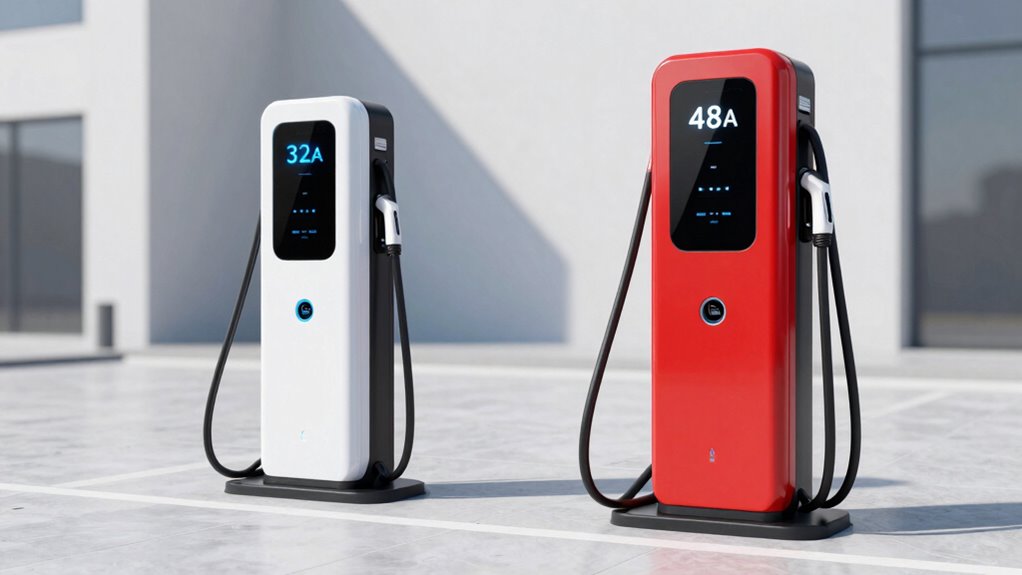
A 48A EV charger charges your vehicle considerably faster than a 32A unit, providing about 30-40 miles of range per hour compared to 20-25 miles. The speed difference is especially noticeable for larger batteries, meaning less time plugged in. However, to upgrade from 32A to 48A, you might need electrical panel upgrades and a higher-capacity circuit. Want to know if your home can handle it? Keep exploring to find out more.
Key Takeaways
- 48A chargers add roughly 30-40 miles of range per hour, significantly faster than 32A chargers’ 20-25 miles.
- The speed difference becomes more noticeable with larger batteries or frequent charging needs.
- Installing a 48A charger may require electrical upgrades, increasing costs and complexity.
- 32A chargers are suitable for most homes and offer a good balance of speed and ease of installation.
- Choose 48A if rapid charging is essential and your electrical system can support higher amperage.

Are you wondering how to choose between a 32A and a 48A EV charger? The decision largely depends on how quickly you want to charge your vehicle and what your installation setup can support. Charging speed is a key factor here—generally, a higher amperage means faster charging, but it’s not just about raw numbers. You also need to consider the installation requirements, as more powerful chargers demand different electrical setups and infrastructure upgrades.
A 32A charger can deliver a substantial charge, typically adding around 20-25 miles of range per hour of charging, depending on your vehicle’s capacity. It’s a popular choice for many EV owners because it offers a good balance of speed and compatibility with standard home electrical systems. Installing a 32A charger usually requires a dedicated circuit and a compatible outlet, but it’s often straightforward and doesn’t demand considerable electrical upgrades. If your home’s electrical panel is relatively modern and has enough capacity, setting up a 32A charger can be quick and cost-effective.
On the other hand, a 48A charger pushes the limits further. It can deliver roughly 30-40 miles of range per hour of charging, which is markedly faster, especially if you need quick turnarounds or have a large battery capacity. However, the installation requirements are more demanding. A 48A charger typically necessitates a higher-capacity circuit, often a 60A or even 80A breaker, and may require upgrading your electrical panel or wiring. This can mean additional costs and planning, especially if your current setup isn’t designed to handle such loads.
While a 48A charger offers faster charging, it’s important to evaluate whether your electrical infrastructure can support it without extensive upgrades. If your home’s wiring is outdated or your panel has limited capacity, installing a 48A charger might not be feasible or could be prohibitively expensive. Conversely, if you’re looking for the fastest possible home charging and your electrical system can accommodate it, then investing in a 48A charger makes sense.
Ultimately, the choice comes down to balancing charging speed with installation requirements. If you prioritize quick charging and your home’s electrical setup allows, a 48A charger can save you time. But if your setup is more modest, a 32A charger can still provide fast, efficient charging without the need for major electrical upgrades. Consider your daily driving habits, current electrical capacity, and future needs before making the decision. Additionally, smart home integration can help optimize your charging routines and ensure your system operates efficiently.
As an affiliate, we earn on qualifying purchases.
Frequently Asked Questions
Can Existing EVS Handle 48A Charging Without Modifications?
Most existing EVs can handle 48A charging without modifications, but it depends on your vehicle’s battery capacity and onboard charger. Check your EV’s specifications to guarantee it supports higher current levels. Upgrading your charging infrastructure, like installing a 48A charger, can considerably reduce charging times. Always verify compatibility with your car’s manufacturer to avoid potential damage or inefficiencies, assuring a safe, faster charging experience.
Are 48A Chargers Compatible With All EV Models?
Not all EV models support 48A chargers, so charger compatibility depends on your vehicle’s support for higher current levels. You should check your EV’s specifications to confirm if it can handle 48A charging without modifications. If your EV model supports higher currents, then using a 48A charger can be seamless. Otherwise, you might need compatibility upgrades or stick with lower amperage chargers to ensure safe and efficient charging.
How Does Charger Installation Differ Between 32A and 48A Units?
Did you know that installing a 48A charger is roughly 50% more complex than a 32A unit? You’ll need upgraded electrical requirements and possibly a dedicated circuit, making installation more involved. Unlike 32A chargers, which often fit standard setups, 48A units demand careful planning for wiring and breaker upgrades. So, if you want faster charging, be prepared for some extra electrical work and a more detailed installation process.
What Are the Long-Term Cost Differences Between 32A and 48A Chargers?
You’ll find that the long-term cost differences depend largely on your economic analysis and infrastructure investment. A 48A charger costs more upfront but charges your vehicle faster, potentially reducing charging time and energy costs over time. Conversely, a 32A unit has lower initial expenses and simpler infrastructure needs. Consider your usage patterns and future EV plans to determine which option offers better value, balancing initial costs with long-term savings.
Is There a Significant Difference in Charging Speed for Daily Use?
Like a swift river carving through stone, a 48A charger delivers noticeably faster daily charging, saving you time. You’ll notice improved charging efficiency, especially for quick top-ups. However, the impact on battery longevity is minimal if you don’t consistently charge at maximum speed. For regular use, the speed difference matters, but balancing it with gentle charging habits helps preserve your battery’s health long-term.
Conclusion
So, when comparing 32A and 48A EV chargers, you’ll notice that the 48A charger can deliver roughly 50% more power, cutting your charging time considerably. For example, a 48A charger can top up a typical EV in about 6 hours, while a 32A takes around 9 hours. That extra amperage truly makes a difference—saving you hours and getting you back on the road faster. It’s a clear upgrade if speed matters to you.