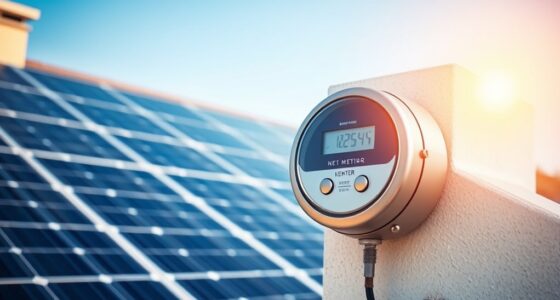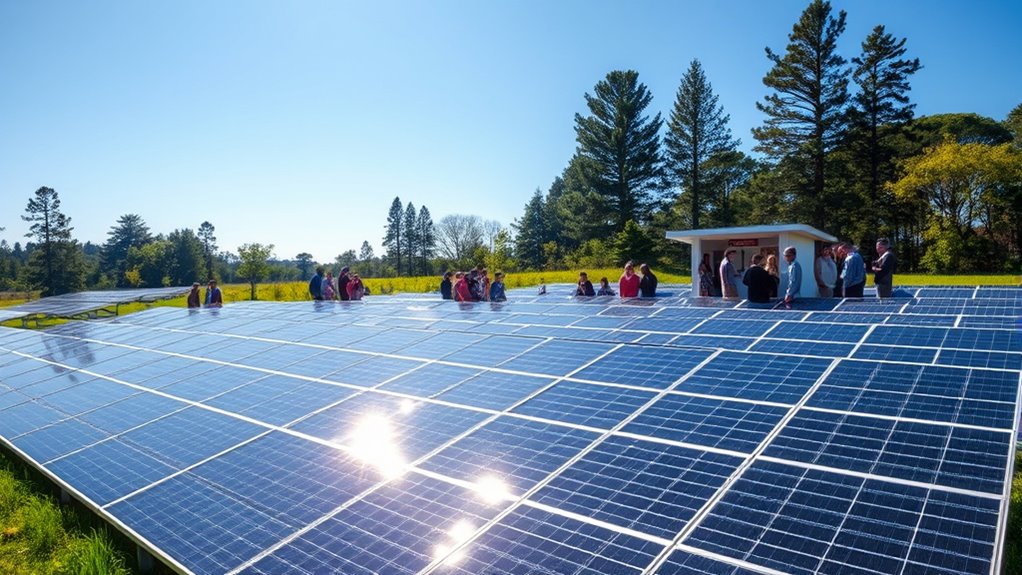

Community solar allows you to share the benefits of large solar farms instead of installing your own panels. You can buy or lease a share of a solar farm, which offsets your electricity use and reduces your bills. This model is cost-effective, accessible, and ideal for renters or those who can’t install panels. It also supports local jobs, lowers greenhouse gases, and promotes cleaner energy. To discover more about how community solar works and its advantages, keep exploring the details below.
Key Takeaways
- Community solar allows participants to share large solar farms, reducing installation costs and eliminating maintenance worries.
- Participants benefit from utility bill savings and energy credits without needing personal solar panels.
- These projects reduce greenhouse gas emissions and support local renewable energy growth.
- AI technology optimizes solar farm performance, ensuring maximum efficiency and environmental benefits.
- Flexible subscription options make community solar accessible to renters, low-income households, and diverse communities.
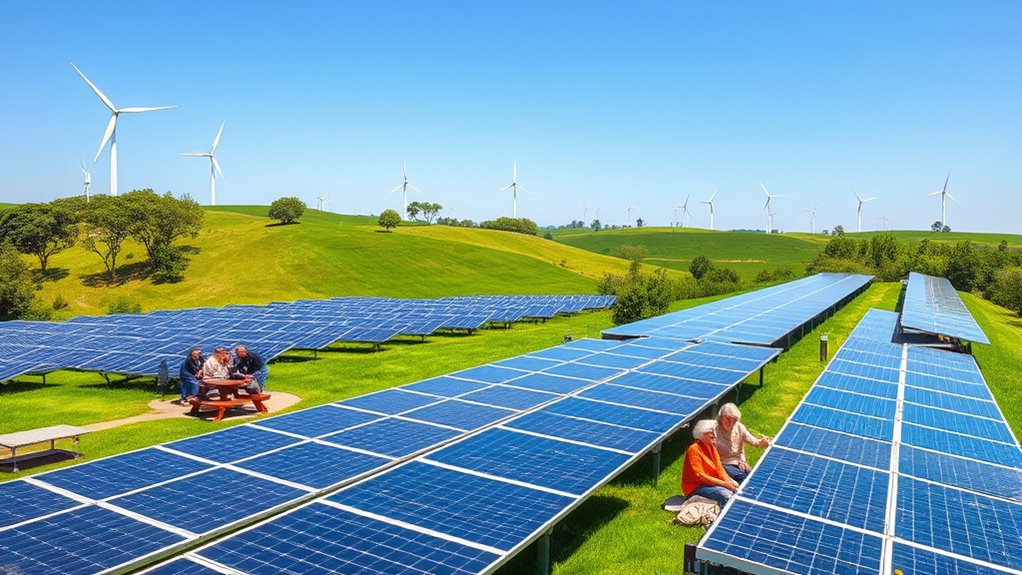
Have you ever wondered how communities can harness solar power collectively? Community solar offers a practical solution, allowing residents and businesses to benefit from solar energy without installing individual solar panels on their rooftops. Instead, a large solar array is installed somewhere accessible, and participants buy or lease a share of this setup. This model makes solar energy more inclusive, especially for those who can’t afford or don’t have suitable roof space for personal solar panels. When you participate in community solar, you’re fundamentally subscribing to a portion of the energy produced by the shared solar farm. As a result, you can enjoy significant energy savings on your utility bills, since the power generated offsets the electricity you use. Over time, these savings add up, making solar energy a cost-effective choice for many households and organizations.
The concept is straightforward: rather than each person managing their own solar panel system, you join a collective effort to generate renewable energy. This approach simplifies the process—no need for complex installations or maintenance—and allows you to support clean energy initiatives without the upfront costs typically associated with installing solar panels. When the solar farm produces electricity, it feeds into the local grid, and your utility company credits your account for your share of the energy generated. These credits directly reduce your monthly energy costs, providing a clear financial benefit. Plus, since the energy is produced locally, it reduces reliance on fossil fuels and cuts down on greenhouse gas emissions, making community solar an environmentally responsible choice. Additionally, integrating AI-powered monitoring and analytics can optimize the performance of solar farms, ensuring maximum efficiency and output.
Participation in community solar also fosters a sense of community engagement and shared responsibility for sustainable practices. It opens opportunities for renters, low-income households, and small businesses to access solar power, which might otherwise be out of reach. Many programs even offer flexible subscription options, allowing you to adjust your participation based on your energy needs and financial situation. The benefits extend beyond personal savings; supporting local solar farms helps create jobs and stimulates economic growth in your area. It also encourages the growth of renewable energy infrastructure, which benefits everyone by advancing the transition to a cleaner, more sustainable grid.

IAMMETER WEM3050T WiFi Energy Meter, Smart Home Energy Monitor for Solar & Power Monitoring, Real-Time Electricity Usage, Compatible with Alexa (Multi-Phase Support)
REAL-TIME HOME POWER MONITORING Track your home’s electricity usage in real time via IAMMETER-Cloud and mobile apps. Monitor…
As an affiliate, we earn on qualifying purchases.
As an affiliate, we earn on qualifying purchases.
Frequently Asked Questions
How Do Community Solar Projects Impact Local Property Values?
Community solar projects can boost your property’s appreciation by enhancing neighborhood development. When these projects are nearby, they often make your area more attractive to buyers interested in sustainable living. This increased interest can lead to higher property values overall. You might see a positive impact on your property’s worth as the community embraces renewable energy options, creating a more desirable and forward-thinking neighborhood.
What Are the Typical Costs Involved in Participating?
You’ll typically face upfront costs like installation or setup fees, but many community solar programs mainly involve ongoing subscription fees. Cost considerations include monthly or annual payments based on your share of the solar farm’s output. Some projects offer no upfront costs, just manageable subscription fees. Always review the terms carefully to understand what you’re paying for, ensuring the savings on your energy bill outweigh the costs involved.
Can Community Solar Be Combined With Other Renewable Energy Sources?
Yes, you can combine community solar with other renewable energy sources like solar panel integration, creating a renewable energy synergy. This approach enhances your overall energy efficiency and sustainability. By integrating solar panels with community solar projects, you maximize your renewable resources and reduce reliance on fossil fuels. This combination allows you to optimize energy production, lower costs, and contribute more effectively to environmental conservation efforts.
How Are Community Solar Projects Regulated Across Different States?
Imagine you’re considering a community solar project in Colorado, where state policies support such initiatives through clear regulatory frameworks. Across states, regulations vary widely—some have favorable policies, while others lack specific guidelines. You must navigate these differences, understanding local rules on interconnection, billing, and incentives. Your success depends on staying informed about each state’s policies, ensuring compliance, and leveraging supportive regulations to maximize your project’s benefits.
What Are the Long-Term Financial Benefits for Participants?
By participating in community solar, you can enjoy long-term savings through financial incentives like tax credits and rebates. These benefits reduce your overall energy costs over time, making it more affordable. Additionally, as electricity rates increase, your savings grow, providing you with stable, predictable expenses. Over the years, these financial incentives help maximize your investment, ensuring you benefit from lower energy bills and contributing to a more sustainable energy future.

ECO-WORTHY 10KW Output 9.36KWH Off Grid Solar System Complete Kit for Home:12pcs 195W Solar Panels(2340W)+10KW 120V/240V Inverter (UL 1741)+ 2pcs 48V 100AH Lithium Batteries(UL 1973&UL 9540A)
[Ideally Output of 9.36KWH] The power of 9.36KWh per day under 4 hours full sunshine by the 2340W…
As an affiliate, we earn on qualifying purchases.
As an affiliate, we earn on qualifying purchases.
Conclusion
By participating in community solar, you expand access, lower costs, and support sustainability. You share in the benefits, you reduce your footprint, and you foster community growth. You embrace renewable energy, you build a resilient future, and you create a cleaner planet. Together, you harness the power of collective effort, together you make a difference, and together you shape a brighter tomorrow. Your involvement matters—because when you join, everyone wins.
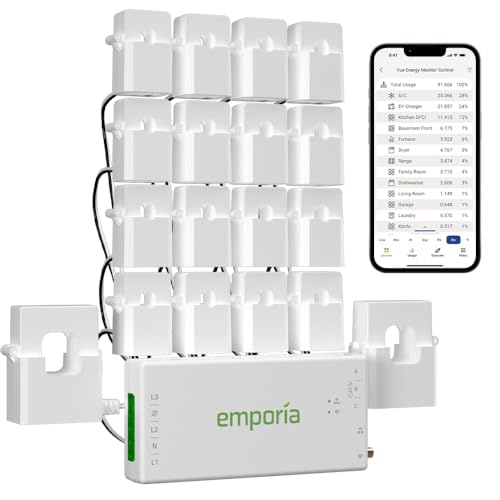
Emporia Vue 3 Home Energy Monitor – Smart Home Automation Module and Real Time Electricity Usage Monitor, Power Consumption Meter, Solar and Net Metering for UL Certified Safe Energy Monitoring
SAFETY YOU CAN TRUST WITH UL CERTIFICATION: With Emporia Energy, your home energy monitoring is safe, reliable, and…
As an affiliate, we earn on qualifying purchases.
As an affiliate, we earn on qualifying purchases.
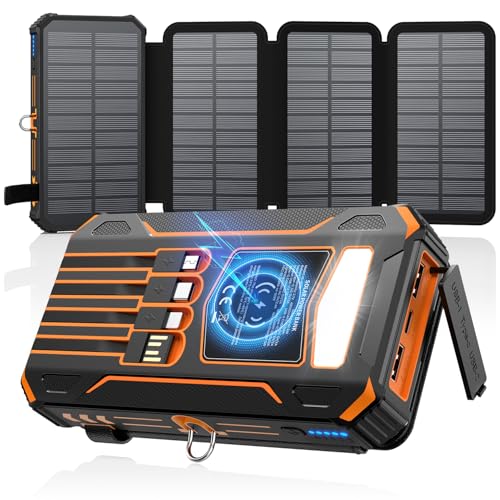
SOARAISE Solar Charger Power Bank – 48000mAh Wireless Portable Charger Built-in 4 Cables and 4 Solar Panels, PD QC 3.0 Fast Charging USB C Battery Pack with Flashlight for Camping Travel
Upgraded High-Efficiency 4 Solar Panels: Equipped with 4 premium solar panels, this solar panel charger charges up to…
As an affiliate, we earn on qualifying purchases.
As an affiliate, we earn on qualifying purchases.