
If you’re searching for wifi weather stations with lightning detection, you’re looking for reliable tools that keep you safe and informed about severe weather conditions. The AcuRite Optimus Weather Station stands out as the overall best choice thanks to its comprehensive sensors and user-friendly display. For those on a budget, the Urageuxy WiFi Weather Station offers solid features including wind and rain sensors at a lower price. Meanwhile, the Ambient Weather WS-2902 impresses with its smart home compatibility and detailed data. These options reveal tradeoffs: some prioritize ease of setup, others focus on advanced features or budget-friendly value. Continue reading for a full breakdown of the best wifi weather stations with lightning detection in 2026.
Complete the kit


Key Takeaways
- The top picks balance lightning detection accuracy with ease of setup and integration.
- Higher-priced models tend to offer more sensors, better build quality, and advanced weather forecasting features.
- Budget options like Urageuxy provide decent lightning detection but may lack some advanced sensors or data precision.
- Smart home compatibility varies widely; choose models with compatible apps or ecosystems if integration matters.
- Weather stations with multiple sensors (rain, wind, UV, lightning) deliver more comprehensive data but often cost more.
| AcuRite Optimus Weather Station 01218M |  | Best Compact All-in-One | Model: 01218M | Outdoor Sensor: Compact solar-powered 6-in-1 array | Measurements: Temperature, humidity, rainfall, wind speed, wind direction, and lightning | VIEW ON AMAZON | See Our Full Breakdown |
| Raddy WF-120C Professional Wi-Fi Weather Station |  | Best Large-Display Alternative | Model: WF-120C | Display: 10-inch HTN color screen with five brightness levels and night mode | Outdoor Sensor: 7-in-1 wireless sensor | VIEW ON AMAZON | See Our Full Breakdown |
| AcuRite Weather Station Forecaster 01071 |  | Best Simple Lightning Alert | Model: 01071 | Core Readings: Indoor/outdoor temperature, humidity, and barometric pressure | Lightning Detection Range: 25 miles | VIEW ON AMAZON | See Our Full Breakdown |
| Urageuxy 7-in-1 Wi-Fi Weather Station |  | Best Multi-Server Data Sharing | Outdoor Sensor: Integrated 7-in-1 array with solar panel | Measurements: Temperature, humidity, wind, pressure, rainfall, UV, and light | Lightning Detection: Not included in the listed measurements | VIEW ON AMAZON | See Our Full Breakdown |
| AcuRite Iris 5-in-1 Weather Station 01024M |  | Best Offline Storm Tracker | Model: 01024M | Outdoor Array: 5-in-1 wireless weather sensor | Weather Data: Temperature, humidity, wind speed, wind direction, rainfall, and barometric pressure | VIEW ON AMAZON | See Our Full Breakdown |
| AcuRite Atlas Professional Weather Station with Wi-Fi and Lightning Detection |  | Best Overall for Comprehensive Safety and Remote Monitoring | Display: HD display with battery backup | Connectivity: Wi-Fi, Weather Underground | Lightning Detection Range: 25 miles | VIEW ON AMAZON | See Our Full Breakdown |
| Ambient Weather WS-2902 WiFi Smart Weather Station |  | Best Value for Hyperlocal Data and Community Sharing | Display: Color LCD with adjustable backlight | Wireless Range: Up to 328 ft / 100 m | Sensors: Wind vane, anemometer, temperature, humidity, rain collector, UV, light, moon phase | VIEW ON AMAZON | See Our Full Breakdown |
| AcuRite Iris Wireless Weather Station with HD Direct-to-Wi-Fi Display, Lightning Sensor, Indoor/Outdoor Temperature and Humidity, Wind Speed/Direction, Rain Gauge, and Barometer | 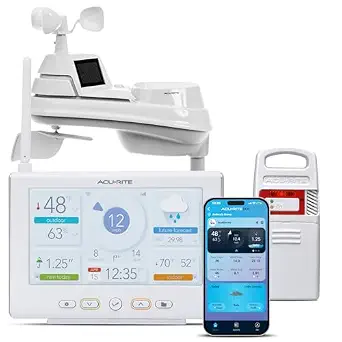 | Best for Hyperlocal Weather and Storm Alerts with Smartphone Integration | Display: HD color display | Lightning Detection: Up to 25 miles | Sensors: Indoor/outdoor temperature, humidity, wind, rain, barometer | VIEW ON AMAZON | See Our Full Breakdown |
| AcuRite Iris Wireless Home Weather Station, Indoor/Outdoor Temperature, Humidity, Wind Speed, Wind Direction, Rain Gauge, Lightning Detection |  | Best for Indoor/Outdoor Monitoring with Lightning and Alerts | Display: Color display with auto-dimming | Lightning Detection: Estimates storm proximity, strike count | Data Points: Over 50 | VIEW ON AMAZON | See Our Full Breakdown |
| AcuRite Weather Station with Lightning Detection, Wind, Rain Gauge, Sportsman |  | Best Overall for Precision and Multi-Function Outdoors Monitoring | Measurement Range: Lightning strikes, wind speed/direction, rainfall, temperature, humidity | Display: High-contrast color display with activity insights | Connectivity: Wi-Fi, AcuRite app | VIEW ON AMAZON | See Our Full Breakdown |
| Raddy WF-120P Professional Wi-Fi Weather Station with App Control, 10″ HTN Color Display, Indoor/Outdoor Temp & Humidity, UV & Light Index, PM2.5 AQI, 5-Day Forecast, 7-in-1 Outdoor Sensor for Farm |  | Best Value for Large Display and Versatile Data | Display Size: 10 inches | Measurement Types: Temp, Humidity, Rain, Wind, UV, PM2.5, Lightning | Forecast: 5-day | VIEW ON AMAZON | See Our Full Breakdown |
| 4900FT WiFi Smart Weather Stations Wireless Indoor Outdoor, LoRa Based Wireless Weather Station with 7-in-1 Solar Sensor, Thermo-Hygro Sensor, Bird Spike, CSV Export for Home, Garden, Farm |  | Best for Long-Range and Expandability in Large Spaces | Range: Up to 4900 ft in open areas | Measurement Types: Temp, Humidity, Rain, Wind, UV, Light, Air Quality | Sensor Type: 7-in-1 solar outdoor sensor plus additional sensors | VIEW ON AMAZON | See Our Full Breakdown |
| wifi weather stations with lightning detection | Display | Connectivity |
|---|---|---|
| AcuRite Optimus Weather Statio | High-definition LCD | — |
| Raddy WF-120C Professional Wi- | 10-inch HTN color screen with five brightness levels and night mode | — |
| AcuRite Weather Station Foreca | — | Wi-Fi connectivity is not specified |
| Urageuxy 7-in-1 Wi-Fi Weather | Color console with three brightness levels, stand, and hanging hole | — |
| AcuRite Iris 5-in-1 Weather St | Auto-dimming high-definition TFT with multiple dashboards | Native Wi-Fi and app monitoring are not stated |
| AcuRite Atlas Professional Wea | HD display with battery backup | Wi-Fi, Weather Underground |
| Ambient Weather WS-2902 WiFi S | Color LCD with adjustable backlight | Wi-Fi 2.4G |
| AcuRite Iris Wireless Weather | HD color display | Wi-Fi |
| AcuRite Iris Wireless Home Wea | Color display with auto-dimming | None (local display only) |
| AcuRite Weather Station with L | High-contrast color display with activity insights | Wi-Fi, AcuRite app |
| Raddy WF-120P Professional Wi- | — | Wi-Fi, Tuya Smart app |
| 4900FT WiFi Smart Weather Stat | HD color screen | LoRa |
More Details on Our Top Picks
AcuRite Optimus Weather Station 01218M
AcuRite Optimus 01218M takes my highest spot in this batch because it combines native Wi-Fi, app access, and lightning detection in one compact, solar-powered outdoor array. That combination matters: unlike the Raddy WF-120C, it can warn about electrical storm activity rather than merely report rain, wind, and pressure. Its aspirating fan and one-degree wind-direction precision also suit buyers who care about cleaner local readings, while Google Home, Alexa, and thermostat links turn weather data into useful automations. The tradeoff is ecosystem freedom: AcuRite promotes its own app, while the Urageuxy supports several public weather servers. The stated data also omits a lightning-detection range. I rank it above the AcuRite Iris 01024M because direct mobile monitoring is part of the package rather than a display-only workflow.
Pros:- Combines Wi-Fi monitoring and lightning detection in a compact 6-in-1 array
- Aspirating fan supports more dependable temperature and humidity readings
- Wind direction is measured to within 1 degree
- Works with AcuRite NOW, Google Home, Amazon Alexa, and compatible thermostats
Cons:- The supplied product data does not state the lightning-detection range
- Weather Underground and other third-party network uploads are not listed
- Smart-home and app features may be excessive for buyers wanting only a local display
Best for: Apartment, HOA, and suburban households seeking compact lightning detection, phone alerts, and smart-home automation from one outdoor array
Not ideal for: Weather-network hobbyists who want confirmed Weather Underground uploads or buyers who need a published lightning-detection radius
- Model:01218M
- Outdoor Sensor:Compact solar-powered 6-in-1 array
- Measurements:Temperature, humidity, rainfall, wind speed, wind direction, and lightning
- Display:High-definition LCD
- Mobile Access:AcuRite NOW app with current readings, alerts, and history
- Smart-Home Support:Google Home, Amazon Alexa, and compatible smart thermostats
- Accuracy Features:Internal aspirating fan and wind direction precision within 1 degree
- Forecast:12- to 24-hour local forecast
- Data Coverage:More than 20 data points with historical records
Our verdict“I recommend the Optimus to buyers who want the strongest compact combination of native Wi-Fi, lightning alerts, and smart-home control.”
Raddy WF-120C Professional Wi-Fi Weather Station
I include the Raddy WF-120C for buyers who value a large console and public weather-network uploads, but its place in a lightning-focused roundup needs a direct warning: the listed sensor has no lightning detector. Compared with the AcuRite Optimus, Raddy provides more screen space, UV and light readings, plus Weather Underground and WeatherCloud sharing. Those extras suit a farm, garden, or rooftop station whose owner wants historical graphs. The 100-meter radio range and battery fallback add flexibility during siting and outages. Yet rain or pressure trends are not substitutes for strike sensing, so I would pair it with a separate lightning alert device. Its forecast also needs one to two weeks of pressure data to improve. I rank it as a large-display alternative, not a complete answer to the article’s core requirement.
Pros:- Large 10-inch color console presents more than a dozen weather values
- Uploads live observations to Weather Underground and WeatherCloud
- Measures UV and light intensity alongside wind, rain, temperature, and humidity
- 100-meter sensor range and dual console power options aid flexible placement
Cons:- The listed 7-in-1 sensor does not detect lightning
- Local forecast needs one to two weeks of data before accuracy improves
- No smart-home automation or dedicated mobile app is listed
Best for: Farmers, gardeners, and rooftop-station owners who want a 10-inch display and public weather-network uploads and can add separate lightning detection
Not ideal for: Storm-aware households seeking built-in strike alerts, distance estimates, or lightning history from a single system
- Model:WF-120C
- Display:10-inch HTN color screen with five brightness levels and night mode
- Outdoor Sensor:7-in-1 wireless sensor
- Measurements:Temperature, humidity, pressure, UV, light, wind, rainfall, dew point, and feels-like temperature
- Lightning Detection:Not included in the listed sensor functions
- Wireless Range:100 meters
- Online Services:Weather Underground and WeatherCloud
- Forecast:12 hours; requires 1–2 weeks of data for improved accuracy
- Console Power:USB-C adapter or 2 AA batteries, with batteries not included
Our verdict“I would choose the WF-120C for big-screen weather analysis, but only alongside a separate lightning-warning device.”
AcuRite Weather Station Forecaster 01071
AcuRite Forecaster 01071 is my pick for readers who care more about a straightforward 25-mile lightning alert than remote app access. Its self-calibrating forecast, freeze and heat-index alerts, and indoor/outdoor readings cover the decisions many gardeners and storm-aware households make each day. Compared with the AcuRite Optimus, however, it omits wind, rainfall, and stated Wi-Fi connectivity, so I cannot treat it as a full connected weather station. It is also narrower than the AcuRite Iris 01024M, which adds wind, rain, and strike histories. The upside is less information overload and a 330-foot sensor link that suits many homes. The downside is a split power setup—AC indoors and four AA batteries outdoors—and no remote monitoring path in the supplied data. I would choose it only when local alerts matter more than app dashboards.
Pros:- Detects lightning strikes within 25 miles
- Self-calibrating technology produces a hyperlocal forecast
- Includes heat-index and freezing-temperature alerts
- 330-foot sensor range suits many residential properties
Cons:- Wi-Fi and mobile monitoring are not listed
- Does not measure wind speed, wind direction, or rainfall
- Outdoor sensor needs four AA batteries, while the indoor display depends on AC power
Best for: Gardeners and storm-aware households wanting a simple local lightning warning and temperature alerts without a dense weather dashboard
Not ideal for: Remote-monitoring buyers or weather hobbyists who need Wi-Fi, rainfall totals, wind data, and public network uploads
- Model:01071
- Core Readings:Indoor/outdoor temperature, humidity, and barometric pressure
- Lightning Detection Range:25 miles
- Forecast System:Self-calibrating hyperlocal forecasting
- Connectivity:Wi-Fi connectivity is not specified
- Wireless Range:330 feet (100 meters)
- Outdoor Sensor:Remote sensor with keyhole hanger
- Indoor Power:AC powered with optional backup batteries
- Outdoor Power:4 AA batteries, not included
Our verdict“I recommend the 01071 when a clear local lightning alert matters more than Wi-Fi access or full backyard weather measurements.”
Urageuxy 7-in-1 Wi-Fi Weather Station
I see the Urageuxy 7-in-1 as the server-friendly choice for hobbyists who want to calibrate readings and publish them widely. It supports Weather Underground, PWSweather, and WeatherCloud, one more listed network than the Raddy WF-120C, while manual calibration gives careful owners control over temperature, humidity, wind, pressure, and rainfall corrections. Its UV, light, moon-phase, and multi-period rain views also make the console information-rich. The hard limit is no listed lightning detection; an alarm for rain or pressure cannot provide strike distance. Compared with the AcuRite Optimus, it offers broader server choice but misses the feature that defines this roundup, and its 2.4 GHz-only Wi-Fi may complicate setup on some combined-band routers. I include it as a DIY data-sharing option for buyers willing to add a separate lightning solution, not as a one-box storm-warning pick.
Pros:- Uploads to Weather Underground, PWSweather, and WeatherCloud
- Allows manual calibration of five major measurement categories
- Tracks rainfall across hourly, daily, weekly, monthly, and lifetime periods
- Provides adjustable alarms for numerous weather readings
Cons:- No lightning detector is listed
- Wi-Fi support is limited to 2.4 GHz routers
- Outdoor array requires three AAA batteries that are not included
Best for: Weather hobbyists who want manual calibration and uploads to several public weather networks and already own a separate lightning detector
Not ideal for: Buyers seeking built-in strike warnings or households unwilling to configure a 2.4 GHz connection and maintain an exposed sensor array
- Outdoor Sensor:Integrated 7-in-1 array with solar panel
- Measurements:Temperature, humidity, wind, pressure, rainfall, UV, and light
- Lightning Detection:Not included in the listed measurements
- Wi-Fi:2.4 GHz router support
- Online Services:Weather Underground, PWSweather, and WeatherCloud
- Calibration:Manual correction for temperature, humidity, wind speed, pressure, and rainfall
- Display:Color console with three brightness levels, stand, and hanging hole
- Alerts:Configurable alarms for temperature, humidity, wind, pressure, rainfall, and light
- Outdoor Power:Solar panel plus 3 AAA batteries, with batteries not included
Our verdict“I would pick the Urageuxy for flexible weather-data publishing only if lightning coverage comes from another device.”
AcuRite Iris 5-in-1 Weather Station 01024M
AcuRite Iris 01024M earns my offline storm-tracking role because it combines a 5-in-1 weather array with a separate lightning sensor that reports distance and daily, weekly, and monthly strike counts. That history is richer than the AcuRite Forecaster 01071, while wind and rainfall make approaching storms easier to interpret. The auto-dimming TFT dashboards are also more polished than a basic alert console. Against the AcuRite Optimus, though, this Iris loses ground: native Wi-Fi and app monitoring are not stated, so it does not fully serve a buyer seeking remote access. A separate outdoor lightning sensor also means another device to place and maintain. I would rank it behind the Optimus for connected households, but ahead of the Raddy WF-120C when actual 25-mile strike detection matters more than weather-network uploads.
Pros:- Detects lightning within 25 miles and estimates distance to the storm
- Stores daily, weekly, and monthly strike totals
- Combines lightning data with wind, rainfall, pressure, temperature, and humidity
- Auto-dimming TFT display offers separate weather and records dashboards
Cons:- Native Wi-Fi and mobile app access are not stated
- Separate lightning sensor adds another outdoor device to place and maintain
- The 5-in-1 array lacks the UV and light readings found on some 7-in-1 rivals
Best for: Home weather enthusiasts who want detailed local strike history, wind, rain, and an HD indoor dashboard without depending on cloud access
Not ideal for: Traveling homeowners who need native Wi-Fi alerts and phone-based monitoring while away from the display
- Model:01024M
- Outdoor Array:5-in-1 wireless weather sensor
- Weather Data:Temperature, humidity, wind speed, wind direction, rainfall, and barometric pressure
- Lightning Hardware:Separate outdoor sensor with a 25-mile detection radius
- Lightning Records:Distance estimates plus daily, weekly, and monthly strike totals
- Forecast:Personalized 12-hour forecast using elevation and pressure data
- Display:Auto-dimming high-definition TFT with multiple dashboards
- Connectivity:Native Wi-Fi and app monitoring are not stated
- Clock Features:Automatic daylight-saving adjustment and integrated alarm
Our verdict“I recommend the Iris 01024M for detailed local storm tracking, but connected buyers should favor the Wi-Fi-equipped Optimus.”
AcuRite Atlas Professional Weather Station with Wi-Fi and Lightning Detection
The AcuRite Atlas stands out for its ability to deliver over 20 real-time weather data points indoors and outdoors, combined with lightning detection up to 25 miles away. Its HD display with battery backup makes it easy to view critical information even during storms, and Wi-Fi connectivity allows sharing data with Weather Underground for hyperlocal forecasts. Compared with the Ambient Weather WS-2902, it offers a more integrated lightning detection feature, making it better suited for storm-prone areas. However, setup can be complex for those unfamiliar with technical installations, and the price point is higher than basic models. This pick makes the most sense for users prioritizing safety, detailed data, and remote access, willing to invest in a premium system.
Pros:- Provides extensive real-time weather data indoors and outdoors
- Lightning detection up to 25 miles enhances storm safety
- Wi-Fi connectivity allows remote monitoring and data sharing
- High-definition display with battery backup
Cons:- Setup may require some technical knowledge
- Higher cost compared to simpler weather stations
Best for: Homeowners in storm-prone regions needing comprehensive weather data and lightning alerts
Not ideal for: Casual users seeking a budget-friendly, simple weather station without lightning detection
- Display:HD display with battery backup
- Connectivity:Wi-Fi, Weather Underground
- Lightning Detection Range:25 miles
- Data Points:Over 20
- Indoor/Outdoor Sensors:Yes
- Power Source:Battery backup included
Our verdict“Ideal for users who want a detailed, reliable weather station with lightning detection and remote access capabilities.”
Ambient Weather WS-2902 WiFi Smart Weather Station
The Ambient Weather WS-2902 offers a comprehensive weather monitoring solution with a wireless sensor array measuring wind, rain, UV, and solar radiation, paired with Wi-Fi to connect to the Ambient Weather Network. Its ability to share data across a large user community provides hyperlocal forecasts, making it a solid choice for dedicated weather enthusiasts. Compared to the AcuRite Atlas, it is more affordable and easier to set up, but lacks integrated lightning detection, which limits safety applications. Its 3 AAA batteries are not included, and Wi-Fi range of 328 feet may not suffice for very large properties. This station is best for hobbyists interested in community-based weather sharing without the need for storm alerts.
Pros:- Affordable and easy to install
- Connects to a large personal weather station network
- Provides hyperlocal weather data and forecasts
- Supports multiple units and calibration
Cons:- No built-in lightning detection
- Requires 3 AAA batteries (not included)
- Wi-Fi range may be limited for large properties
Best for: Weather hobbyists who want community-driven data sharing and easy setup without lightning detection
Not ideal for: Users in storm-prone areas needing lightning alerts and storm safety features
- Display:Color LCD with adjustable backlight
- Wireless Range:Up to 328 ft / 100 m
- Sensors:Wind vane, anemometer, temperature, humidity, rain collector, UV, light, moon phase
- Power:Requires 3 AAA batteries (not included)
- Connectivity:Wi-Fi 2.4G
- Installation:Easy mounting with waterproof sensors
Our verdict“Best suited for weather enthusiasts focused on hyperlocal data sharing rather than storm safety features.”
AcuRite Iris Wireless Weather Station with HD Direct-to-Wi-Fi Display, Lightning Sensor, Indoor/Outdoor Temperature and Humidity, Wind Speed/Direction, Rain Gauge, and Barometer
The AcuRite Iris combines a high-definition color display with Wi-Fi connectivity and a lightning sensor capable of detecting strikes up to 25 miles away. Its comprehensive suite of sensors provides indoor and outdoor temperature, humidity, wind speed/direction, rainfall, and barometric pressure. This makes it ideal for users wanting a visually appealing, all-in-one weather station with storm alerts. Unlike the Ambient Weather WS-2902, it emphasizes storm safety with lightning detection and offers app integration for remote monitoring. However, its setup process can be complex, and the station may be relatively costly. This device is perfect for serious weather watchers who want detailed, real-time alerts and a stylish display.
Pros:- HD color display with easy-to-read data
- Lightning detection up to 25 miles away
- Wi-Fi connectivity with app notifications
- Includes wind, rain, barometric sensors
Cons:- Setup can be complex for beginners
- Higher price point compared to basic models
Best for: Weather enthusiasts seeking a stylish all-in-one station with lightning detection and app alerts
Not ideal for: Casual users or those on a tight budget who do not need lightning alerts
- Display:HD color display
- Lightning Detection:Up to 25 miles
- Sensors:Indoor/outdoor temperature, humidity, wind, rain, barometer
- Connectivity:Wi-Fi
- App Support:AcuRite NOW app
- Measurement Range:Storm detection up to 25 miles
Our verdict“Great for users who prioritize storm safety, stylish design, and remote alerts in a weather station.”
AcuRite Iris Wireless Home Weather Station, Indoor/Outdoor Temperature, Humidity, Wind Speed, Wind Direction, Rain Gauge, Lightning Detection
The AcuRite Iris offers a versatile indoor/outdoor weather monitoring experience with over 50 data points, including lightning detection that estimates storm proximity. Its built-in temperature, humidity, and barometric pressure gauges allow for detailed analysis at home or in the yard. While it excels at providing comprehensive environmental data and lightning strike counts, it lacks the HD display and app integration seen in the Iris model, making it more suitable for straightforward monitoring. Compared to the AcuRite Iris (01532M), it offers basic lightning detection but fewer advanced visualization features. This station is ideal for users needing a reliable, feature-rich weather station with lightning alerts, but not necessarily a high-end display or remote app support.
Pros:- Provides over 50 weather data points
- Lightning detection with strike count
- Indoor and outdoor temperature and humidity
- Auto-dimming display with programmable alerts
Cons:- No HD display or smartphone app
- Limited visual customization
- Requires batteries for outdoor sensors
Best for: Home users wanting detailed environmental data with lightning detection and simple alerts
Not ideal for: Tech-savvy users looking for high-resolution displays and app integration
- Display:Color display with auto-dimming
- Lightning Detection:Estimates storm proximity, strike count
- Data Points:Over 50
- Indoor/Outdoor Sensors:Temperature, humidity, barometer
- Power:Batteries required for outdoor sensors
- Connectivity:None (local display only)
Our verdict“Suitable for those who want a reliable, feature-rich weather station with lightning detection for basic storm awareness.”
AcuRite Weather Station with Lightning Detection, Wind, Rain Gauge, Sportsman
This model stands out for its comprehensive 6-in-1 outdoor sensor, combining lightning detection with wind, rain, temperature, and humidity measurements, making it ideal for serious outdoor enthusiasts. Its exclusive Sportsman display provides real-time weather insights alongside tailored activity suggestions, which is a rarity among weather stations. Compared with the Raddy WF-120P, it offers more specialized outdoor data tailored to hunters and fishermen, though it lacks the detailed forecast features of the Raddy. The built-in Wi-Fi and AcuRite app enhance remote monitoring, but the interface isn’t as customizable as some high-end systems. Its lightning detection offers early warnings, which can help users avoid severe weather, though it may have slightly less sensor range than some larger setups. Overall, this station is best suited for landowners, hunters, and anglers needing reliable, detailed outdoor data with storm alerts, but it might be less ideal for casual gardeners or indoor-only users.
Pros:- Comprehensive 6-in-1 outdoor sensor for accurate environmental data
- Includes lightning detection with early warning alerts
- High-contrast, tailored display with hunting & fishing insights
- Reliable Wi-Fi connectivity and app integration
Cons:- Lacks detailed forecast features found in some competitors like Raddy WF-120P
- Sensor installation can be somewhat complex for beginners
Best for: Outdoor enthusiasts, hunters, and fishermen who need precise, multi-sensor weather data with storm alerts
Not ideal for: Indoor-only users or casual gardeners who want simple, easy-to-read weather info without advanced storm detection
- Measurement Range:Lightning strikes, wind speed/direction, rainfall, temperature, humidity
- Display:High-contrast color display with activity insights
- Connectivity:Wi-Fi, AcuRite app
- Sensor Type:6-in-1 outdoor sensor
- Storm Alerts:Yes, early warning for lightning
- Compatibility:Smartphone remote monitoring
Our verdict“This weather station is best for serious outdoor users needing detailed data and storm alerts to stay safe and plan activities effectively.”
Raddy WF-120P Professional Wi-Fi Weather Station with App Control, 10″ HTN Color Display, Indoor/Outdoor Temp & Humidity, UV & Light Index, PM2.5 AQI, 5-Day Forecast, 7-in-1 Outdoor Sensor for Farm
The Raddy WF-120P stands out for its large 10-inch color display that consolidates a wide array of weather data at a glance, including lightning detection, temperature, humidity, UV, air quality, and a 5-day forecast. Compared with the AcuRite Sportsman, it offers a more detailed forecast and customizable display options, making it appealing for hobbyists and small farm owners. While its lightning detection feature is robust, it does not include the activity-specific insights of the Sportsman model, making it less tailored for outdoor sports planning. Its app connectivity provides real-time data and historical trends, but the interface may be less intuitive for less tech-savvy users. The sensor range is sufficient for most backyard or farm settings, though it’s less suited for very large properties. This makes it ideal for users who want a comprehensive, visually accessible weather dashboard without the highest-end features or extreme range, but those needing extensive sensor expansion might prefer other systems.
Pros:- Large, clear 10-inch color display with comprehensive data
- Includes lightning detection and 5-day forecast
- Wi-Fi app connectivity for remote access and historical data
- 7-in-1 outdoor sensor for versatile measurements
Cons:- Less customizable than some higher-end systems for advanced users
- Limited sensor expansion options beyond included sensors
Best for: Farmers, hobbyists, and families wanting an all-in-one weather display with forecast and storm alerts
Not ideal for: Users needing ultra-long-range sensors or extensive add-on sensor networks for large properties
- Display Size:10 inches
- Measurement Types:Temp, Humidity, Rain, Wind, UV, PM2.5, Lightning
- Forecast:5-day
- Connectivity:Wi-Fi, Tuya Smart app
- Sensor Range:Up to 100 meters
- Power:Indoor power adapter, outdoor sensor solar
Our verdict“This station offers excellent value for users seeking a detailed, easy-to-read weather dashboard with storm alerts and forecast capabilities.”
4900FT WiFi Smart Weather Stations Wireless Indoor Outdoor, LoRa Based Wireless Weather Station with 7-in-1 Solar Sensor, Thermo-Hygro Sensor, Bird Spike, CSV Export for Home, Garden, Farm
This weather station excels in environments where long-range data transmission is essential, thanks to its LoRa technology reaching up to 4900 feet in open areas. Compared with the AcuRite models, it offers superior connectivity over large properties, making it perfect for farms, greenhouses, or expansive backyards. Its 7-in-1 sensor covers the basics—temperature, humidity, wind, rainfall, UV, and light—plus additional sensors for air quality and water leaks, making it highly adaptable. It includes a solar panel to extend battery life, reducing maintenance, and supports multiple add-on sensors, which is a major advantage for users wanting comprehensive environmental monitoring. The lightning detection feature is available but not as central as in dedicated models. The system’s complexity and need for setup might be overkill for casual users or those in small spaces. It suits those with large land or farm needs who want detailed, expandable weather data with minimal maintenance, but less so for small gardens or indoor-only use.
Pros:- LoRa long-range signal up to 4900 feet outdoors
- Expandable system supporting multiple sensors
- Solar-powered outdoor sensor extends battery life
- Includes bird spike to prevent sensor interference
Cons:- Setup and configuration may be complex for beginners
- Lightning detection is less central and not as detailed as dedicated systems
Best for: Large property owners, farmers, and greenhouses needing long-range, expandable weather monitoring with storm alerts
Not ideal for: Urban residents or small-scale gardeners seeking simple, plug-and-play weather stations
- Range:Up to 4900 ft in open areas
- Measurement Types:Temp, Humidity, Rain, Wind, UV, Light, Air Quality
- Sensor Type:7-in-1 solar outdoor sensor plus additional sensors
- Connectivity:LoRa
- Battery Life:Up to 2.5 years with solar
- Display:HD color screen
Our verdict“This station is ideal for users with large outdoor spaces who need long-range, expandable environmental monitoring with storm detection, but it may be too complex for casual users or small gardens.”
How We Picked
These products were evaluated based on multiple criteria that matter to buyers: lightning detection accuracy, sensor versatility, ease of Wi-Fi setup, app functionality, build quality, and value for money. Preference was given to models offering reliable lightning detection combined with comprehensive weather data, especially for outdoor safety. We also considered user interface clarity, connectivity options, and the reputation of brands in weather tech. Products were ranked to highlight those that balance performance, usability, and affordability, ensuring options for different needs and budgets.Factors to Consider When Choosing Wifi Weather Stations With Lightning Detection
Choosing a wifi weather station with lightning detection involves considering several key factors. It’s not just about sensor quantity but also about how well these sensors perform in real-world conditions and how seamlessly the device connects to your smart home setup. Understanding your specific needs—whether for outdoor safety, gardening, or hobbyist weather tracking—helps narrow down your choices. Here are some critical factors to keep in mind:Lightning Detection Accuracy and Range
Lightning detection is central to safety-focused weather stations. Look for models with proven detection range and quick response times. Cheaper units may offer basic detection, but they can miss strikes or generate false alarms. Higher-end models typically incorporate multi-sensor arrays and calibration features that improve reliability, especially in storm-prone areas. Consider how frequently you need alerts and whether the device’s detection range aligns with your outdoor space.
Sensor Versatility and Data Depth
Beyond lightning, consider what other weather data you need—temperature, humidity, wind speed, rain, UV, and barometric pressure. Devices with more sensors provide a fuller picture, especially useful for outdoor activities or farming. However, more sensors often mean higher costs and complex setup. Balance sensor variety with ease of use; a simpler station with core features might suit casual users better than overly complex systems for some.
Ease of Setup and Connectivity
A user-friendly setup process saves time and frustration. Wireless connectivity should be stable and compatible with your home network. Some models require extensive configuration, while others offer plug-and-play functionality. App integration is equally important—look for intuitive apps with remote monitoring, alerts, and data logging. Compatibility with smart home ecosystems can extend functionality but may also add complexity or cost.
Build Quality and Durability
Weather stations are exposed to the elements, so durability matters. Look for models with weatherproof enclosures, UV-resistant plastics, and sturdy mounting options. Cheaper units might degrade faster or require frequent maintenance. Consider the device’s longevity, especially if you plan to leave it outdoors year-round. A well-built station reduces future replacement costs and ensures consistent performance during storms.
Value and Price Considerations
Prices vary greatly based on sensor count, brand, and features. Balance your budget with your needs—premium models offer advanced detection, better build, and more data, but may be unnecessary for casual users. Budget options can provide basic lightning alerts and weather info, suitable for occasional use or smaller outdoor spaces. Remember, investing a bit more often results in more reliable detection and longer-lasting equipment.
Frequently Asked Questions
How accurate is lightning detection on these weather stations?
Lightning detection accuracy varies by model and sensor technology. Premium stations utilize multi-sensor arrays and calibration features, offering detection ranges up to several miles with fewer false alarms. Budget options might detect nearby strikes but are more prone to inaccuracies and false positives. For outdoor safety, choosing a station with proven detection capability and positive user reviews is advisable.
Can I connect these weather stations to my smart home system?
Many models support integration with popular smart home platforms through Wi-Fi or compatible apps. Devices like the Ambient Weather WS-2902, for example, offer extensive app control and some compatibility with systems like Alexa or Google Home. Compatibility varies, so it’s important to verify whether the weather station supports your preferred ecosystem before purchasing. Proper integration can enhance automation, such as alerting you during storms or adjusting outdoor lighting.
What is the typical setup process for these weather stations?
Most modern wifi weather stations aim for straightforward setup, involving mounting outdoor sensors, connecting to Wi-Fi, and configuring the app. Some units feature quick-install guides or automatic detection, while others may require manual IP or network setup. Accurate placement—away from obstructions and with good Wi-Fi signal—is key to reliable data. Expect some initial calibration, especially for lightning detection, which can improve accuracy over time.
How often do I need to replace or maintain these stations?
Proper maintenance extends the lifespan of your weather station. Regularly clean sensors, check for corrosion, and update firmware when needed. Weatherproof enclosures and UV-resistant parts reduce degradation, but exposure to harsh elements still causes wear. Typically, a well-built station can last 3-5 years with minimal upkeep. If you notice inconsistent data or failed sensors, replacement or repairs might be necessary.
Is lightning detection enough for outdoor safety, or should I rely on dedicated systems?
While wifi weather stations with lightning detection provide timely alerts for nearby strikes, they are generally not substitutes for dedicated lightning warning systems used in professional or industrial settings. These consumer devices are designed to inform outdoor enthusiasts, homeowners, and hobbyists about storm activity, but their detection range and precision may not match specialized safety systems. For critical safety, combining a weather station with official alerts and local emergency plans offers the best protection.