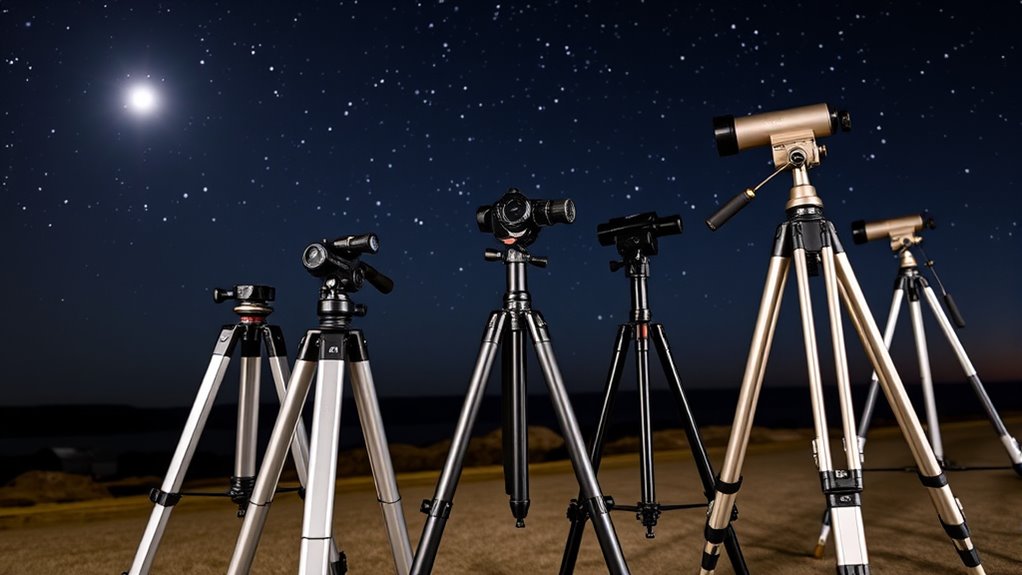

If you’re looking for the 15 best tripods and pier mounts for astrophotography in 2025, I’ve got you covered. I recommend options like the Sky-Watcher Star Adventurer GTI, iEXOS-100-2 tracker system, heavy-duty piers, portable tripods, and versatile mounts like the AZ-GTI. These choices balance stability, portability, and compatibility with various gear. To find out which ones suit your needs best, keep exploring the options below—I’ll guide you through each.
Key Takeaways
- Prioritize stability and vibration reduction features in tripods and pier mounts for sharp astrophotography images.
- Consider weight and portability for ease of transport and setup, especially for field astrophotography.
- Ensure compatibility with your mount type and payload capacity to support your telescope or camera system.
- Look for adjustable height and leveling options to optimize viewing angles and compensate for uneven terrain.
- Check build quality and material durability, favoring steel, aluminum, or high-quality composites for long-term reliability.
Sky-Watcher Star Adventurer GTI Mount Kit


If you’re looking for a portable, user-friendly mount for astrophotography, the Sky-Watcher Star Adventurer GTi Kit is an excellent choice. It features a built-in illuminated polar scope for quick, precise alignment and Wi-Fi connectivity, allowing control via your smartphone. With multiple tracking modes—lunar, solar, sidereal—and a 11-pound payload capacity, it handles DSLR cameras, small telescopes, and astrographs with ease. The kit includes a sturdy tripod, pier extension, and counterweights, making setup straightforward. Many users praise its reliable tracking and compact design, perfect for travel and beginners, though some note balancing challenges with heavier gear.
Best For: beginner to intermediate astrophotographers seeking a portable, easy-to-use mount with smartphone control and reliable tracking for wide-field and deep-sky imaging.
Pros:
- User-friendly setup with built-in polar scope and Wi-Fi control via smartphone app
- Lightweight, compact design ideal for travel and portable use
- Supports multiple tracking modes and handles DSLR/mirrorless cameras and small telescopes
Cons:
- Occasional challenges with polar alignment consistency and software adjustments
- Balancing heavier gear may require additional counterweights and careful handling
- Design flaws such as polar scope cover falling off or battery compartment issues
iEXOS-100-2 PMC-Eight Astrophotography Tracker System (Tripod & Mount)

The iEXOS-100-2 PMC-Eight Astrophotography Tracker System stands out as an excellent choice for beginner to intermediate astrophotographers seeking a portable and reliable mount. Its advanced PMC-Eight system, with eight independent CPUs, offers quick responsiveness and smooth tracking. The mount’s dual-axis worm gears and quiet stepper motors provide precise movement, while its WiFi and Bluetooth compatibility simplify control via the ExploreStars app. Weighing only 20 pounds, it’s easy to transport and set up, making it ideal for light-polluted sites. Though some users note stability issues with the tripod and initial alignment challenges, its guiding accuracy and affordability make it a popular option.
Best For: beginner to intermediate astrophotographers seeking a portable, user-friendly, and affordable mount with reliable tracking.
Pros:
- Advanced PMC-Eight system with eight CPUs for quick responsiveness and smooth tracking
- Lightweight and portable at only 20 pounds, easy to transport and set up
- Compatible with WiFi and Bluetooth, enabling control via the ExploreStars app on multiple devices
Cons:
- Stability issues due to flimsy tripod legs and lack of azimuth adjustment options
- Initial GoTo alignment can be inaccurate, requiring careful calibration and optional accessories
- Connectivity and firmware update challenges, including finicky WiFi and serial connections
Sky Watcher Star Adventurer Tripod

The Sky Watcher Star Adventurer Tripod stands out as an excellent choice for amateur astronomers seeking a lightweight yet sturdy mount for astrophotography. It’s compact, measuring 36 x 54 x 36 inches, and weighs just under 5 pounds, making it highly portable. Built from high-quality materials, it offers excellent stability with no flexure, supporting various telescope types and payloads. Its easy height adjustment and quick setup make it perfect for travel. Although some users note minor tray misalignment, proper installation fixes this. Overall, it’s praised for durability, ease of use, and versatility, earning a high rating among astrophotographers.
Best For: amateur astronomers and astrophotographers seeking a lightweight, stable, and portable tripod for various telescope setups and astrophotography applications.
Pros:
- Highly portable and lightweight at under 5 pounds, ideal for travel
- Sturdy construction with no flexure, supporting heavy payloads
- Easy to set up, adjust height, and compatible with multiple telescope types
Cons:
- Minor tray misalignment issues that can be corrected with proper installation
- Some users may find the accessory tray design slightly challenging initially
- Limited to compatible mounts and payloads specified by the manufacturer
iOptron Mini Pier Tripod Extension

Looking for a reliable way to improve your astrophotography setup? The iOptron Mini Pier Tripod Extension offers a solid foundation that enhances stability and reduces vibrations, giving you clearer images. It elevates your mount by 8 inches, improving viewing angles and helping avoid ground obstructions. Its universal design fits mounts like the MiniTower series and includes specific alignment pegs for iEQ45 and iEQ30, making polar alignment easier. Made from durable materials with multiple hex screws and a central bolt, it ensures your equipment stays secure. This extension is an excellent addition for anyone seeking stability, precision, and improved usability in their astrophotography gear.
Best For: amateur astronomers and astrophotographers seeking increased stability, improved viewing angles, and precise polar alignment for their mounts.
Pros:
- Enhances stability and vibration reduction for clearer images and better astrophotography results
- Elevates mounts by 8 inches, improving viewing angles and preventing ground obstructions
- Compatible with a variety of mounts, including MiniTower series, iEQ45, and iEQ30, with included alignment pegs for easy setup
Cons:
- May add extra weight and bulk to the existing setup, reducing portability
- Requires assembly and proper securing with multiple hex screws and bolts, which could be time-consuming
- Compatibility limited to specific mounts; not suitable for all astrophotography equipment
Sky-Watcher AZ-GTI Portable WiFi GoTo Alt-Az Mount

If you’re seeking a portable, easy-to-use mount for astrophotography and casual sky observing, the Sky-Watcher AZ-GTI Portable WiFi GoTo Alt-Az Mount stands out. Weighing just 8.6 pounds, it’s compact enough to travel with and includes an adjustable aluminum tripod that extends from 28 to 53 inches. Supporting up to 11 pounds, it handles small telescopes and DSLR cameras smoothly. Controlled via WiFi using the SynScan Pro app, it offers reliable tracking and quick alignment. Its solid brass and aluminum gears ensure precision, making it ideal for visual astronomy, time-lapse, and short-exposure astrophotography on the go.
Best For: amateur astronomers and astrophotographers seeking a portable, easy-to-use mount for casual sky observing and short-exposure imaging.
Pros:
- Compact and lightweight design (8.6 pounds) ideal for travel and mobile astronomy
- Supports up to 11 pounds, suitable for small telescopes and DSLR cameras
- Reliable WiFi control with the SynScan Pro app for quick setup and alignment
Cons:
- Internal gears may produce clicking noises and have some slop in certain orientations
- Limited maximum payload capacity for larger telescopes or heavy gear
- Not designed for long-exposure astrophotography without additional modifications
iOptron SkyHunter Extension Pier and Tripod

For astrophotographers seeking enhanced stability and versatility, the iOptron SkyHunter Extension Pier and Tripod stands out as an excellent choice. The stainless steel tripod offers robust support, compatible with SkyHunter, SkyGuider Pro, SkyTracker Pro, iPano, and other mounts with a 3/8-16 or M6 mounting hole. The aluminum extension pier adds 7.5 inches of height, improving line-of-sight and stability. With a flange diameter of 82mm and tube diameter of 58mm, it ensures secure mounting. Its adaptable design makes it a reliable, versatile platform for a wide range of astrophotography setups.
Best For: astrophotographers and amateur astronomers seeking a stable, versatile platform for mounting telescopes and cameras with compatible mounts and tripods.
Pros:
- Robust stainless steel tripod provides durable, stable support.
- Aluminum extension pier adds 7.5 inches for better line-of-sight and flexibility.
- Compatible with a variety of mounts and cameras featuring 3/8-16 or M6 mounting holes.
Cons:
- May be heavier than lightweight tripod options due to stainless steel construction.
- Assembly and setup could require additional tools or adjustments.
- Limited to mounts and equipment with compatible mounting hole standards (3/8-16 or M6).
iOptron Tri-Pier for GoTo Mounts

The iOptron Tri-Pier stands out as an excellent choice for astronomers who need a stable, heavy-duty platform compatible with various GoTo mounts. Its robust construction supports up to 220 pounds, ensuring minimal vibrations and steady observations. Despite its strength, it’s portable, weighing just 25.8 pounds and folding to 12.8 x 26 inches for easy transport. The adjustable height from 31.5 to 42.5 inches allows for comfortable viewing, while the versatile leveling system handles uneven ground up to 3.35 inches. With a broad compatibility range, including a 5.7-inch pier and 150mm top plate, it suits many telescope setups perfectly.
Best For: amateur and professional astronomers seeking a stable, heavy-duty, portable observation platform compatible with various GoTo mounts.
Pros:
- Superior stability with support for up to 220lbs, reducing vibrations for clearer observations
- Portable design weighing only 25.8lbs with foldable dimensions for easy transport
- Adjustable height from 31.5 to 42.5 inches and versatile leveling system for uneven terrains
Cons:
- May be heavier than some portable tripods, potentially challenging for very frequent transport
- Limited to specific pier diameters and top plate sizes, which may require additional adapters for some mounts
- The fixed maximum height range might not accommodate extremely tall or very low viewing positions
Celestron Heavy Duty Alt-Azimuth Tripod

Designed for casual astronomers and outdoor enthusiasts, the Celestron Heavy Duty Alt-Azimuth Tripod offers a sturdy yet portable platform that supports lightweight telescopes, binoculars, and cameras. Its robust aluminum construction minimizes vibrations, ensuring sharp images at high magnifications. Fully adjustable legs let you set the height from 30.9 to 49.2 inches, with a stabilizing center brace. Weighing only 7.8 lbs and folding to 32.3 inches, it’s easy to transport. The metal alt-azimuth head features friction and locking controls, with slow-motion handles for precise adjustments. It’s ideal for casual observing, terrestrial viewing, and lightweight astrophotography, though it’s less suited for long-exposure tracking.
Best For: casual astronomers, outdoor enthusiasts, and beginners seeking a lightweight, stable tripod for small telescopes, binoculars, or cameras.
Pros:
- Robust aluminum construction provides stability and minimizes vibrations for clear images.
- Fully adjustable legs with a stabilizing center brace allow customizable height and added support.
- Compact and lightweight design (7.8 lbs, folds to 32.3 inches) for easy portability and outdoor use.
Cons:
- Limited coarse altitude control, requiring manual adjustments for tilting.
- Flimsy components such as plastic covers and hollow legs may reduce durability.
- Short height range may not accommodate all viewing positions or larger scopes.
Sky-Watcher AZ5 Telescope Mount

If you’re looking for a lightweight, beginner-friendly mount that still offers precise manual control, the Sky-Watcher AZ5 Telescope Mount is an excellent choice. It supports optical tubes up to 15 pounds, making it suitable for small to medium-sized refractors, SCTs, and Maksutovs. Constructed from durable cast aluminum with adjustable steel tripod legs, it provides a stable, vibration-free platform. The geared slow-motion controls enable smooth, accurate tracking, perfect for visual astronomy. Weighing around 12 pounds and featuring a convenient pier extension and accessory tray, it’s a reliable, user-friendly option that enhances your observing experience without the bulk of heavier mounts.
Best For: beginner and amateur astronomers seeking a lightweight, stable, and precise manual mount for small to medium-sized telescopes.
Pros:
- Durable cast aluminum construction with adjustable steel tripod legs for stability
- Geared slow-motion controls allow for smooth and accurate manual tracking
- Supports optical tubes up to 15 pounds, suitable for various small to medium scopes
Cons:
- Manufacturing defects with extension threading reported by some users
- Slight delays and backorders can affect availability
- Limited to manual operation without motorized tracking options
DaVoice 44mm Tripod Quick Release Plate Camera Mounting Adapter

For astrophotographers who frequently switch between cameras or need a reliable quick attachment system, the DaVoice 44mm Tripod Quick Release Plate Camera Mounting Adapter offers a practical solution. Its 44mm x 44mm square tapered base fits select tripods like Amazon Basics and Velbon, ensuring versatility. Made from durable plastic with a rubber top, it includes a metal pin and thumb screw for tool-free, secure mounting. Extra plates allow easy swapping between devices, saving time during shoots. Rated 4.6 stars, users praise its fit and value, though some note fragility if mishandled. Overall, it’s a reliable, cost-effective accessory that enhances flexibility in astrophotography setups.
Best For: astrophotographers and videographers who need quick, secure camera attachment and easy device swapping on compatible tripods.
Pros:
- Provides a secure, tool-free quick-release mounting system for cameras and devices
- Compatible with select tripods like Amazon Basics and Velbon, offering versatility
- Durable construction with a rubber top and high-quality metal components for reliable use
Cons:
- Can be fragile and may break if mishandled or subjected to excessive force
- Limited to tripods with a 44mm x 44mm square tapered mounting opening
- May require careful measurement of tripod compatibility before purchase
NEEWER 72-Inch Camera Tripod with Monopod and Ball Head
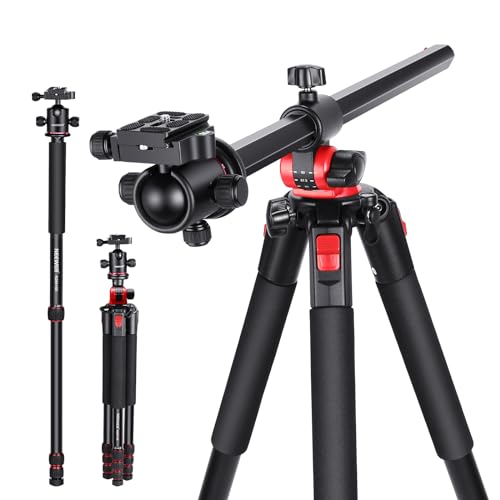
The NEWEER 72-Inch Camera Tripod with Monopod and Ball Head stands out as a versatile choice for astrophotographers who need stability and flexibility. Made from durable aluminum alloy, it supports cameras up to 33 pounds and includes a carabiner to hang heavy objects for extra stability. Its four-section legs extend up to 72 inches and can be adjusted or removed for monopod use. The multi-angle center column allows precise vertical and horizontal adjustments, while the panoramic ball head offers smooth movement with three knobs and quick-release plate. This setup is compatible with most DSLR cameras and camcorders, making it an excellent all-in-one solution for astrophotography.
Best For: amateur and professional photographers and videographers seeking a versatile, stable tripod suitable for both macro and astrophotography.
Pros:
- Durable aluminum alloy construction supports up to 33 lb/15 kg, ensuring stability for heavy cameras.
- Multi-angle center column and panoramic ball head enable precise vertical and horizontal adjustments.
- Includes a carabiner for hanging additional weights, enhancing overall stability in challenging conditions.
Cons:
- The height may be less convenient for very tall users without additional extension accessories.
- Slightly heavier compared to lightweight tripods, which may impact portability.
- The complexity of multi-angle adjustments could require some familiarity for optimal use.
Sky Watcher Star Adventurer GTI Mount Kit

The Sky Watcher Star Adventurer GTI Mount Kit excels for astrophotographers seeking a lightweight, portable tracking solution with full GoTo capabilities. Its compact design, weighing around 15 pounds, makes it easy to carry into remote locations. The built-in Wi-Fi, illuminated polar scope, and compatibility with Sky-Watcher’s SynScan app provide straightforward setup and precise alignment. Supporting multiple tracking rates and up to 11 pounds of payload, it’s perfect for DSLR, mirrorless, or small telescopes. While some users report minor app glitches and quality issues, overall, the GTI offers reliable tracking and user-friendly features, making it a solid choice for both beginners and enthusiasts on the go.
Best For: amateur astrophotographers and enthusiasts seeking a portable, feature-rich mount for wide-field and small telescope astrophotography.
Pros:
- Lightweight and portable design weighing around 15 pounds, ideal for remote setups
- Built-in Wi-Fi and smartphone compatibility with SynScan app for easy control and alignment
- Supports multiple tracking rates and up to 11 pounds payload, suitable for DSLR, mirrorless, and small telescopes
Cons:
- Occasional issues with app glitches and mechanical defects in some units
- Polar scope LEDs and other accessory quality components may be low quality or malfunctioning
- GoTo accuracy relies on basic star calibration and may not be highly precise without fine adjustments
EQ6 Tripod to Wave Steel by Sky-Watcher

If you’re seeking a sturdy tripod that can support larger optical tubes and Wave Mounts with minimal vibrations, the EQ6 Tripod to Wave Steel by Sky-Watcher is an excellent choice. Made from 2-inch rolled steel legs, it offers exceptional stability, ensuring steady tracking and clear images. Designed mainly for Sky-Watcher Wave mounts, it’s also compatible with NEQ6, EQ6, EQ6-R, and AZ-EQ6 mounts when paired with the Wave Pier Adapter. Its sleek black finish looks professional, and its dimensions (36.4 x 11.4 x 11.1 inches) make it suitable for serious astrophotography setups. It’s a reliable, high-performance support solution for demanding observational work.
Best For: astronomers and astrophotographers seeking a stable, durable tripod capable of supporting large optical tubes and Wave Mounts for precise observations and imaging.
Pros:
- Constructed with 2-inch rolled steel legs for maximum stability and minimal vibrations
- Compatible with multiple mounts including NEQ6, EQ6, EQ6-R, and AZ-EQ6 when used with the Wave Pier Adapter
- Sleek black finish and professional design suitable for serious observational setups
Cons:
- Heavier weight at 21.3 pounds, which may be less portable for travel
- Requires an additional adapter (Wave Pier Adapter S30916) for Wave Mount compatibility, adding to setup complexity
- Dimensions (36.4 x 11.4 x 11.1 inches) may be bulky for limited space or compact storage
Vortex Optics Mountain Pass Tripod Kit
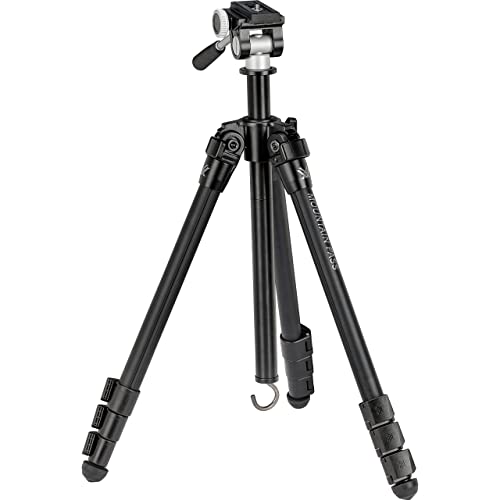
For outdoor enthusiasts seeking a reliable and portable tripod, the Vortex Optics Mountain Pass Tripod Kit stands out with its Arca-Swiss compatible quick-release system. It offers a compact, sturdy design that balances packability with durability, making it perfect for various terrains. The adjustable, telescoping legs lock quickly with flip levers, ensuring stability on uneven ground. Its two-way pan and tilt head allow smooth, precise movements, ideal for tracking celestial objects or wildlife. Built from machined aluminum, it supports up to 22 pounds, accommodating larger optics. Plus, the unlimited warranty gives peace of mind, making it a versatile choice for outdoor and astrophotography adventures.
Best For: outdoor enthusiasts, birdwatchers, and wildlife observers seeking a durable, portable tripod for wildlife viewing, telescopic observing, or astrophotography.
Pros:
- Compact, lightweight design made from machined aluminum for durability and portability
- Features an Arca-Swiss compatible quick-release system for easy mounting and switching devices
- Adjustable, telescoping legs with quick flip levers for quick setup on uneven terrain
Cons:
- Supports a maximum load of 22 pounds, which may limit use with very large or heavy optics
- Two-way pan and tilt head might not offer advanced control for professional photographers
- Limited information on included accessories or carrying case for enhanced transport convenience
NEEWER Basic 74 Video Tripod Monopod with Phone Holder

Ideal for photographers on a budget, the NEEWER Basic 74 Video Tripod Monopod with Phone Holder offers essential stability and versatility without breaking the bank. Made from durable aluminum alloy, it supports cameras and smartphones up to 8kg, making it suitable for various devices. Its adjustable height from 60cm to nearly 1.9 meters, combined with a 3-way pan tilt head and bubble level, ensures precise framing. The tripod folds compactly for easy transport and includes a built-in handle and carrying bag. Plus, it functions as a monopod and offers flexible mounting options, including a horizontal central axis, perfect for creative shots or astrophotography.
Best For: budget-conscious photographers and videographers seeking a versatile, portable tripod and monopod solution for smartphones and cameras.
Pros:
- Durable aluminum alloy construction supports devices up to 8kg for reliable stability.
- Adjustable height range from 60cm to nearly 1.9 meters provides versatile shooting angles.
- Includes a 3-way pan tilt head, bubble level, and detachable monopod feature for creative flexibility.
Cons:
- Adapter for action cameras is not included, limiting compatibility out of the box.
- The phone holder accommodates devices up to 4.1 inches in width, which may exclude some larger smartphones.
- Lacks advanced features like motorized controls or extensive customization options for professional use.
Factors to Consider When Choosing Tripods and Pier Mounts for Astrophotography

When selecting a tripod or pier mount for astrophotography, I focus on stability and vibration control to keep my images sharp. I also consider the payload capacity to guarantee it can support my equipment without strain, along with portability for easy setup. Ultimately, I check adjustability and compatibility to match my gear and shooting needs effectively.
Stability and Vibration Control
A stable tripod or pier mount is essential in astrophotography because even tiny vibrations can blur long-exposure images. To achieve that stability, materials like steel or machined aluminum are ideal, offering better rigidity and damping than plastic or hollow aluminum legs. Proper weight distribution and adding counterweights help minimize vibrations caused by movement or wind during imaging sessions. Enhancing vibration control with damping pads, lockable leg clamps, or vibration-absorbing pads placed beneath the mount can make a significant difference. The design of the mount itself also matters—rigid joints and minimal flexure points ensure stability. By prioritizing these factors, you’ll capture sharper, clearer images and make the most of your astrophotography sessions.
Payload Capacity Limits
Choosing a tripod or pier mount with an adequate payload capacity is essential because exceeding its limits can compromise stability and image quality. If you overload your mount, vibrations increase, tracking becomes inaccurate, and your equipment risks damage. To avoid this, always confirm the mount’s maximum capacity surpasses the total weight of your astrophotography setup, including the camera, telescope, counterweights, and accessories. Higher payload capacities generally offer better stability but tend to be heavier and less portable. It’s also important to verify the manufacturer’s specified capacity and steer clear of using mounts at or near that limit. Staying within safe payload limits helps maintain superior performance, prolongs the mount’s lifespan, and ensures sharper, more reliable astrophotography results.
Portability and Weight
Lightweight tripods and pier mounts are popular choices for astrophotographers who need to transport their gear to remote locations. They’re easier to carry and quick to set up, making them ideal for field work. However, lighter models, typically under 10 pounds, might need additional stabilizers like weights or sandbags to combat wind and ground vibrations. While reducing weight improves portability, it can also impact rigidity—overly light materials may flex or wobble during long exposures, impacting image sharpness. It’s crucial to find a balance between portability and stability, ensuring the tripod or pier is manageable to carry yet sturdy enough to support your gear securely. Always consider your carrying capacity and the mount’s weight limits for safe, stable operation in the field.
Adjustability and Flexibility
When selecting a tripod or pier mount for astrophotography, the ability to adjust height and angle is indispensable for achieving ideal positioning. Adjustable legs and center columns let me fine-tune my setup for superior framing and stability. Flexible mounts often feature multi-angle or reversible center columns, which help me adapt quickly to different terrains and shooting orientations. Smooth locking and loosening mechanisms are critical because they allow me to reposition my gear easily without sacrificing stability. Incorporating bubble levels and calibration tools ensures proper leveling and alignment, essential for long-exposure shots. Quick-release plates and adjustable tightening systems simplify setup and adjustments, enabling me to change equipment orientation or focal length swiftly. Overall, excellent adjustability and flexibility make a significant difference in capturing sharp, well-composed astrophotos.
Compatibility With Equipment
Selecting a tripod or pier mount that matches my equipment’s specifications is vital for stable and effective astrophotography. I need to verify the mounting holes or screw sizes, like 3/8-16 or 1/4-20 threads, fit my telescope or camera mounts. It’s also important that the platform supports the weight and size of all my gear to avoid instability during long exposures. If I use dovetails, I must check compatibility with Vixen, Losmandy, or Arca-Swiss systems. Additionally, I look for attachment points for guiding systems, autoguiders, and accessories. Checking the maximum payload capacity guarantees my gear is securely attached and balanced, which is essential for maintaining precise tracking and capturing clear astrophotos. Compatibility is key to a smooth, frustration-free session.
Build Quality and Durability
Choosing a tripod or pier mount with solid build quality is essential for reliable astrophotography, especially during long exposures. High-quality materials like aluminum, steel, or machined aluminum boost durability and resist wear from environmental factors. Sturdy construction with reinforced joints and thick, non-flexing legs ensures stability and minimizes vibrations that can blur images. Precise manufacturing and tight tolerances reduce wobble and help maintain alignment over time. Weather-resistant coatings and corrosion-proof components extend the lifespan of outdoor gear exposed to moisture, dust, and temperature changes. Additionally, well-designed locking mechanisms and high-grade hardware secure equipment firmly, preventing slippage under varying loads. Investing in durable, well-built tripods and pier mounts guarantees consistent performance and peace of mind during those critical astrophotography sessions.
Ease of Setup
Ease of setup is essential because astrophotography often involves working in dark, outdoor environments where time and patience are limited. A tripod or pier mount with quick-release plates and adjustable legs makes assembly faster and leveling more precise, saving valuable time. Built-in bubble levels and user-friendly pan-and-tilt heads help streamline initial positioning and alignment, reducing frustration. Lightweight, portable designs allow me to transport and set up gear quickly at different sites without sacrificing stability. Clear instructions, minimal parts, and intuitive locking mechanisms cut down setup time and prevent user error. Additionally, compatibility with automated or motorized tracking systems simplifies adjustments, making the entire setup process more straightforward and efficient, especially in challenging conditions.
Frequently Asked Questions
How Does Weather Resistance Impact Tripod Durability for Astrophotography?
Weather resistance substantially boosts a tripod’s durability for astrophotography. I’ve learned that tripods exposed to rain, snow, or dust need protective features like waterproof coatings or sealed joints to prevent corrosion and wear. When I choose a tripod, I prioritize weatherproof materials because they guarantee my gear stays reliable over time, even in tough conditions. This resilience helps me capture clear images without worrying about equipment damage.
What Is the Ideal Weight Capacity for Astrophotography Tripods?
I believe a tripod with at least 20 pounds (9 kg) of weight capacity is ideal for astrophotography. This guarantees stability when using heavy cameras and long lenses, preventing vibrations that ruin images. A sturdy tripod builds confidence, allowing me to focus on capturing the night sky without worrying about wobbling or tipping over. Trust me, investing in the right weight capacity makes all the difference in achieving sharp, stunning astrophotos.
How Does Vibration Reduction Technology Improve Astrophotography Images?
Vibration reduction technology really helps improve my astrophotography images by minimizing camera shake during long exposures. It stabilizes the camera, allowing me to capture sharper, clearer stars and celestial details. Without it, even tiny movements can blur images, especially at high magnifications. This tech makes a noticeable difference, giving me confidence to shoot longer exposures without worrying about vibrations ruining my shots.
Can Portable Tripods Support Heavy Telescope Equipment Safely?
Absolutely, portable tripods can support heavy telescope equipment if you choose the right one. I always look for sturdy materials like aluminum or carbon fiber, and check the weight capacity carefully. It’s vital to verify that the tripod’s legs are robust and stable, especially on uneven terrain. When properly selected, a quality portable tripod provides secure support, allowing me to capture sharp, clear astrophotography images without worrying about stability.
Are There Specific Maintenance Tips to Extend Tripod Lifespan?
Yes, there are specific maintenance tips to extend your tripod’s lifespan. I recommend regularly cleaning the legs with a damp cloth to remove dirt and dust, especially after outdoor use. Lubricate moving parts with a light oil to guarantee smooth operation, and check for loose screws or bolts monthly. Storing your tripod in a cool, dry place also prevents corrosion and damage, keeping it reliable for years to come.
Conclusion
Choosing the right tripod or pier mount can truly elevate your astrophotography game. Did you know that over 60% of successful astrophotographers invest in sturdy, precision mounts? It’s worth the investment, as stability directly impacts image quality. Whether you’re a beginner or pro, selecting the right gear makes all the difference. So, explore these top picks and find the perfect setup to capture the cosmos with clarity and confidence.