Based on the latest reviews, the SVBONY SV605CC and the Astromania SGCMOS series stand out as the top cooled CMOS astro cameras for deep sky imaging in 2025. The SV605CC offers high resolution and good cooling efficiency, making it great for detailed shots. The Astromania model provides versatile imaging features and reliable cooling, ideal for long exposures. If you’re curious about which one suits your setup best, there’s more to learn ahead.
Key Takeaways
- The SVBONY SV605CC offers high-resolution imaging with 9MP CMOS sensor, 80% QE, and effective cooling for detailed deep sky captures.
- The Astromania SGCMOS features versatile auto-guiding, long exposure support, and robust thermal stability suitable for advanced astrophotography.
- Both models provide broad OS compatibility, remote control, and essential accessories, ensuring ease of use and adaptability.
- Cooling efficiency, including TEC or dual-stage systems, significantly reduces thermal noise, enhancing faint object detection.
- Sensor sensitivity, pixel size, and cooling performance are critical factors influencing image quality and depth in 2025 astrophotography.
SVBONY SV605CC Cooled Camera, 9MP CMOS Telescope Camera
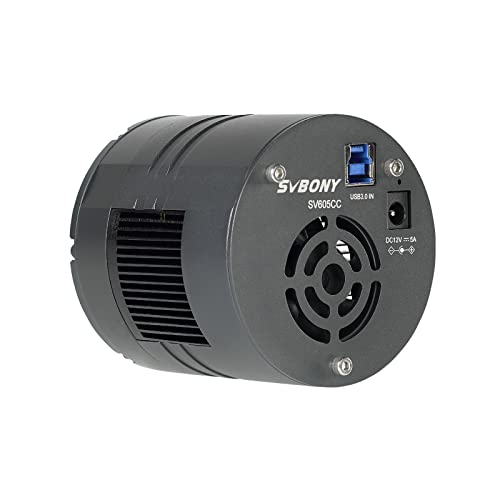

If you’re an amateur astronomer looking to capture detailed deep-sky images without breaking the bank, the SVBONY SV605CC cooled camera is an excellent choice. It features a 9MP CMOS sensor with a square IMX533 chip, offering 3008×3008 resolution and 80% quantum efficiency. The camera’s TEC cooling system reduces sensor temperature by 30°C, improving image quality, though cooling can sometimes be inconsistent. Its compatibility spans Windows, Linux, Mac OS, and Raspberry Pi, with Wi-Fi control and manual focus and zoom options. Many users praise its affordability and ease of use, making it a versatile tool for nebulae, galaxies, and planetary imaging.
Best For: amateur astronomers seeking an affordable, user-friendly cooled camera for deep-sky astrophotography and planetary imaging.
Pros:
- Affordable entry-level cooled camera with high-resolution 9MP CMOS sensor
- Compatible with multiple operating systems including Windows, Linux, Mac OS, and Raspberry Pi
- Includes essential accessories and Wi-Fi control for convenient operation
Cons:
- Inconsistent cooling performance and potential for high sensor noise
- Occasional frame drops and noisy fans can affect image quality and reliability
- Image quality may not match more expensive, professional-grade astrophotography cameras
Astromania SGCMOS Series Telescope CMOS Camera

The Astromania SGCMOS Series Telescope CMOS Camera is an excellent choice for astrophotographers seeking versatile imaging capabilities, from auto-guiding to detailed astrophotography. It features a high-sensitivity sensor, fast frame rate, and long exposure support, making it suitable for multiple imaging needs. Its aluminum CNC housing guarantees thermal stability, while the 1.25-inch outer interface and C-mount inner thread provide compatibility with eyepieces and industrial lenses. With a built-in ST4 guider port, native/ASCOM drivers, and included accessories like filters and cables, this camera integrates seamlessly into most setups, offering reliable performance for both beginner and advanced astrophotographers.
Best For: amateur and professional astrophotographers seeking a versatile CMOS camera for auto-guiding, long-exposure astrophotography, and multicolor imaging that integrates seamlessly with existing setups.
Pros:
- High-sensitivity sensor and fast frame rate enable high-quality imaging and auto-guiding
- Durable aluminum CNC housing ensures thermal stability during extended use
- Compatible with standard C-mount lenses and 1.25-inch filters for versatile imaging options
Cons:
- May require additional adapters for compatibility with certain telescope models
- Software setup and driver installation can be complex for beginners
- Limited to USB 2.0 connectivity, which might be slower compared to newer standards
Factors to Consider When Choosing Cooled CMOS Astro Cameras for Deep Sky Imaging

When selecting a cooled CMOS astro camera, I focus on factors like cooling efficiency, sensor resolution, and sensitivity to guarantee clear, detailed images. Compatibility with my setup and the software options also matter to streamline the imaging process, while noise levels directly impact image quality. Considering these points helps me choose a camera that best fits my deep sky imaging needs.
Cooling Efficiency and Performance
Achieving peak cooling efficiency is crucial for deep sky imaging with CMOS astro cameras, as it directly impacts image quality by reducing thermal noise. Typically, effective cooling lowers sensor temperature by 20°C to 40°C below ambient, markedly decreasing dark current and residual glow. However, performance can vary due to factors like ambient temperature fluctuations, condensation risks, and the limitations of TEC or Peltier modules. High cooling efficiency requires proper thermal management and insulation to maintain stable temperatures. Some advanced models feature dual-stage TECs or secondary refrigeration, enabling lower, more stable sensor temperatures for better long-exposure results. Ultimately, cooling performance influences noise levels, making calibration and post-processing essential to extract the best possible images from your deep sky shots.
Sensor Resolution and Sensitivity
Choosing the right cooled CMOS astro camera involves considering both sensor resolution and sensitivity, as these factors directly affect image quality. Higher resolution, like 9MP or more, enables capturing more detailed images of deep sky objects, revealing finer structures. Sensor sensitivity, often indicated by quantum efficiency around 80%, determines how well the camera captures faint signals from distant celestial bodies. Larger sensors, such as 1-inch or square formats, offer wider fields of view and better light collection, essential for deep sky imaging. Pixel size, typically around 3.7 μm, impacts the camera’s ability to resolve fine details and influences noise levels. Additionally, long exposure capabilities and low read noise are crucial for detecting faint objects and achieving high-quality, detailed astrophotographs.
Compatibility and Connectivity
Selecting a cooled CMOS astro camera that seamlessly integrates with your existing setup requires careful attention to compatibility and connectivity options. First, confirm the camera supports your preferred operating system—Windows, Linux, Mac OS, or Chrome OS—to avoid driver issues. Check if it offers standard connectivity options like USB 2.0, USB-C, or Wi-Fi for reliable data transfer and remote operation. Auto-guiding ports, such as ST4, are essential for smooth integration with guiding telescopes and software. Compatibility with popular astrophotography platforms like ASCOM, INDI, or WDM ensures seamless control. Lastly, verify that the camera includes necessary adapters and interfaces, such as C-mount or 1.25-inch, to connect with your telescope or lens system effortlessly. Compatibility and connectivity are crucial for a hassle-free imaging experience.
Software and Control Options
When it comes to integrating cooled CMOS astro cameras into your deep sky imaging setup, the software and control options play a vital role in guaranteeing smooth operation. Many cameras support multiple interfaces like ASCOM, INDI, and proprietary software, making them compatible with a variety of planetarium and astrophotography programs. Dedicated software often includes live preview, image capture, dark frame subtraction, and adjustments for gain, exposure, and cooling. Compatibility with popular tools such as SharpCap, AstroImager, and BackyardEOS helps streamline workflows and enhances image processing. Some cameras also offer remote control via Wi-Fi or network connections, enabling automation and remote operation during long sessions. Regular driver updates and software improvements are essential to maintain performance and guarantee compatibility with evolving operating systems and applications.
Noise and Image Quality
Cooled CMOS astro cameras substantially enhance image quality by reducing thermal noise, which is crucial for capturing faint deep sky objects. Lowering sensor temperature during long exposures minimizes residual noise, revealing more detail and clarity. The level of cooling, measured in degrees Celsius below ambient, directly influences residual noise levels—more cooling generally means cleaner images. High-quality CMOS sensors with higher quantum efficiency and low read noise further improve image sharpness and detail. However, excessive noise can still occur, requiring calibration frames like darks and flats to achieve ideal results. Cooling system performance varies, and inconsistent cooling can cause fluctuating noise levels, impacting overall image quality. Careful consideration of cooling efficiency and sensor characteristics is essential for capturing stunning deep sky images.
Frequently Asked Questions
How Do Cooled CMOS Cameras Compare to CCD Cameras in Astrophotography?
Cooled CMOS cameras often outperform CCDs in astrophotography today because they offer faster readout speeds, lower power consumption, and are more compact. I find them more versatile for capturing deep-sky objects, especially with their improved sensitivity and noise reduction. While CCDs still excel in certain high-end applications, for most amateur astronomers like myself, cooled CMOS cameras provide excellent image quality and easier operation at a more affordable price.
What Maintenance Is Required for Cooled CMOS Astrophotography Cameras?
I regularly clean my cooled CMOS camera’s sensor and lens to keep images sharp. I also check the cooling system for proper operation and verify the camera’s firmware is up to date. It’s important to keep the camera dry and store it in a dust-free environment when not in use. Periodic calibration, like dark frame subtraction, helps maintain peak performance and image quality over time.
Can Cooled CMOS Cameras Be Used for Planetary Imaging?
Cooled CMOS cameras are fantastic for planetary imaging—they can capture incredible detail that seems almost magical. I’ve used them to photograph planets with stunning clarity, thanks to their low noise and high sensitivity. While they excel at deep sky work, their fast readout speeds and high frame rates make them ideal for capturing fleeting planetary details. So yes, cooled CMOS cameras are definitely a great choice for planetary imaging!
What Is the Typical Lifespan of a Cooled CMOS Sensor?
The typical lifespan of a cooled CMOS sensor is about 5 to 10 years, depending on usage and operating conditions. I’ve found that with proper care, such as avoiding excessive heat and keeping the sensor clean, it can last toward the higher end of that range. Regular maintenance and gentle handling help guarantee your camera stays in good shape, capturing clear images for years to come.
Are There Specific Software Requirements for Processing Cooled CMOS Astrophotography Images?
Absolutely, you need specific software to unbolt the full potential of cooled CMOS astrophotography images. I’ve found that advanced processing tools like DeepSkyStacker, PixInsight, and Adobe Photoshop are essential—they handle calibration, stacking, and enhancement like magic. These programs are designed to manage the massive data sets from cooled CMOS sensors, transforming raw captures into stunning, detailed images. Without them, your astrophotography efforts would be like trying to paint the night sky with a broom!
Conclusion
After reviewing these top cooled CMOS astro cameras for 2025, I’m impressed by how much technology has advanced—did you know that modern cameras can reduce noise by up to 90%? Whether you’re after high resolution or excellent cooling efficiency, both the SVBONY SV605CC and Astromania SGCMOS series stand out. Choosing the right camera really depends on your specific deep sky goals, but either way, you’ll be capturing stunning images with ease. Happy stargazing!