
If you’re looking for the best 130mm triplet APO refractors for stellar astrophotography in 2025, I recommend models like the Explore Scientific ED102 and FCD100 series, Askar 120APO, and SVBONY SV550 with field flattener. These offer excellent optical quality, minimal chromatic aberration, and portability. Their focal lengths and high-precision features make them perfect for capturing stunning deep-sky and planetary images. Keep exploring to find out which one suits your needs best.
Key Takeaways
- High-quality 130mm triplet APOs with ED or FCD1 glass minimize chromatic aberrations for sharp, true-color astrophotos.
- Focal ratios around f/6 to f/7.5 provide ideal balance between brightness and detail for astrophotography.
- Lightweight, portable designs with carbon fiber or aluminum construction enhance ease of transport and field use.
- Advanced focusing mechanisms and accessory compatibility support precise, long-exposure imaging sessions.
- Top optical features like multi-layer coatings and air-spaced triplet designs ensure maximum contrast and resolution.
Explore Scientific FCD100 Series 127mm f/7.5 Carbon Fiber Triplet ED APO Refractor Telescope
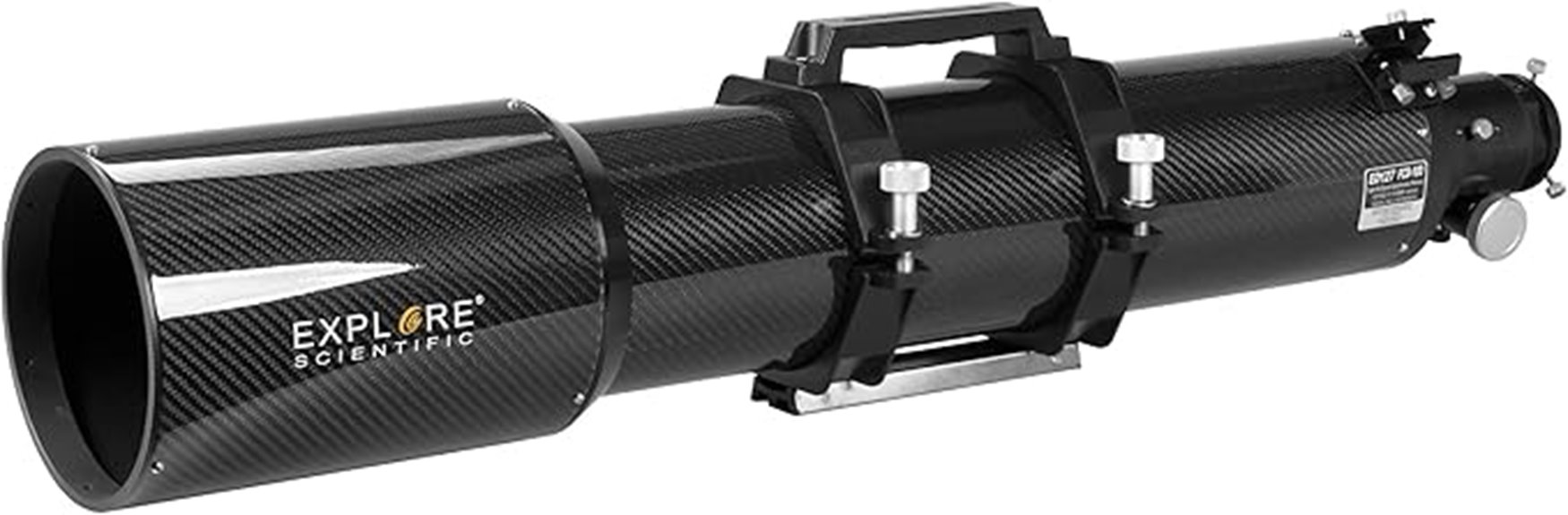
If you’re serious about astrophotography and need a lightweight yet high-performance refractor, the Explore Scientific FCD100 Series 127mm f/7.5 Carbon Fiber Triplet ED APO is an excellent choice. Its 127mm aperture and fast f/7.5 focal ratio deliver sharp, detailed images, while the carbon fiber construction keeps the weight down at just 14 pounds. The 2.5″ HEX focuser ensures smooth focusing, and its impressive resolution of 0.9 arcseconds allows you to capture fine details. With a limiting magnitude of 13, it’s capable of viewing faint celestial objects. This refractor combines portability with stellar imaging capabilities, making it perfect for serious astrophotographers on the go.
Best For: astrophotographers and amateur astronomers seeking a lightweight, high-performance refractor for detailed celestial imaging and observation.
Pros:
- Sharp, detailed images with a resolution of 0.9 arcseconds, ideal for astrophotography.
- Lightweight and portable at only 14 pounds, thanks to carbon fiber construction.
- Fast f/7.5 focal ratio and 127mm aperture allow for bright, high-quality views of faint objects.
Cons:
- Moderate customer ratings (2.3 out of 5 stars) suggest potential issues or limited user satisfaction.
- Higher price point compared to entry-level refractors, which may be a consideration for budget-conscious buyers.
- Limited online reviews make it harder to assess long-term performance and reliability.
Askar 120APO Telescope for Astrophotography and Viewing
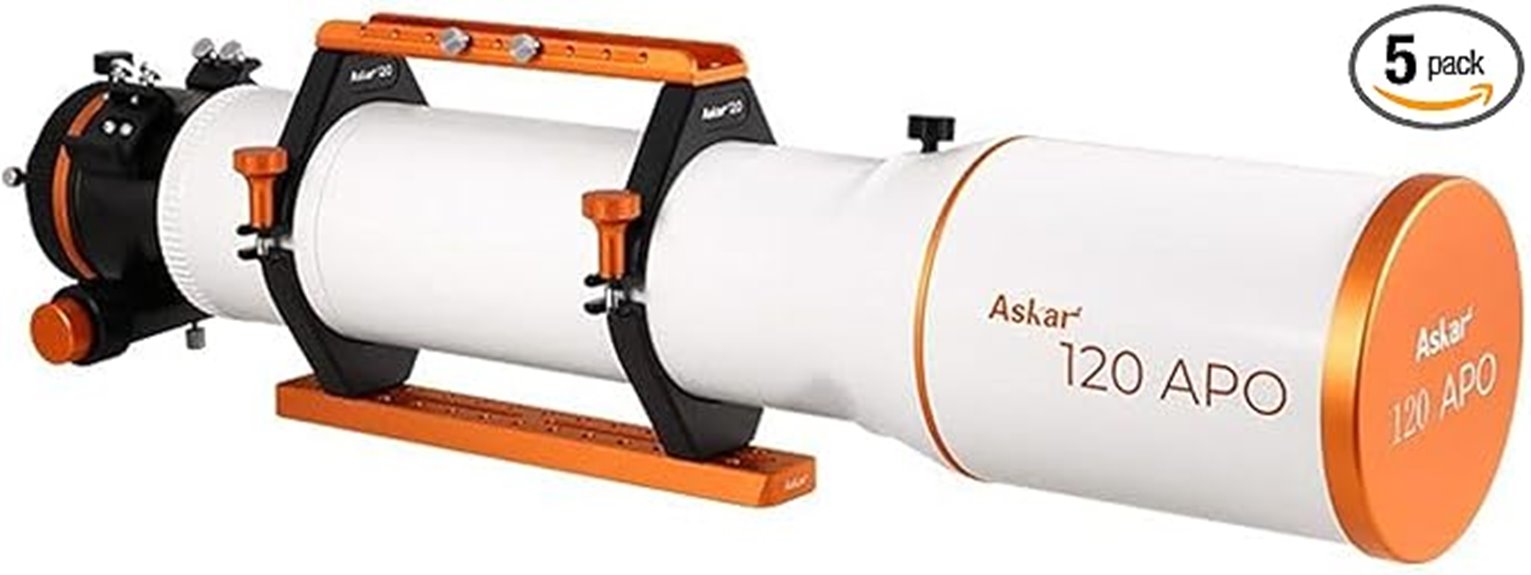
The Askar 120APO Telescope stands out as an excellent choice for astrophotographers seeking high-quality, portable optics. Its 120mm ED glass triplet APO lens delivers sharp, color-corrected images perfect for astrophotography and detailed viewing. With an F7 focal ratio and 840mm focal length, it offers great versatility for capturing deep-sky objects. The telescope weighs just 5.7kg, making it easy to transport, and includes a Vixen dovetail, handle, and protective case. Its air-spaced design guarantees excellent imaging quality, while the compact size makes setup quick and convenient. Overall, the Askar 120APO combines portability with professional-grade performance, ideal for serious astrophotographers.
Best For: serious astrophotographers and amateur astronomers seeking a portable, high-quality refractor telescope for astrophotography and detailed viewing.
Pros:
- High-quality triplet APO lens with ED glass ensures sharp, color-corrected images.
- Compact and lightweight design for easy transport and quick setup.
- Includes essential accessories like a Vixen dovetail, handle, and protective case for convenience.
Cons:
- Slightly higher price point compared to entry-level telescopes.
- Limited aperture size for extremely deep-sky object imaging without additional equipment.
- May require additional accessories (e.g., mounts, cameras) for full astrophotography capabilities.
Celestron Omni XLT 120 Refractor Telescope

Designed with amateur astronomers who value precise tracking and high-quality optics, the Celestron Omni XLT 120 Refractor Telescope offers a compelling choice for astrophotography enthusiasts. Its hand-selected optical glass and StarBright XLT fully multi-coated surfaces maximize light transmission for brighter, sharper images. The manual German equatorial mount features worm gear slow-motion controls and ball bearings on both axes, ensuring smooth, accurate movement. It comes with essential accessories like a finderscope, steel tripod, and a multicoated eyepiece. Plus, a free Starry Night software download helps plan observations. This telescope combines solid construction with reliable performance, making it a versatile tool for capturing stunning celestial shots.
Best For: Amateur astronomers and astrophotographers seeking precise tracking, high-quality optics, and versatile celestial imaging capabilities.
Pros:
- Hand-selected optical glass and StarBright XLT coatings ensure bright, sharp images.
- German equatorial mount with worm gear slow-motion controls provides accurate, smooth tracking.
- Comes with essential accessories and free software for planning and enhancing observations.
Cons:
- Relatively heavy and large, which may require a sturdy setup and storage space.
- Manual mount requires some skill to operate for precise tracking.
- Price may be higher compared to entry-level telescopes, potentially limiting accessibility for casual users.
Explore Scientific ED80 Triplet Refractor Telescope
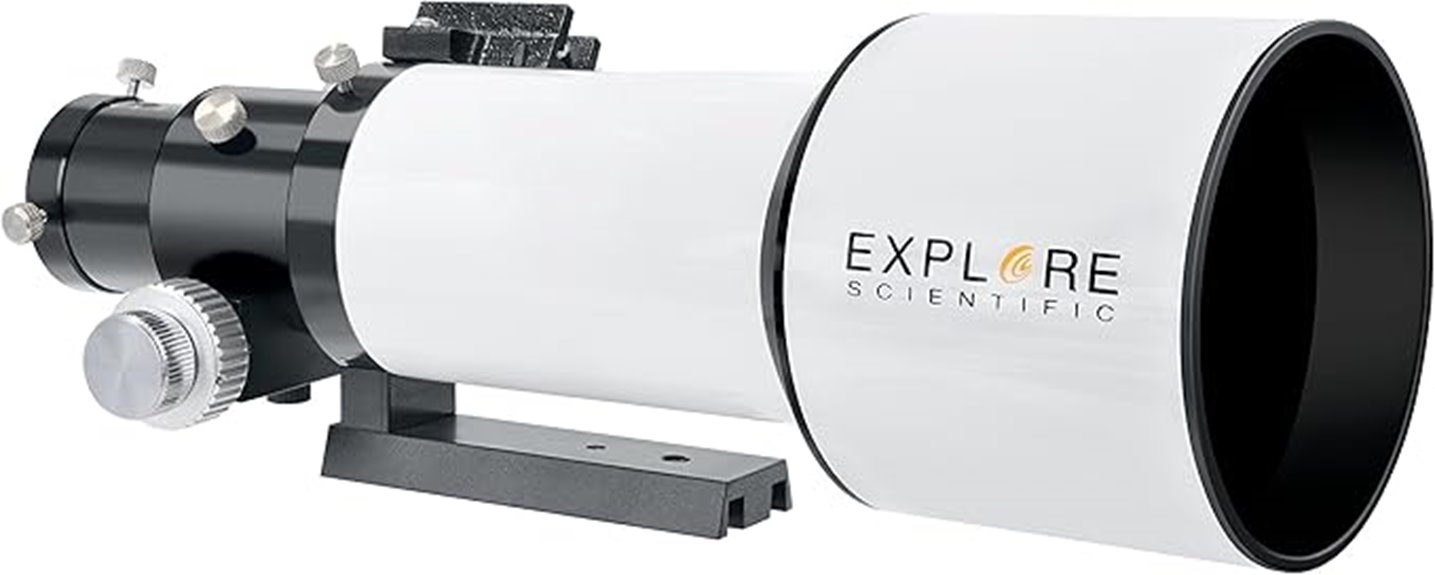
Looking for a portable yet high-performance astrophotography telescope? The Explore Scientific ED80 Triplet Refractor delivers exceptional clarity with its genuine FCD1 HOYA ED glass and multi-layer coatings, ensuring sharp, high-contrast images. Its air-spaced triplet design virtually eliminates chromatic aberration, making it perfect for capturing detailed views of the Moon, planets, nebulae, and star clusters. With an 80mm aperture and f/6 focal ratio, it offers great versatility. Compact at 480mm, it’s easy to transport, and the retractable dew shield adds convenience. Collimation is straightforward with push-pull adjustments, and reliable customer support from Springdale, Arkansas, backs up its quality.
Best For: amateur astronomers and astrophotographers seeking a portable, high-quality refractor telescope for detailed celestial imaging and visual observing.
Pros:
- Combines genuine FCD1 HOYA ED glass with multi-layer coatings for sharp, high-contrast images
- Virtually eliminates chromatic aberration thanks to air-spaced triplet design
- Compact and lightweight with a retractable dew shield for easy transport and setup
Cons:
- May require additional accessories like mounts or cameras for full astrophotography setup
- Slightly higher cost compared to entry-level refractors of similar size
- Limited aperture size may restrict deep-sky object brightness compared to larger telescopes
SVBONY SV550 Telescope with Field Flattener Bundle
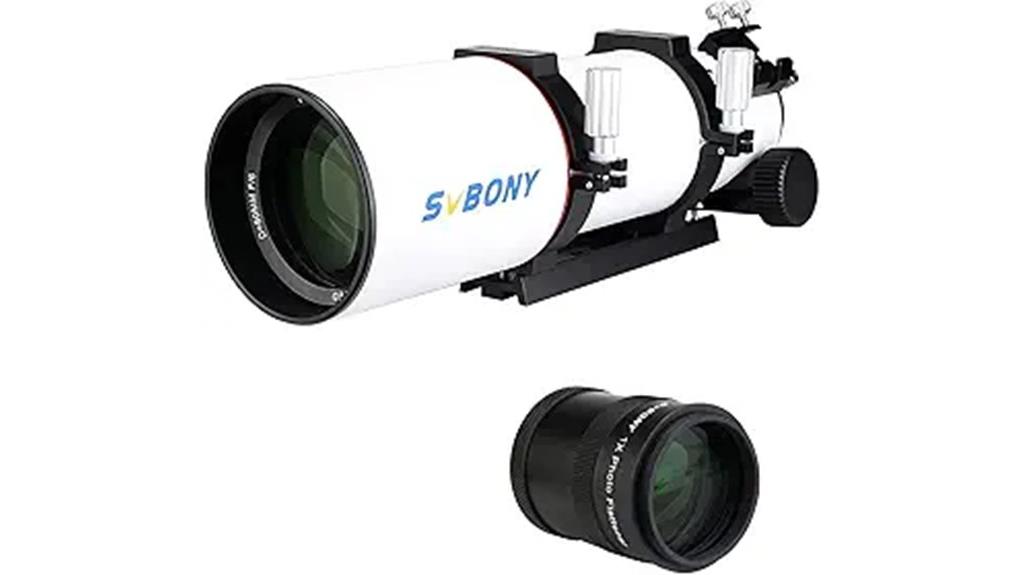
Are you seeking a reliable telescope that delivers sharp, flat-field images for deep sky astrophotography? The SVBONY SV550 Telescope with Field Flattener Bundle fits the bill perfectly. Its 80mm F6 APO triplet design minimizes aberrations, ensuring crisp images. The bundle includes the SV209 Field Flattener, which maintains a flat field suitable for both half-frame and full-frame cameras. Advanced internal light barriers reduce stray light, boosting contrast. Lightweight magnesium alloy focusing and a hollow dovetail plate make setup and handling easier. Overall, this setup offers excellent image quality, portability, and compatibility, making it a solid choice for serious deep sky astrophotographers.
Best For: amateur and advanced astrophotographers seeking a lightweight, high-quality telescope with flat-field imaging capability for deep sky astrophotography.
Pros:
- Minimizes optical aberrations with an 80mm F6 APO triplet design for sharp, detailed images
- Includes the SV209 Field Flattener compatible with both half-frame and full-frame cameras for versatile imaging
- Lightweight magnesium alloy focusing system and hollow dovetail plate enhance portability and ease of setup
Cons:
- May require additional accessories or adapters for certain camera models or mounting setups
- Slightly higher cost compared to entry-level telescopes with similar aperture
- Requires careful handling of internal light barriers to maintain maximum stray light suppression
SVBONY SV105 Telescope Camera, 1.25″ CMOS Astrophotography Camera
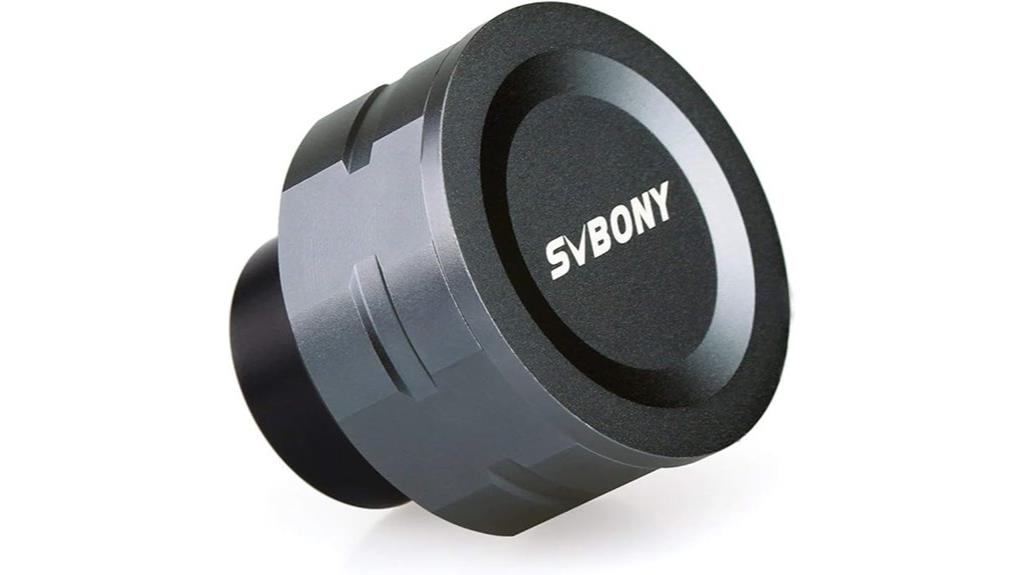
If you’re a beginner enthusiastic to explore astrophotography without the hassle of complicated equipment, the SVBONY SV105 Telescope Camera offers an excellent entry point. This 1.25-inch CMOS camera features a high-quality IMX307 sensor, capturing crisp 1080p videos at 30 fps and recording 2K footage with ease. It’s plug-and-play, compatible with Windows, Linux, and Android, making setup simple. Perfect for lunar and planetary imaging, it enhances low-light images with dark light compensation technology. Weighing just 9.6 ounces, it’s portable and easy to handle. With over 785 reviews averaging 4.2 stars, it’s a reliable, affordable choice for those starting their astrophotography journey.
Best For: beginners seeking an easy-to-use, portable astrophotography camera for lunar and planetary imaging without complex setup.
Pros:
- Plug-and-play compatibility with Windows, Linux, and Android, no drivers needed
- High-quality IMX307 sensor captures crisp 1080p videos at 30 fps and 2K footage
- Compact, lightweight design at 9.6 ounces makes it highly portable and easy to handle
Cons:
- Discontinued by the manufacturer, potentially limiting future support and updates
- Not compatible with iOS devices such as phones and tablets
- Limited to 1.25-inch threaded connections, which may restrict use with some larger telescopes
Explore Scientific ED102 Triplet Refractor Telescope

The Explore Scientific ED102 Triplet Refractor Telescope stands out as an excellent choice for astrophotographers seeking high-contrast, sharp images of celestial objects. Its 102mm aperture combined with genuine FCD1 HOYA ED glass and multi-layer coatings delivers exceptional detail and minimal chromatic aberration. Designed for portability, it features a 714mm focal length, retractable dew shield, and easy collimation adjustments, making setup quick and precise. Optimized for astrophotography, it produces stunning images of planets, nebulae, and star clusters. Backed by solid customer support and a reliable warranty, the ED102 is a versatile, high-performance instrument perfect for serious stargazers and astrophotographers alike.
Best For: astrophotographers and serious stargazers seeking high-contrast, sharp images of celestial objects with a portable and easy-to-use telescope.
Pros:
- Exceptional optical quality with genuine FCD1 HOYA ED glass and multi-layer coatings for minimal chromatic aberration
- Portable design with a retractable dew shield and secure handle, ideal for field use and quick setup
- Optimized for astrophotography, providing detailed, high-contrast images of planets, nebulae, and star clusters
Cons:
- Weighs 12 pounds, which may be less ideal for extended portability compared to smaller telescopes
- Requires precise collimation adjustments for optimal performance, which may be challenging for beginners
- Limited to a 102mm aperture, which might be less suitable for deep-sky imaging requiring larger apertures
SVBONY SV550 Triplet APO Telescope, 122mm F7 ED Glass

For astrophotographers seeking a portable yet high-performance telescope, the SVBONY SV550 Triplet APO with 122mm aperture and F7 ED glass stands out as an excellent choice. Its lightweight design, weighing just over 6.4 kg, makes it ideal for fieldwork and travel. The FPL-51 triplet lens provides exceptional correction of chromatic aberration, resulting in sharp, vibrant images. The dual-speed 2.5-inch focuser offers precise control, essential for detailed astrophotography. With an 854mm focal length, it captures deep-sky objects effectively. Overall, the SVBONY SV550 combines portability, optical quality, and versatility, making it a compelling option for both amateurs and experienced astrophotographers.
Best For: amateur and professional astrophotographers seeking a portable, high-quality refractor telescope for deep-sky imaging and observation.
Pros:
- High 122mm aperture for excellent light-gathering and detailed imaging
- Superior chromatic aberration correction with FPL-51 triplet ED glass
- Precise dual-speed 2.5-inch focuser for accurate focusing adjustments
Cons:
- Slightly heavier compared to smaller portable scopes, which may affect transport ease
- Higher price point relative to entry-level telescopes
- Requires careful handling and setup to maximize optical performance
Explore Scientific FCD100 Series 80mm Air-Spaced Apochromatic Triplet Refractor Telescope
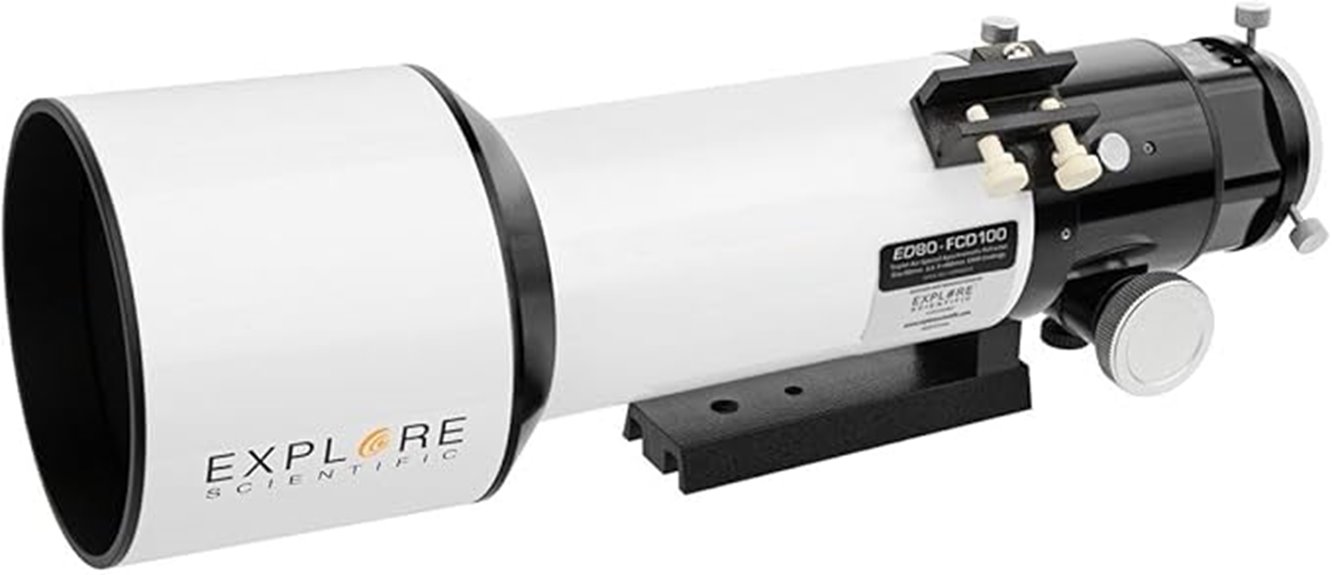
The Explore Scientific FCD100 Series 80mm Air-Spaced Apochromatic Triplet Refractor Telescope stands out as an excellent choice for amateur astronomers and astrophotographers seeking high-contrast, sharp images in a compact design. It uses genuine Hoya FCD100 ED glass and multi-layer coatings to deliver bright, detailed views while virtually eliminating chromatic aberration. With an 80mm aperture, 480mm focal length, and f/6 ratio, it offers great light-gathering power in a portable package. Features like an integrated dew shield, Vixen-style dovetail, and a high-quality 2.5-inch two-speed focuser make it a versatile, reliable option for capturing stunning astrophotos.
Best For: amateur astronomers and astrophotographers seeking a high-quality, portable apochromatic refractor for detailed celestial imaging and observation.
Pros:
- Virtually eliminates chromatic aberration due to air-spaced triplet design and ED glass
- Bright, high-contrast views with excellent light-gathering capacity in a compact form
- Features like a high-quality two-speed focuser and integrated dew shield enhance usability and image stability
Cons:
- Relatively lightweight build may require careful handling and additional stabilization for astrophotography
- Premium optical components and features may come with a higher price point
- Limited aperture size compared to larger telescopes, which might restrict some deep-sky observing capabilities
Explore Scientific FCD100 Series ED102 Refractor Telescope
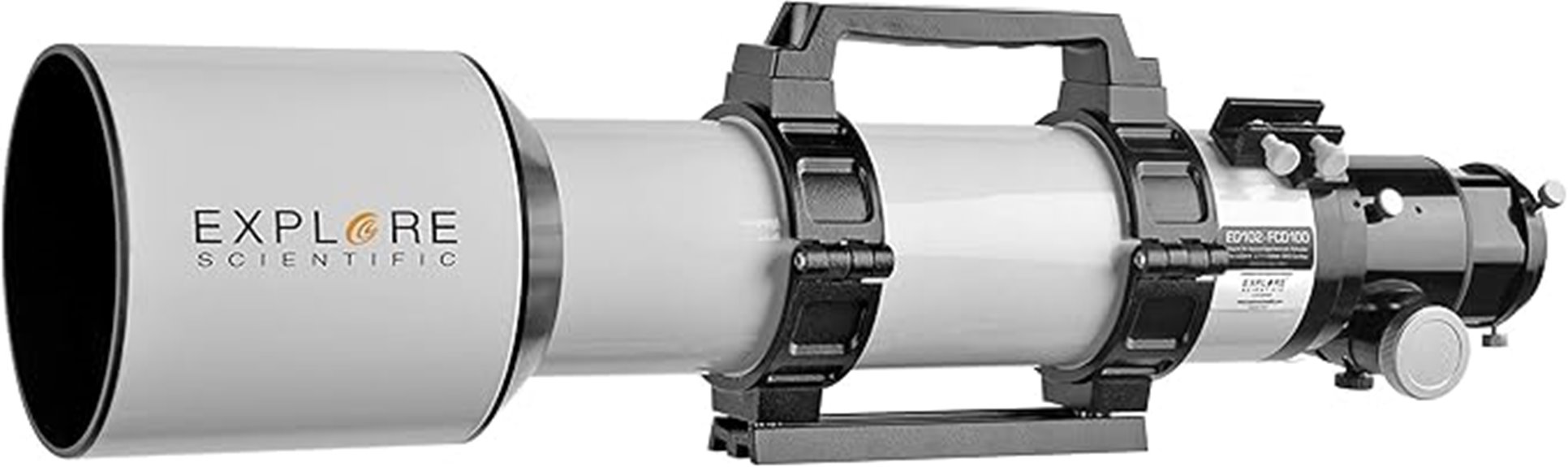
If you’re serious about astrophotography and want a telescope that delivers exceptional image clarity, the Explore Scientific FCD100 Series ED102 Refractor Telescope is an excellent choice. Its 102mm aperture and f/7 focal ratio provide sharp, detailed images with minimal chromatic aberration thanks to high-quality ED glass and advanced coatings. Weighing just under 11 pounds, it’s versatile and compatible with various mounts, making setup straightforward. The high-precision optics ensure stunning color accuracy and contrast, ideal for capturing deep-sky objects and planetary details. This telescope combines top-tier optical performance with portability, making it a favorite among astrophotographers seeking stellar results.
Best For: Serious astrophotographers and astronomy enthusiasts seeking high-quality, portable refractor telescopes with excellent chromatic aberration correction.
Pros:
- Exceptional image clarity with high-quality ED glass and advanced coatings
- Lightweight and versatile, weighing under 11 pounds for easy setup and transport
- Perfect for detailed deep-sky and planetary imaging with minimal chromatic aberration
Cons:
- As an OTA only, it requires additional mounts and accessories for complete setup
- Higher price point may be a barrier for casual users
- Limited to optical performance without included mounting hardware or accessories
Celestron StarSense Explorer DX 130AZ Telescope with Smartphone Dock for Beginners
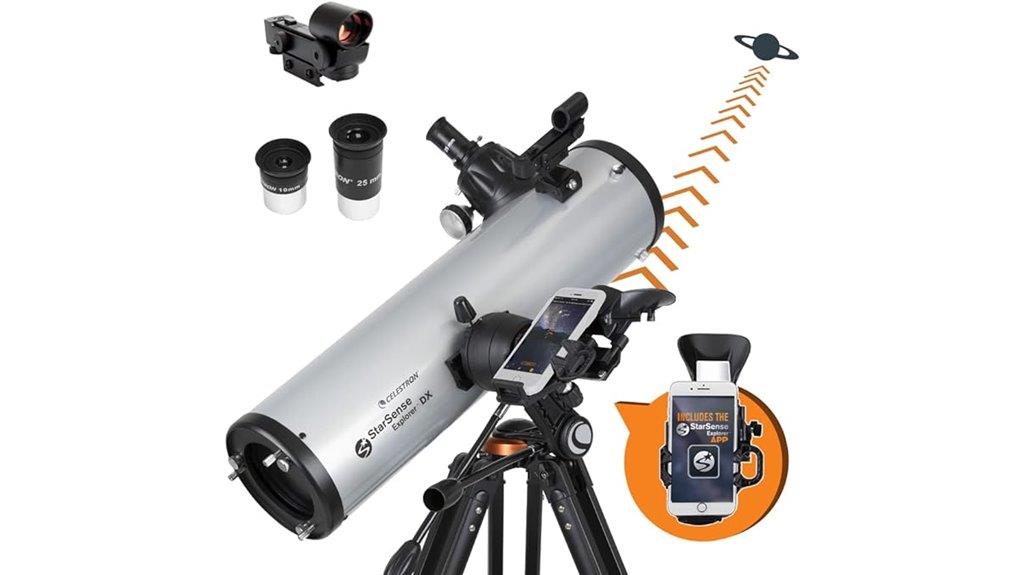
Looking for an easy-to-use telescope that makes celestial exploration accessible to beginners? The Celestron StarSense Explorer DX 130AZ fits the bill perfectly. It features a 130mm Newtonian reflector with high-reflectivity coatings, delivering bright, detailed views of the Moon, planets, and deep-sky objects like nebulae and galaxies. The telescope comes with two eyepieces, a red dot finderscope, a full-height tripod, and a smartphone dock. Its smart sky navigation technology uses StarSense and LISA to identify celestial objects and guide you via on-screen arrows, making setup and finding targets straightforward—even in light-polluted skies.
Best For: beginners and amateur astronomers seeking an easy-to-use, app-guided telescope for exploring the night sky with bright, detailed views.
Pros:
- User-friendly with smart sky navigation technology that simplifies celestial object location
- Includes essential accessories like two eyepieces, smartphone dock, and full-height tripod for versatile viewing options
- Bright 130mm Newtonian reflector delivers clear, detailed images of Moon, planets, and deep-sky objects
Cons:
- Manual mount requires some adjustment, which may be challenging for complete beginners
- Smartphone app dependency means functionality may be limited without a compatible device or proper setup
- Heavier and larger, making it less portable compared to more compact telescopes
Factors to Consider When Choosing 130MM Triplet APO Refractors for Astrophotography

When selecting a 130mm triplet APO refractor for astrophotography, I consider several key factors to guarantee I get the best results. Things like optical quality, focal length, size, mount compatibility, and focusing mechanisms all play an essential role. Understanding these points helps me choose a telescope that fits my needs and maximizes my imaging potential.
Optical Quality and Glass
Optical quality is the cornerstone of exceptional astrophotography with 130mm triplet APO refractors, and choosing the right glass is essential. High-grade ED or FCD1 glass minimizes chromatic aberration, ensuring sharp, true-to-color images. Genuine air-spaced triplet designs improve performance by preventing lens contact, reducing distortions, and enhancing contrast. Multi-layer coatings on all optical surfaces boost light transmission, cut reflections, and produce brighter, clearer images. The quality of optical glass and precision lens fabrication directly impact the resolving power, allowing for detailed views of planets and deep-sky objects. Superior optical components and meticulous assembly are critical for high-resolution astrophotography, especially under demanding conditions like high magnification and long exposures. Investing in quality optics makes a noticeable difference in your astrophotography results.
Focal Length and Ratio
Choosing the right focal length and ratio is essential for getting the most out of a 130mm triplet APO refractor in astrophotography. A longer focal length increases magnification and detail, ideal for planetary and small deep-sky objects. Typically, a focal length between 840mm and 1000mm offers a good balance, providing enough image scale without sacrificing field coverage. The focal ratio, calculated by dividing focal length by aperture, influences brightness and exposure time. A lower f/ratio (around f/6) delivers a wider field suitable for deep-sky imaging, while a higher ratio (f/7.5 or more) enhances planetary detail. Selecting the appropriate focal length and ratio ensures compatibility with your camera sensor and aligns with your astrophotography goals, whether wide-field or high-magnification imaging.
Portability and Size
Portability and size are essential factors when selecting a 130mm triplet APO refractor for astrophotography, especially if you plan to take it into the field or travel frequently. These telescopes typically weigh between 5.7 kg and 12 pounds, making them manageable for transport. Compact designs often feature retractable dew shields and shorter focal lengths, which simplify setup and packing. The optical tube length, usually around 480mm to 840mm, affects how easily you can carry and store the telescope. Using lightweight materials like carbon fiber or aluminum helps reduce weight without sacrificing optical quality. A smaller, more portable scope allows for quick assembly, maximizing observation and imaging time while minimizing effort during setup and breakdown.
Mount Compatibility
Selecting the right mount is vital because it directly impacts the stability and accuracy of your astrophotography setup. Make certain the mount’s load capacity exceeds the weight of your 130mm triplet APO refractor to guarantee stability during imaging sessions. Check that the mount’s attachment interface, like Vixen, Losmandy, or D-style dovetails, matches your telescope’s dovetail plate for secure fitting. Precise tracking and reliable GoTo capabilities are fundamental for capturing sharp images and reducing star trailing. Additionally, verify if the mount supports motorized or computerized control systems, which can be integrated with planetarium software for efficient object acquisition. Finally, confirm the mount’s polar alignment features are suitable for long exposures, minimizing tracking errors during extended imaging sessions.
Focusing Mechanisms
A high-quality focusing mechanism is essential for capturing sharp astrophotography images with your 130mm triplet APO refractor. I look for dual-speed (2.5-inch or 2.1-inch) rack-and-pinion focusers with 10:1 gear ratios, providing precise control. Smooth, fine-threaded focusers allow micro-adjustments, helping me achieve perfect focus during imaging sessions. Some models feature push-pull collimation adjustments on the front cell, which help maintain optical alignment. Advanced options include motorized or electronic focusers, enabling remote or automated focusing—crucial for long exposures. Equally important is the system’s stability and backlash management, as high-quality focusers minimize vibrations and guarantee repeatable, accurate focus adjustments. These features directly impact the clarity and detail of my astrophotography results.
Light Gathering Power
A 130mm triplet APO refractor captures considerably more light than smaller telescopes, making it ideal for deep-sky astrophotography. Its larger aperture substantially boosts the light collection capability, allowing me to see faint objects like distant galaxies and nebulae with greater detail. This increased light-gathering power raises the limiting magnitude, so I can observe dimmer stars and nebulae that smaller scopes simply can’t detect. Thanks to the optical design of a triplet APO, chromatic aberration is minimized, ensuring that the additional light results in clear, sharp, and true-color images. The combination of focal length and aperture in these telescopes strikes a perfect balance between brightness and resolution, enabling me to capture stunning astrophotos with remarkable detail and clarity.
Price and Warranty
When considering a 130mm triplet APO refractor for astrophotography, understanding the price range and warranty options can help you make a smarter investment. Prices vary widely depending on optical quality, brand, and included accessories, from affordable models to premium options. Many manufacturers offer warranties spanning 1 to 10 years, covering defects and optical issues. Longer or more detailed warranties can give you added peace of mind and protection against costly repairs or replacements. Some models even include warranty extensions or support packages, which can influence the overall cost. It’s vital to carefully verify warranty details—such as coverage scope, duration, and whether service is handled locally or internationally—to ensure you’re adequately protected and making a sound purchase.
Accessories and Support
Ensuring compatibility with various mounts and accessories is vital when selecting a 130mm triplet APO refractor for astrophotography, as it directly impacts your setup’s versatility and imaging potential. A well-supported telescope works seamlessly with different mounting options, including equatorial and alt-azimuth mounts, expanding your observational flexibility. Reliable customer support and warranty services are essential; they provide prompt assistance with repairs, technical issues, and maintenance, saving you time and frustration. Accessory options like field flatteners, focal reducers, and specialized adapters can greatly improve image quality and broaden observational capabilities. Additionally, clear documentation, user guides, and online resources help with setup, collimation, and troubleshooting. Dedicated support channels and replacement parts ensure your telescope remains in top condition for years of consistent astrophotography.
Frequently Asked Questions
How Does Triplet APO Compare to Doublet or Quadruplet Refractors?
Triplet APO refractors generally outperform doublets and quadruplets in astrophotography because they offer better color correction and sharper images. I’ve found that triplets reduce chromatic aberration more effectively, making them ideal for capturing fine details in deep-sky objects. While quadruplets can provide excellent performance, they tend to be more expensive and heavier, whereas doublets are more affordable but less precise. Overall, triplets strike a great balance of quality and value.
What Is the Ideal Mount Type for 130MM Triplet APO Refractors?
For my 130mm triplet APO refractor, I prefer an equatorial mount, specifically a sturdy German equatorial mount. It offers smooth tracking essential for astrophotography, especially long exposures. I look for one with a high payload capacity, precise slow-motion controls, and good balancing options. This setup helps me capture sharp, detailed astrophotos without star trails or drift, making my imaging sessions more successful and enjoyable.
How Important Is Lens Coating for Astrophotography Clarity?
Think of lens coatings as the secret sauce that transforms a good telescope into a stellar instrument. For astrophotography, coatings are vital—they cut down glare, reduce reflections, and boost contrast, revealing the universe’s intricate details. Without proper coatings, your images can look washed out or hazy. So yes, investing in high-quality lens coatings is essential for capturing crisp, clear, and breathtaking celestial shots.
Can These Refractors Capture Deep-Sky Objects Effectively?
Yes, these 130mm triplet APO refractors can effectively capture deep-sky objects. Their large aperture gathers plenty of light, revealing faint details in nebulae, galaxies, and star clusters. I’ve found that with proper tracking and exposure, these telescopes produce stunning images of deep-sky wonders. Their color correction and high-quality optics make them ideal for detailed astrophotography, allowing me to capture the universe’s beauty with remarkable clarity.
What Accessories Enhance Astrophotography With 130MM Triplet APOS?
Did you know that adding the right accessories can boost your astrophotography success rate by up to 50%? I recommend investing in a high-quality field flattener to guarantee sharp, pinpoint stars across the entire image. A sturdy mount and guiding system are also essential for long exposures. Don’t forget a good set of filters and a remote shutter release—they’ll help you capture cleaner, more detailed stellar shots.
Conclusion
Choosing the right 130mm triplet APO refractor is like finding the perfect brush for a masterpiece—essential for capturing stunning astrophotos. Whether you’re a seasoned astronomer or just starting out, each of these telescopes offers unique strengths to elevate your stargazing game. Remember, the right scope isn’t just about specs; it’s about how it sparks your curiosity and fuels your passion for the night sky. Happy shooting and clear skies ahead!