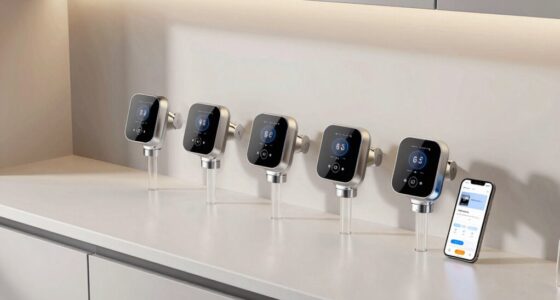
Finding the best energy monitor for EV charging circuits involves balancing accuracy, compatibility, and ease of integration. The Poniie PN2500 stands out for its reliability and Wi-Fi capabilities, making it ideal for detailed monitoring. The Emporia Vue 3 offers extensive circuit coverage for comprehensive insight, while the Refoss Smart Home Energy Monitor provides a flexible, open API platform for tech-savvy users. Tradeoffs often involve choosing between high precision and ease of use or affordability versus advanced features. Continue reading for a detailed breakdown of the best options for different needs and budgets.
Key Takeaways
- The best energy monitors for EV circuits combine high accuracy with ease of integration into smart home systems.
- Compatibility with existing home automation platforms, like Home Assistant or MQTT, is a key factor for tech-savvy users.
- Many top models offer extensive circuit coverage, which is ideal for multi-vehicle setups or detailed energy analysis.
- Price varies widely, with premium options offering more features but at a higher cost, while budget models focus on core functionality.
- Build quality and safety certifications are critical for reliable long-term use in high-current EV charging circuits.


More Details on Our Top Picks
Poniie PN2500 Professional NEMA 5-15 Wi-Fi Wireless Level 1 EV Charger Pass-Through Power Usage Monitor
This monitor stands out for its high accuracy (Class 1.0) and comprehensive metrics, including Watts, kWh, Power Factor, and Cost, making it suitable for detailed energy tracking. Compared with the Refoss Smart Home Energy Monitor, it offers Wi-Fi connectivity and app control without requiring external hubs, which appeals to tech-savvy users. The ability to monitor multiple appliances and forecast energy costs makes it ideal for homeowners aiming for precise energy management. However, this model’s Wi-Fi setup and app reliance may be complex for beginners, and its pass-through design limits installation flexibility in some setups. This pick is perfect for EV owners or advanced users seeking detailed, real-time data without extensive wiring.
Pros:- Class 1.0 high precision with 0.001A resolution
- Wide range of metrics including power, energy, and cost
- Wi-Fi app control for remote monitoring
Cons:- Setup can be complex for non-technical users
- Limited installation flexibility due to pass-through design
Best for: Homeowners who want precise, real-time energy monitoring with app control and detailed metrics.
Not ideal for: Beginners or users seeking simple plug-and-play solutions due to the setup complexity and app dependency.
- Voltage:60-240V
- Current:25Amp
- Connectivity:Wi-Fi
- App Compatibility:iOS and Android
- Accuracy:Class 1.0
- Resolution:0.001A
Bottom line: Ideal for tech-savvy users needing detailed energy data and remote control for EV charging circuits.
Refoss Smart Home Energy Monitor, Native Open API & Web UI (No Cloud Required), Real Time Electricity Usage Monitor, Power Consumption Meter Works with Home Assistant & MQTT, Solar Net Metering, ETL
This monitor excels in data privacy and local control, offering a built-in Web UI, Open API, and MQTT support, making it a top choice for users wary of cloud dependence. In comparison to the Emporia Vue 3, it provides full local access and supports extensive customization through open standards, ideal for advanced users integrating with Home Assistant or other automation platforms. Its ±1% accuracy across multiple circuits and long-term data storage up to 5 years make it suitable for detailed audits and solar energy management. The main tradeoff is that setup and configuration can be more technical, requiring familiarity with MQTT and API integrations. This monitor is best suited for DIY enthusiasts or property managers prioritizing data privacy and customization.
Pros:- Local control via Web UI, Open API, and MQTT
- Supports detailed circuit-level monitoring
- Long-term data storage (up to 5 years)
Cons:- Requires technical knowledge for setup
- No built-in cloud or app interface
Best for: Tech-savvy homeowners and property managers seeking privacy-focused, customizable energy monitoring.
Not ideal for: Users preferring plug-and-play solutions or with limited technical skills in network automation.
- Number of Circuits:up to 18 circuits
- Current Range:Up to 60A per circuit
- Data Storage:5 years
- Accuracy:±1%
- Connectivity:Web UI, Open API, MQTT
- Certification:ETL
Bottom line: Perfect for users who want comprehensive, private energy data integration with home automation systems.
This device delivers real-time power monitoring across 16 circuits with high accuracy (±1%), making it ideal for rental properties and shared apartments. Unlike the Emporia Vue 3, it emphasizes affordability while supporting extensive circuit-level monitoring and integration with Home Assistant. Its flexible installation supports single-phase and three-phase systems, with optional sensors for larger setups. The ability to track usage by circuit allows landlords to bill accurately or tenants to monitor their consumption. However, the setup process is more involved, requiring some familiarity with network configuration. Its focus on privacy and local control makes it appealing for shared housing. This model is best suited for landlords or tenants aiming for detailed, circuit-specific energy tracking without cloud reliance.
Pros:- Supports 16 circuits with 50A sensors
- High accuracy (±1%)
- Compatible with Home Assistant for automation
Cons:- Installation can be complex for novices
- Requires network setup knowledge
Best for: Rental property owners or tenants wanting accurate, circuit-specific energy monitoring without cloud dependence.
Not ideal for: Users seeking a simple, plug-and-play device or those with limited technical knowledge.
- Circuit Sensors:16 x 50A
- System Compatibility:Single-phase and three-phase
- Accuracy:±1%
- Connectivity:Home Assistant compatible
- Data Storage:Local, real-time
- Certification:ETL
Bottom line: A solid choice for landlords or tenants needing detailed circuit-level energy tracking in shared homes.
Emporia Vue 3 Home Energy Monitor – Smart Home Automation Module and Real Time Electricity Usage Monitor, Power Consumption Meter, Solar and Net Metering for UL Certified Safe Energy Monitoring
This monitor emphasizes UL safety certification (UL Listed) and robust energy management features, making it suitable for homeowners who prioritize safety alongside detailed energy insights. Compared to the Refoss EM16, it offers a user-friendly interface with screw terminals for easy installation and a focus on appliance-level monitoring, including solar and net metering. Its ±2% accuracy is suitable for most residential applications, and its 16 circuit sensors help track critical loads. The main tradeoff is that it requires Wi-Fi and internet access for full functionality, which might be a limitation for highly secure or offline setups. This product is best for users wanting reliable, UL-certified safety with broad automation support.
Pros:- UL Listed safety certification
- Supports solar and net metering
- Easy installation with screw terminals
Cons:- Requires Wi-Fi for full features
- Slightly lower accuracy (±2%) than some competitors
Best for: Homeowners seeking UL safety certification, reliable installation, and integration with smart home systems.
Not ideal for: Users who want private, local-only control without internet connectivity or cloud features.
- Number of Circuits:16
- Accuracy:±2%
- Monitoring Type:Whole home, solar, net metering
- Connectivity:Wi-Fi
- Certification:UL
- Installation:Screw terminals
Bottom line: Ideal for safety-conscious homeowners who want robust, certified energy monitoring integrated into smart home setups.
Refoss Smart Home Energy Monitor Real-Time Electricity Usage Monitor with 16x60A Circuit Sensor, Energy Meter, Local Data Storage with Open API & Web UI, Home Assistant, Solar Metering, ETL Certified
This monitor excels in privacy and customization, supporting local data access via Web UI, Open API, and MQTT, making it ideal for users with advanced automation needs. Unlike the Emporia Vue 3, it provides extensive circuit-level monitoring with a focus on local control, perfect for DIY enthusiasts and privacy-conscious users. Its ±1% accuracy and 5-year data storage are advantageous for long-term energy audits and solar management. The setup can be more technical, requiring familiarity with MQTT and network configuration, but the flexibility in data handling and automation is unmatched. This is the best choice for users prioritizing privacy, extensive customization, and local control over cloud dependence.
Pros:- Local Web UI, Open API, MQTT support
- Supports 18 circuits with high accuracy
- Long-term data storage (5 years)
Cons:- Complex setup for non-technical users
- Requires network configuration knowledge
Best for: DIY enthusiasts or privacy-focused users seeking extensive, circuit-level energy data with local control.
Not ideal for: Beginners or those wanting simple, out-of-the-box solutions with minimal setup.
- Number of Circuits:18
- Accuracy:±1%
- Data Storage:5 years
- Connectivity:Web UI, Open API, MQTT
- Certification:ETL
- Monitoring Type:Circuit-level, solar, net metering
Bottom line: Best suited for users who want detailed, private, and customizable energy monitoring with local data control.
Meross Smart Energy Consumption Monitor with 18 Circuit Monitoring, Electricity Usage Monitor, Real-Time Power Usage Monitor, Home Assistant Support, Smart Alerts, No Subscriptions, 2-Year Warranty
This model stands out for its comprehensive circuit monitoring capability, supporting up to 18 circuits including main panels and branch circuits, making it ideal for detailed energy insights. Unlike the Siemens Inhab, which primarily targets professional installations and offers extensive diagnostics, the Meross is designed for smart homeowners who want quick installation and local data privacy. Its easy clamp-on design and app interface provide a user-friendly experience, with real-time alerts and charts that help identify energy hogs. However, the setup can look cluttered due to the sensor wires, and it only supports circuits up to 60A per branch, which might be limiting for larger systems. This pick makes the most sense for solar households or those wanting detailed, circuit-specific data without cloud dependence.
Pros:- Supports up to 18 circuits, including main and branch panels
- Local data storage with no cloud or subscription fees
- Supports integration with Home Assistant for automation
Cons:- Cluttered wiring with 16 sensors can look messy
- Limited to 60A per branch circuit, less suitable for larger systems
Best for: Homeowners with solar setups or those needing detailed circuit-level insights without relying on cloud services
Not ideal for: Users with large, complex electrical systems exceeding 60A per circuit or those seeking a professional-grade installation
- Circuit support:Supports up to 18 circuits including main and branch
- Current capacity:Supports circuits up to 60A
- Monitoring type:Clamp-on CT sensors
- Data storage:Local, up to 5 years of data
- App support:Home Assistant integration
- Installation:Quick clamp-on, minimal tools
- Communication:Wi-Fi
- Warranty:2 years
Bottom line: This monitor is ideal for solar homeowners and tech-savvy users seeking circuit-level detail with privacy and automation support.
SIEMENS Inhab Smart Home Energy Monitor with 16-50Amp Circuit Level Sensors and 2-200Amp Main Sensors for Real Time Electricity Monitoring and Metering
The Siemens Inhab stands out for its professional installation and comprehensive panel integration, offering direct measurement at the main and circuit level, which makes it better suited for detailed analysis compared with the Meross. Unlike the Meross, which is more DIY-friendly and local-focused, the Inhab connects directly to the electrical panel, supporting up to 16 circuits and main sensors up to 200A, making it ideal for large homes or multi-circuit systems. Its advanced features include Time of Use, Peak Demand, and load shedding capabilities, appealing to users wanting more control. Still, this setup involves professional installation and may be overkill for small or simple homes. This pick makes the most sense for those needing enterprise-level accuracy and automation in a whole-home context.
Pros:- Measures energy directly at main and circuit levels with up to 16 circuits
- Supports high current sensors up to 200A
- Enables advanced energy management functions like demand response
Cons:- Requires professional installation, adding cost and complexity
- Designed mainly for panel mounting, less portable or flexible
Best for: Homeowners with large, complex electrical systems or those seeking integration with energy management and load shedding features
Not ideal for: DIY enthusiasts or small-scale setups where simplicity and ease of installation are priorities
- Circuit sensors:16-50A sensors, 2 main sensors up to 200A
- Monitoring type:Direct panel connection with CT sensors
- Data access:Cloud and mobile app
- Advanced features:Time of Use, Peak Demand, Load Shedding
- Installation:Professional panel mounting
- Compliance:CE and UL listed
- Supported functions:Real-time monitoring, demand management, solar net metering
- App support:Mobile app with detailed analytics
- Warranty:Not specified
Bottom line: This monitor is best suited for users who need detailed, whole-home energy data with automation and demand management capabilities.

How We Picked
In selecting these products, I prioritized accuracy, circuit capacity, ease of installation, and compatibility with popular smart home platforms. Reliability and safety certifications were also essential, given the high power levels involved in EV charging. I compared user reviews, feature set, and technical specifications to identify models that offer a good balance of value and performance. The ranking reflects how well each monitor addresses the needs of EV owners who want precise, real-time energy data while considering ease of use and affordability.Factors to Consider When Choosing Best Energy Monitor For Ev Charging Circuits
Choosing the best energy monitor for EV charging circuits requires considering several factors that affect both performance and usability. While features like Wi-Fi or open API are attractive, they need to align with your existing smart home setup. Understanding circuit capacity helps prevent overloads and ensures accurate measurement of high-power EV chargers. The right monitor should also offer straightforward installation and robust build quality to withstand frequent use in demanding environments. Here are key factors to keep in mind:Circuit Compatibility and Capacity
Ensure the monitor supports the amperage and voltage of your EV charging circuit. Many models specify their maximum circuit rating, which must match or exceed your setup to avoid inaccuracies or safety issues. For multi-vehicle households or large chargers, look for monitors with multiple sensors or higher amp ratings. Choosing a device with a flexible sensor range can future-proof your investment and prevent mismatched specifications.
Integration with Smart Home Systems
If you already use platforms like Home Assistant, MQTT, or other automation tools, select a monitor that offers open APIs or native integrations. This enables real-time data collection, alerts, and automation based on energy usage patterns. Conversely, if you prefer plug-and-play solutions, prioritize models with dedicated apps or Wi-Fi connectivity that require minimal setup. Compatibility can significantly enhance the monitor’s utility and your overall energy management experience.
Accuracy and Data Granularity
For EV charging, precise energy measurement is vital to track consumption accurately and manage costs. Look for monitors with high-resolution sensors and the ability to log detailed data over time. Some models provide additional features like peak demand alerts or solar net metering, which can help optimize your energy use and savings. Keep in mind that higher accuracy often comes with a higher price, but it can be worth it for detailed insights.
Ease of Installation and Maintenance
Ease of setup varies across models; some require professional wiring, while others are plug-and-play. Consider your technical skills and whether you’ll need assistance during installation. Maintenance should be straightforward, with clear instructions and durable components. Choosing a monitor with a user-friendly interface can save time and reduce frustration, especially if you plan to monitor multiple circuits.
Build Quality and Safety Certifications
Since these devices operate at high currents, safety certifications like UL or ETL are non-negotiable. A well-built monitor with quality sensors ensures reliable operation over time and protects against electrical faults. Investing in a certified model minimizes risk and provides peace of mind, particularly in environments with frequent or heavy EV charging sessions.
Frequently Asked Questions
Can I install an energy monitor on my existing EV charger?
Yes, most energy monitors can be installed on existing circuits, provided they support the circuit’s amperage and voltage ratings. Many models are designed for easy installation without needing to replace your charger, but some may require professional wiring. Always verify the device’s specifications and safety certifications before attempting installation, especially in high-current circuits involved with EV charging.
Will a smart energy monitor work with my home automation system?
Most modern energy monitors offer compatibility with popular platforms like Home Assistant, MQTT, or SmartThings. Check the product details for supported protocols and APIs. If you already use a smart home hub, choosing a monitor with open API support or native integrations can streamline setup and enable automation, like turning off charging during peak hours or sending alerts if usage exceeds thresholds.
How accurate do energy monitors need to be for EV charging?
High accuracy is generally recommended for EV charging because it helps track real consumption and manage costs precisely. Look for models with high-resolution sensors and proven measurement reliability. Inaccurate readings can lead to misestimations of energy costs and inefficient energy management, especially if you’re balancing solar production or participating in net metering programs.
Do I need a professional to install a circuit-level energy monitor?
Installation complexity depends on the monitor’s design and your electrical skills. Many models support DIY installation, but high-current circuits often require professional wiring to ensure safety and compliance with electrical codes. If you’re unsure about handling high amperage or complex wiring, hiring a licensed electrician is a wise step to prevent hazards and ensure accurate setup.
What features should I prioritize for a beginner setting up EV energy monitoring?
For beginners, simplicity and ease of use are paramount. Look for monitors with plug-and-play installation, clear mobile apps, and straightforward data display. Features like Wi-Fi connectivity and automatic updates simplify ongoing management. While advanced features are attractive, starting with a user-friendly model helps build confidence and understanding before moving on to more complex, multi-circuit systems.