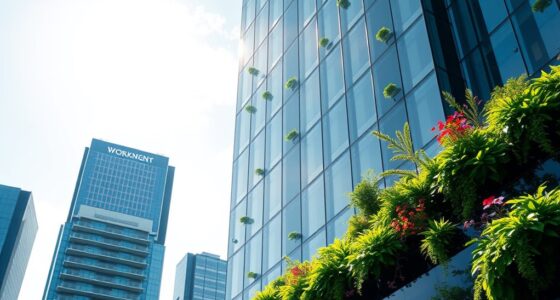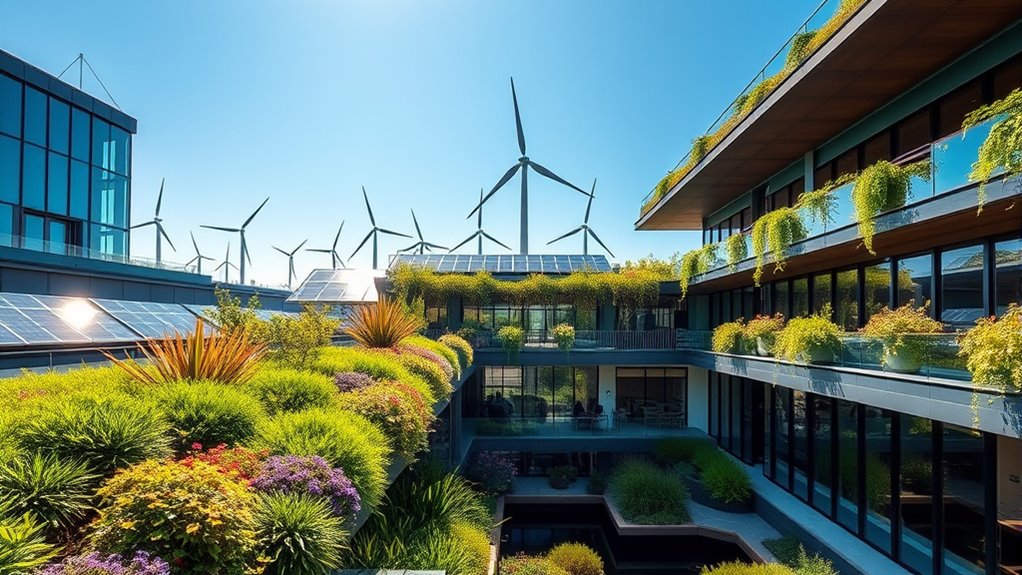

Net zero focuses on balancing energy use with renewable production, aiming for a neutral environmental impact during operation. In contrast, net positive design endeavors to generate more renewable energy than you consume, actively improving ecological conditions. It involves thorough lifecycle assessments to guarantee total environmental benefits. If you want to understand how these approaches differ in scope and impact, exploring their core principles and strategies can give you deeper insights.
Key Takeaways
- Net zero balances energy consumption with renewable production, aiming for energy neutrality; net positive generates more renewable energy than consumed.
- Net zero focuses on offsetting emissions during operation; net positive seeks to actively improve environmental conditions through surplus energy.
- Lifecycle assessment in net positive design evaluates impacts across all project stages, including embodied energy, beyond operational phases.
- Net zero emphasizes minimizing environmental impact; net positive promotes innovation and ecological regeneration beyond neutrality.
- Both strategies require careful planning, but net positive encourages leadership in sustainable, regenerative design practices.

As sustainability becomes a top priority in design, understanding the difference between net zero and net positive approaches is crucial. Both strategies aim to reduce environmental impact, but they do so in fundamentally different ways. Net zero focuses on balancing energy consumption with renewable energy production, ensuring that your project’s operational emissions are offset or eliminated. This often involves integrating renewable energy sources—like solar panels or wind turbines—into the building or infrastructure to achieve energy self-sufficiency. When considering renewable integration, you’re not just installing renewable systems; you’re planning for their peak performance over the entire lifecycle of the project. This means evaluating how these systems will operate, maintain, and possibly upgrade over time, which leads you to the importance of a lifecycle assessment.
Lifecycle assessment (LCA) becomes a critical tool in this context. It helps you understand the environmental impacts associated with every stage of the project—from material extraction and manufacturing to construction, operation, and eventual decommissioning. By conducting a thorough LCA, you can identify areas where renewable integration might have unintended consequences, such as high embodied energy or waste. This holistic view ensures that your net zero efforts truly minimize overall environmental harm, rather than simply shifting impacts elsewhere. It’s about creating a balanced approach that considers both the immediate operational phase and the long-term sustainability of materials and components used.
Lifecycle assessment ensures net zero efforts minimize overall environmental impacts through comprehensive material and process evaluation.
In contrast, net positive design goes beyond merely balancing energy inputs and outputs. It aims to generate more renewable energy than the building consumes, effectively giving back to the grid or community. This approach requires you to think creatively about how your project can produce surplus energy and contribute positively to the environment. It often involves innovative renewable integrations that maximize energy generation, along with strategies for reducing overall resource use. The focus is on creating a regenerative system—one that not only minimizes harm but actively improves environmental conditions.
Achieving net positive status also demands a thorough lifecycle assessment. You need to analyze not just the operational phase but also the embodied impacts of materials and construction processes. By doing so, you ensure that the surplus energy produced truly offsets the full environmental footprint of your project, including manufacturing and end-of-life disposal. In essence, net positive design invites you to look at the bigger picture: how your project can serve as a force for ecological regeneration, rather than just a neutral participant in the environment. Both approaches require careful planning, but net positive pushes you to innovate and lead in sustainable design practices. Recognizing the importance of Lifecycle assessment helps ensure that your sustainability goals are genuinely achieved and maintained over time.

DIY Home Solar Power System: The Complete Guide to Solar Panels, Battery Storage, Wiring, and Off-Grid Energy Systems
As an affiliate, we earn on qualifying purchases.
As an affiliate, we earn on qualifying purchases.
Frequently Asked Questions
How Do Costs Compare Between Net Zero and Net Positive Projects?
You’ll find that net positive projects often have higher upfront costs compared to net zero ones, mainly due to more advanced technologies and design features. However, a thorough cost analysis shows that net positive investments can yield greater long-term returns through energy savings, improved sustainability, and brand value. While initial expenses are higher, the enhanced investment return over time makes net positive projects a smart financial choice.
What Industries Benefit Most From Adopting Net Positive Design?
Imagine transforming entire cities into lush, breathing ecosystems—that’s what industries like sustainable agriculture and urban greening can achieve with net positive design. You’ll see benefits like thriving green spaces, improved air quality, and boosted biodiversity. These industries gain the most, as they actively contribute to ecological health, turning their projects into vibrant, self-sustaining environments that outshine traditional practices and set new standards for environmental impact.
How Do Regulations Influence Net Zero Versus Net Positive Strategies?
Regulations substantially influence your choice between net zero and net positive strategies by shaping your approach to regulatory compliance and leveraging policy incentives. Stricter rules push you toward net zero to meet emission limits, while favorable incentives encourage you to adopt net positive designs that go beyond compliance. Staying aware of evolving policies helps you align your projects with regulatory standards, potentially benefiting from subsidies or tax breaks that support sustainable, innovative solutions.
Can Existing Buildings Be Retrofitted to Achieve Net Positive Status?
It’s entirely possible to retrofit existing buildings to achieve net positive status, especially when you enhance building insulation and incorporate renewable energy sources. You’ll find that upgrading insulation reduces energy needs, while renewable integration—like solar panels—generates excess energy. These improvements work together, turning your building into a positive energy producer. With careful planning and investment, your current structure can become a sustainable, net positive asset, benefiting both the environment and your bottom line.
What Are the Long-Term Maintenance Requirements for Each Approach?
You’ll find that net positive design generally requires more complex maintenance due to advanced systems and renewable energy components, which can increase maintenance complexity. However, it often promotes greater operational sustainability over time, reducing reliance on external resources. In contrast, net zero buildings tend to have simpler maintenance routines but might need ongoing adjustments to uphold balance. Both approaches demand ongoing monitoring and updates to ensure long-term efficiency and sustainability.

FLTXNY POWER Wind Turbine 2000W AC 48V Home Use Horizontal Wind Generator Kits 3 Blades with Digital MPPT Controller to Charge Batteries Off Grid System for Home, Boat, Marine, Garden
1.Low start up speed, 3 Nylon blades at length of 105cm, high wind energy utilization
As an affiliate, we earn on qualifying purchases.
As an affiliate, we earn on qualifying purchases.
Conclusion
Deciding between net zero and net positive design demands dedication, discipline, and a deep desire to deliver difference. By embracing bold, balanced approaches, you can build beyond boundaries, boost benefits, and bring brighter, better, and more sustainable futures. Remember, your role in reshaping realities isn’t just about meeting minimums but making meaningful moves. So, step confidently into this sustainable sphere, and let your designs demonstrate dedication, drive, and a desire to deliver real, remarkable change.
Design of Mechanical Systems: Accelerated Lifecycle Testing and Reliability (Springer Series in Reliability Engineering)
As an affiliate, we earn on qualifying purchases.
As an affiliate, we earn on qualifying purchases.

Net Zero Energy Buildings (NZEB): Concepts, Frameworks, and Roadmap for Project Analysis and Implementation
As an affiliate, we earn on qualifying purchases.
As an affiliate, we earn on qualifying purchases.