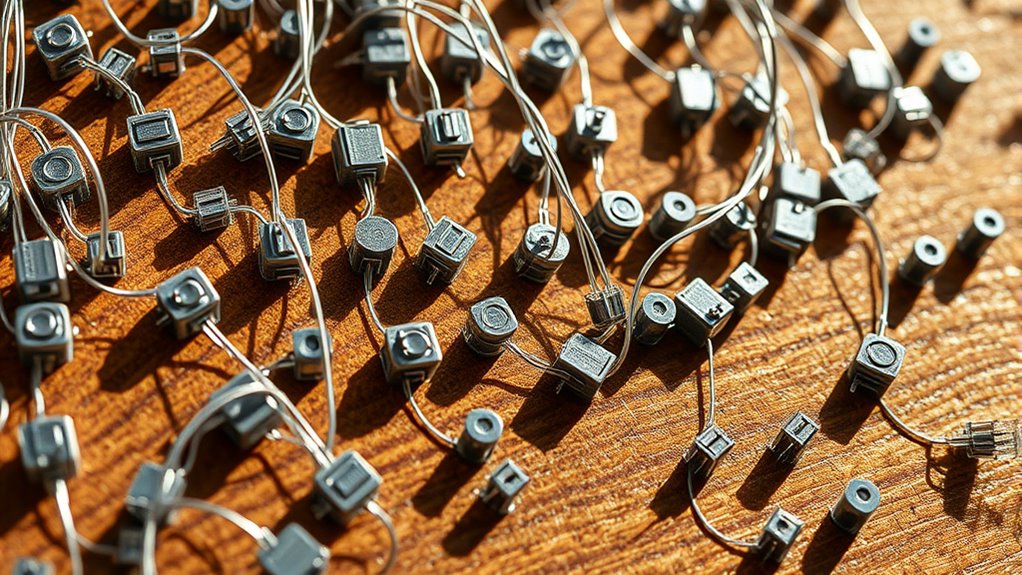

Sensor networks for temperature and humidity allow you to gather accurate, real-time environmental data essential for smart buildings, climate monitoring, and weather forecasting. They enable remote calibration, ensuring sensors stay precise over time without manual adjustments. By combining data from multiple sensors, these networks improve measurement reliability and filter out noise. This seamless integration means you can maintain high data quality effortlessly, and if you keep exploring, you’ll discover how these systems enhance long-term environmental insight.

Get garden gear delivered free with Prime
- Fast, free delivery on millions of items
- Prime Video, Amazon Music and more included
- Member-only deals all year
Key Takeaways
- Sensor networks enable real-time temperature and humidity monitoring for environmental assessment and smart building management.
- Wireless calibration allows remote adjustment of sensors, maintaining measurement accuracy over time.
- Data fusion combines readings from multiple sensors to improve reliability and filter out noise in environmental data.
- Integrating wireless calibration with data fusion enhances network scalability, resilience, and long-term measurement precision.
- Automated calibration drift detection and remote tuning ensure consistent, high-quality temperature and humidity data with minimal manual intervention.

Sensor networks for temperature and humidity play an essential role in monitoring environmental conditions across various applications, from weather forecasting to smart buildings. These networks rely heavily on accurate measurements to guarantee data quality, which is where wireless calibration becomes crucial. Instead of manual calibration or physical adjustments, wireless calibration allows you to fine-tune sensors remotely, saving time and reducing maintenance costs. This process helps correct sensor drift and offset errors, ensuring that the data you collect remains precise over time. By implementing wireless calibration, you can maintain sensor accuracy without disrupting ongoing measurements, making your sensor network more reliable and efficient.
Data fusion is another critical component in these sensor networks. It involves combining data from multiple sensors to produce a more accurate and thorough understanding of environmental conditions. When you fuse temperature and humidity data, you leverage the strengths of each sensor while compensating for their individual limitations. This process improves the overall robustness of your measurements, especially in complex environments where conditions can fluctuate rapidly. Data fusion techniques help filter out noise and anomalies, allowing you to analyze cleaner, more trustworthy data. This is particularly useful in applications like climate monitoring, where precise conditions are necessary for accurate forecasting or environmental assessment.
Combining sensor data enhances accuracy and reliability in dynamic environments.
In practice, integrating wireless calibration with data fusion enhances your ability to deploy scalable, resilient sensor networks. You can update calibration parameters remotely, adapt to changing environmental conditions, and ensure that your sensors remain in sync. As new sensors are added, data fusion algorithms can seamlessly incorporate their data, creating a unified picture of the environment. This dynamic approach not only improves measurement accuracy but also simplifies network management, as you don’t have to manually calibrate or troubleshoot each sensor individually. It also enables real-time adjustments, so your system remains responsive to sudden environmental shifts.
Furthermore, by combining wireless calibration with advanced data fusion techniques, you position your sensor network to operate efficiently over long periods. The system can automatically detect calibration drift and initiate remote calibration processes, maintaining high data quality without constant human intervention. This synergy reduces downtime and increases the lifespan of your sensors, translating into more dependable environmental monitoring. Whether you’re managing a smart building, conducting research, or deploying weather stations, leveraging wireless calibration and data fusion ensures your sensor network delivers consistent, accurate data — empowering better decision-making and more precise environmental insights. Additionally, understanding the importance of high refresh rates in sensor data collection can further enhance the responsiveness of your monitoring system.
wireless temperature and humidity sensor
As an affiliate, we earn on qualifying purchases.
As an affiliate, we earn on qualifying purchases.
Frequently Asked Questions
How Do Sensor Networks Handle Power Consumption Efficiently?
You can handle power consumption efficiently by implementing duty cycling, where sensors alternate between active and sleep modes to save energy. Additionally, using energy harvesting techniques, like solar or vibration energy, helps replenish power, reducing reliance on batteries. These strategies work together to extend sensor network lifespan, ensuring continuous operation while minimizing energy use. This way, your sensor network remains sustainable and effective over long periods.
What Are the Security Risks in Sensor Networks?
Did you know that 70% of sensor networks face security breaches? You risk unauthorized access if you don’t implement strong data encryption. Hackers can intercept sensitive data or even manipulate sensor readings, compromising system integrity. To protect your network, you must prioritize data encryption and regularly update security protocols. Failing to do so leaves your sensor network vulnerable to attacks, potentially causing data leaks or system failures.
Can Sensor Networks Operate in Extreme Environmental Conditions?
Yes, sensor networks can operate in extreme environmental conditions if you choose sensors with high durability and environmental resilience. They’re designed to withstand harsh temperatures, humidity, and other challenging factors. You should select rugged sensors made with durable materials and proper enclosures. Regular maintenance and protective coatings further enhance their longevity, ensuring reliable data collection even in severe environments. This way, your sensor network stays functional and accurate under extreme conditions.
How Is Data Accuracy Maintained Across Multiple Sensors?
You maintain data accuracy across multiple sensors by regularly performing sensor calibration to guarantee each sensor provides precise readings. Additionally, you use data fusion techniques to combine data from all sensors, reducing errors and providing a more reliable overall measurement. This process helps account for sensor drift or inconsistencies, ensuring your temperature and humidity data remains accurate and trustworthy across the entire network.
What Are the Costs Associated With Deploying Large-Scale Sensor Networks?
Imagine a vast web of tiny sensors like glowing fireflies, each adding to a shimmering network. You’ll face costs like cost estimation for hardware, installation, and maintenance. Deployment challenges include overcoming terrain obstacles and ensuring reliable data transmission. These expenses can add up quickly, but careful planning helps you balance budget and coverage, making your large-scale sensor network a powerful tool for real-time environmental monitoring.
Conclusion
You’ve seen how sensor networks bring precision to monitoring temperature and humidity, transforming complex data into simple insights. Like a trusty thermometer or hygrometer, they offer real-time alerts, yet they operate quietly in the background, unnoticed. This blend of technology’s power and subtlety reminds you that while tools may be small, their impact is huge—making your environment safer and more comfortable without you ever having to lift a finger.
Fall Picks
fall essentials
As an affiliate, we earn on qualifying purchases.