
Robot mowers use either boundary wire systems or RTK navigation to keep your lawn well-maintained. Boundary wire creates a virtual fence by laying a physical wire around your yard, guiding the mower within set limits. RTK systems use satellite data for precise navigation, ideal for complex or large areas without wires. Both options automate mowing and docking, but their suitability depends on your yard’s shape and complexity. Keep going to discover which system might be best for your lawn.

Get garden gear delivered free — and shop member deals
- Fast, free delivery on millions of items
- Access to Prime Big Deal Days deals on October 6–7
- Prime Video, Amazon Music and more included
Key Takeaways
- Boundary wire creates a physical virtual fence, guiding the mower within set lawn limits, while RTK uses satellite GPS for boundary-free navigation.
- Boundary wire systems are simpler and more reliable for straightforward lawns, whereas RTK offers high-precision navigation for complex or large yards.
- RTK navigation provides greater flexibility to customize mowing patterns and easily adapt to irregular terrains without physical wires.
- Boundary wire setup involves burying wires around the lawn perimeter, while RTK requires satellite signal access and minimal physical setup.
- Both systems enable automatic docking and recharging, but RTK offers more precise coverage in challenging or irregular-shaped landscapes.
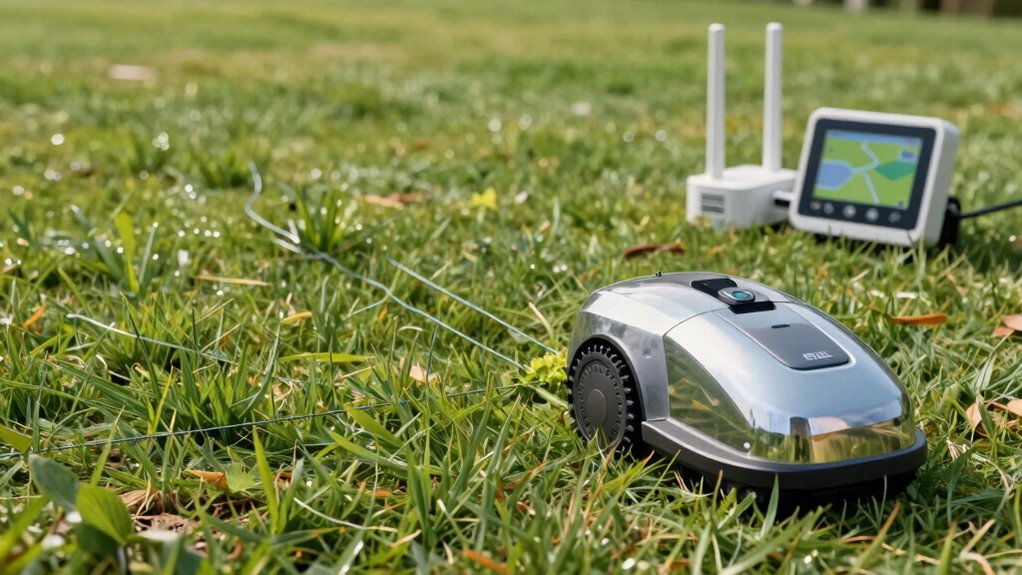
Robot mowers are revolutionizing lawn care by offering a convenient and efficient way to keep your yard tidy without manual effort. When you set up your mower, you’ll notice that it often comes with a charging station—an essential component that guarantees your mower stays powered and ready to go. These stations are typically placed in a strategic spot in your yard, allowing the mower to automatically return when the battery runs low. This setup simplifies maintenance and guarantees your mower follows a consistent mowing schedule, whether daily or a few times a week, depending on your preferences.
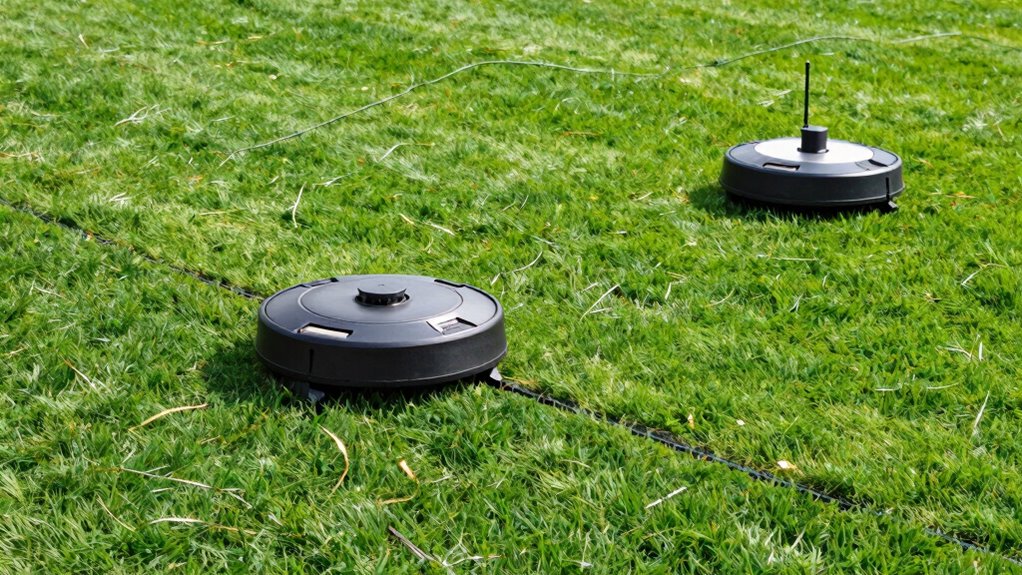
Understanding the difference between boundary wire and RTK navigation is key to optimizing your robot mower’s performance. With boundary wire systems, you lay a physical wire around the perimeter of your lawn, creating a virtual fence. Your mower detects this wire via a buried sensor and knows exactly where to mow and where to stay out. This method is reliable and straightforward, giving you a clear boundary to prevent the mower from wandering off. It also works well with most terrains and lawn shapes, making it a popular choice for many homeowners. Once the boundary wire is set, your mower operates within these limits, following a predefined mowing schedule that you can customize through its control interface.
Boundary wire creates a virtual fence, guiding your mower within set limits for reliable, customizable lawn care.
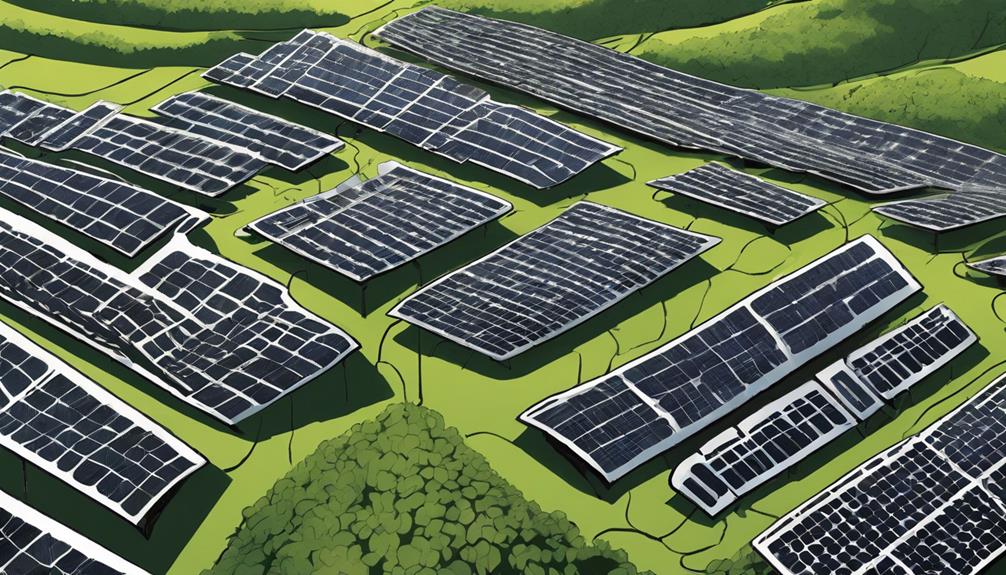
On the other hand, RTK (Real-Time Kinematic) navigation uses satellite positioning technology to guide the mower. This system doesn’t require a physical boundary wire; instead, it relies on GPS signals corrected with real-time data to pinpoint the mower’s location with high accuracy. RTK navigation allows your mower to adapt on the fly, navigating complex landscapes and obstacles more precisely than traditional wire systems. It’s especially beneficial if you have a large or irregularly shaped yard, as it reduces setup time and offers more flexible mowing patterns. Plus, RTK-equipped mowers can often be programmed to follow intricate mowing schedules, ensuring your lawn gets the perfect cut at specific times without manual intervention. Accurate positioning is essential for maximizing the efficiency of RTK systems.
Both boundary wire and RTK navigation systems connect seamlessly with their respective charging stations, enabling your mower to dock and recharge automatically. This automation guarantees your mower stays on schedule, maintaining a consistent mowing routine that keeps your lawn healthy and well-groomed. Your choice between these systems depends on your yard’s layout, your budget, and how much customization you want in your mowing schedule. Whether you prefer the simplicity of boundary wire or the advanced precision of RTK navigation, both options are designed to make lawn care easier, saving you time and effort while delivering professional-looking results.
As an affiliate, we earn on qualifying purchases.
Frequently Asked Questions
How Do Robot Mowers Handle Steep Slopes and Uneven Terrain?
You’ll find that many robot mowers handle steep slopes and uneven terrain well thanks to advanced terrain adaptation and slope handling features. These mowers often have powerful motors and specialized wheels that grip and navigate challenging surfaces. They automatically adjust their cutting height and speed to match the terrain, ensuring efficient mowing even on slopes and uneven ground without getting stuck or losing performance.
What Maintenance Is Required for Boundary Wires and RTK Systems?
Imagine maintaining a delicate garden maze; you’ll need to tend to your boundary wires and RTK systems regularly. For boundary wires, inspect for wire breaks or damage, perform wire repair as needed, and make certain they stay buried properly. RTK systems require periodic calibration to keep navigation precise. Keep connectors clean and check signals to prevent errors, so your mower continues to trim flawlessly without getting lost in the labyrinth.
Can Robot Mowers Operate in All Weather Conditions?
You can’t expect robot mowers to operate perfectly in all weather conditions. Most models have weather resilience and waterproof features, allowing them to handle rain or light snow. However, heavy storms, thick snow, or extreme cold can impair their performance or damage the system. Always check your mower’s specifications and verify it’s designed for the weather in your area to keep it functioning effectively and avoid unnecessary repairs.
How Do Robot Mowers Detect and Avoid Obstacles?
Your robot mower is a vigilant guardian, constantly on alert for obstacles. It detects and avoids obstacles through sensor activation, which triggers immediate responses to prevent collisions. These sensors identify objects in its path, allowing the mower to adjust its route seamlessly. With advanced obstacle detection, your mower efficiently navigates around garden furniture, trees, and uneven terrain, ensuring a smooth, hassle-free mowing experience without risking damage.
What Is the Typical Lifespan of Boundary Wire Versus RTK Navigation Systems?
You’ll find that boundary wires typically last around 3 to 5 years, depending on wire durability and environmental exposure, but RTK navigation systems tend to last longer because they have fewer physical components prone to wear. RTK systems, with their advanced technology, usually boast greater system longevity, reducing the need for frequent replacements. Proper maintenance can extend the lifespan of both, ensuring your mower operates efficiently for years.
Conclusion
Now that you know the difference between boundary wire and RTK navigation, you’re better equipped to choose the perfect robot mower for your yard. Think of boundary wire as a gentle guide and RTK as the GPS superstar of lawn care. Whichever you pick, your lawn will thank you with a lush, perfectly trimmed look that’ll make your neighbors jealous. With the right system, your yard will be the envy of the neighborhood—an absolute mowing masterpiece!
Fall yard work Picks
leaf blowers
As an affiliate, we earn on qualifying purchases.