TL;DR

Get garden gear delivered free with Prime
- Fast, free delivery on millions of items
- Prime Video, Amazon Music and more included
- Member-only deals all year
Tree of heaven can produce new shoots from its roots when cut or mowed, so removal needs to target the root system. Country Living’s guide recommends choosing a control method based on the tree’s size, using herbicides only as their labels direct, and monitoring for new growth after treatment.
A Country Living gardening report advises against cutting or mowing tree of heaven as a removal method, warning that damage can prompt the invasive tree to send up new shoots from its roots. The report recommends identifying the plant first, choosing a method suited to its size and continuing to monitor the site after treatment because a single attempt may not kill the root system.
The report says tree of heaven can be confused with native sumac and black walnut, so identification matters before any treatment. Its compound leaves typically measure 1 to 4 feet long. The leaflets have mostly smooth edges, with one to four small teeth near the base; a gland sits beneath each tooth. Sumac and walnut leaflets are serrated and do not have the same teeth and glands, according to the report. Crushed or broken tree of heaven leaves and branches can also give off a foul odor.
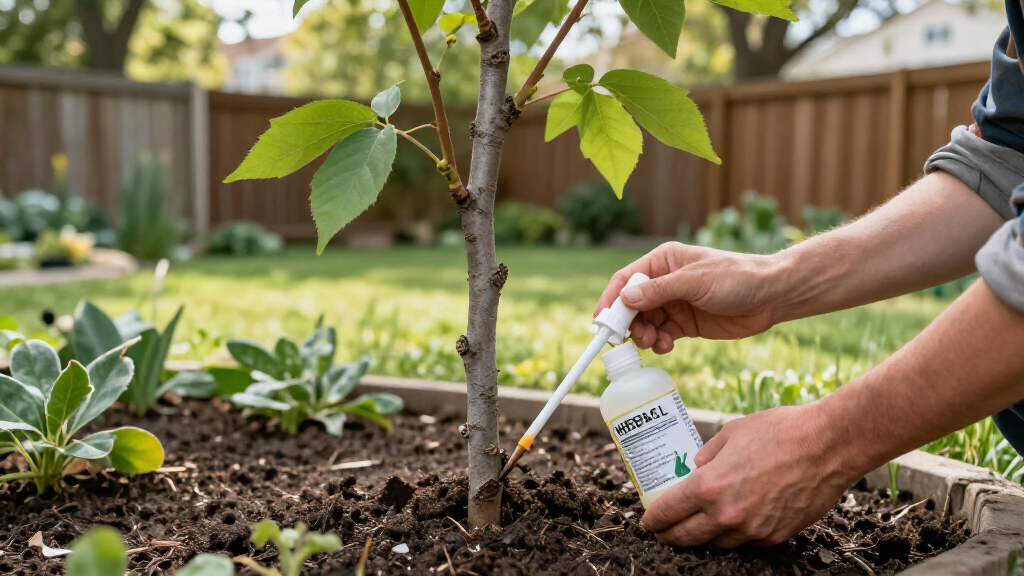
Control options vary by plant size. Hand-pulling is recommended only for very small seedlings, when soil is moist enough to help remove the entire root. Larger seedlings and small trees up to 10 feet tall may be treated with a labeled herbicide applied to foliage. For trunks up to 6 inches in diameter, the report describes basal-bark treatment; larger trees may call for a hack-and-squirt method, in which herbicide is applied to cuts around the trunk.
The report cautions that herbicide use must follow the product label, including its directions on application method, protective equipment, weather and permitted use sites. Keep spray away from desirable plants and check local rules. It advises against treatment while the tree is flowering, generally in spring or early summer, and says herbicide applications are most effective from mid- to late summer until fall color begins. The report says follow-up treatment and monitoring are often needed.
Why Cutting Can Spread Shoots
Tree of heaven’s ability to produce root suckers changes the consequences of routine yard work. Cutting or mowing may remove visible growth but leave the root system alive, with more shoots emerging nearby. A poorly chosen control method can expand the amount of growth a property owner must manage rather than resolve the infestation.
The stakes can extend beyond an individual yard: the report describes the species as an invasive competitor with native plants and says it is a preferred host of the invasive spotted lanternfly. Correct identification and sustained control matter, while chemical treatment also carries risks to nearby plants if products drift or are used contrary to their labels.
tree of heaven identification field guide
As an affiliate, we earn on qualifying purchases.
As an affiliate, we earn on qualifying purchases.
Identify the Tree Before Treatment
The report’s guidance centers on two decisions: confirming the species and matching treatment to its size. Tree of heaven’s leaflet arrangement can help distinguish it from lookalikes: leaflets sit opposite one another along the leaf stem, while the compound leaves alternate along the twig. The small teeth and glands near leaflet bases provide another identifying feature.
After identification, the report advises against treating all growth alike. A tiny seedling may be removable by hand if its full root can be pulled. Larger plants generally call for a treatment aimed at the root system, rather than repeated cutting of the top growth. The article notes that trees in flower should be left untreated until a more suitable period.
““Cutting or mowing can cause the tree to send up root suckers.””
— Country Living report
What Treatment Cannot Guarantee
The report does not provide a guarantee that any one treatment will eradicate an established tree of heaven. It says the first treatment may only weaken the root system, and new shoots may appear later. The time and number of follow-up treatments needed can vary; the report does not specify a universal schedule.
It also does not name a single herbicide product or give a one-size-fits-all application rate. Product labels and local rules govern what can be used and how. Where identification is uncertain, or the tree is near structures, power lines or valuable landscaping, the report recommends seeking qualified help rather than attempting treatment without advice.
Monitor Growth and Seek Help
After treatment, check the site for new shoots and continue control as needed. Do not assume the visible tree is dead simply because its top growth has declined: the report says the roots may survive an initial treatment. For a large tree near a home, power lines or valuable landscaping, or for an infestation covering a wide area, it recommends contacting an arborist or invasive-plant specialist.
Before applying any herbicide, confirm that the product is labeled for tree of heaven and for the chosen method. Follow the label’s protective-equipment, weather and site instructions, prevent contact with desirable plants, and consult a local cooperative extension if directions are unclear.
Key Questions
Can I cut down tree of heaven?
The report advises against cutting or mowing as a control method because the surviving roots can produce new shoots. Cutting alone may leave the root system alive.
How can I tell tree of heaven from sumac or walnut?
Look for compound leaves with mostly smooth-edged leaflets and small teeth with glands near their bases. The report says sumac and walnut have serrated leaflets without those features. Crushed tree of heaven foliage may also have a foul odor.
When is the best time to treat tree of heaven?
The report says herbicide applications are most effective from mid- to late summer until fall color begins. It advises holding off while the tree is flowering, usually in spring or early summer. Follow the product label and local rules.
When should I call a professional?
Contact an arborist or invasive-plant specialist if a large tree is near a home, power lines or valuable landscaping, or if the infestation covers a wide area.
Source: rss
Fall Picks
fall essentials
As an affiliate, we earn on qualifying purchases.