
TL;DR
IdeaClyst is a local-first, AI-powered war room that helps founders rigorously evaluate ideas, find overlooked opportunities, and turn concepts into action. It’s like having a boardroom of critics on your laptop, keeping your best ideas sharp and ready to build.
Imagine this: you’re staring at three promising ideas, each with potential. But which one deserves your six months, your team’s effort, your investment? The stakes are high, and gut feelings just won’t cut it anymore.
Enter IdeaClyst — your personal war room for ideas. It’s not just a brainstorming tool; it’s a strategic battlefield where your concepts are tested, challenged, and sharpened before you commit. This isn’t about vague optimism. It’s about making smarter, evidence-based decisions that save time, money, and frustration.
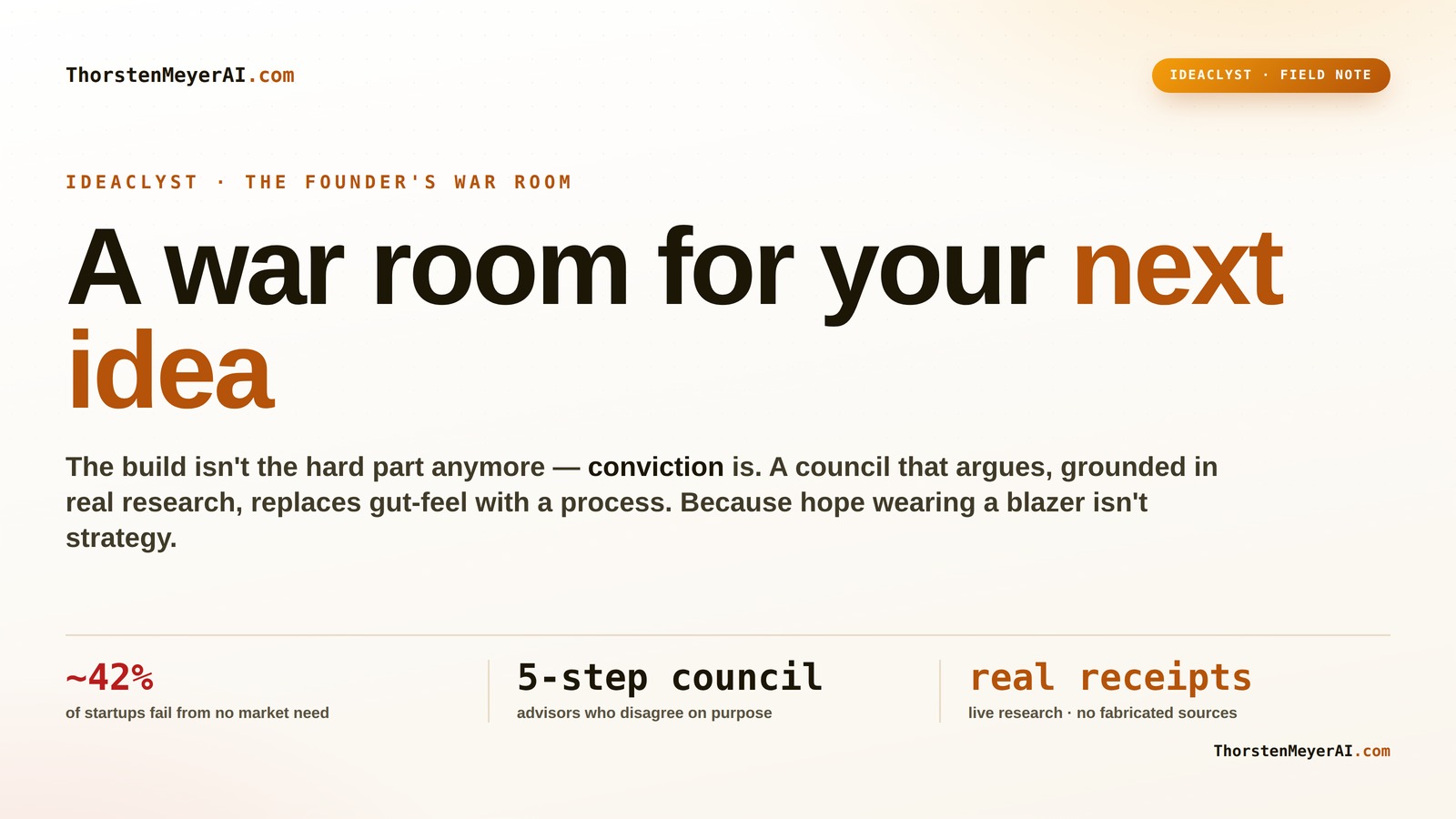
A war room for your next idea
The build isn’t the hard part anymore — conviction is. Knowing which idea deserves the next six months, and being able to defend it. Most founders answer with gut feel and optimistic math. That’s hope wearing a blazer. IdeaClyst replaces it with a process.
The most expensive decision is what to build
The single most valuable thing a tool can do is talk you out of the wrong six months. The numbers make the case better than any pitch.

AI Programming Made Practical: A Step-by-Step Guide to Building AI-Powered Applications, Writing Better Code Faster, and Using Modern AI Tools with Confidence
As an affiliate, we earn on qualifying purchases.
As an affiliate, we earn on qualifying purchases.
Three tools in one — on your own machine
Strip away the framing and IdeaClyst is three things at once, all running locally with nothing leaving your laptop.
An AI council
Pressure-tests an idea you bring it — advisors who argue on purpose.
A discovery engine
Finds ideas you didn’t know to look for by hunting real demand signals.
A founder’s workspace
Carries winners from “interesting” all the way to “ready to build.”

AI for E-commerce: Launch Market and Scale Your E-commerce Brand Using AI-Powered Product Research Marketing and Customer Service: AI Powered Blueprints … Money and Achieve Finacial Freedom Book 11)
As an affiliate, we earn on qualifying purchases.
As an affiliate, we earn on qualifying purchases.
Advisors who disagree on purpose
Not one confident, agreeable answer — a structured five-step deliberation where models play different roles and turn on their own work. The disagreement is the feature.
The five-step deliberation
A council that leads with the bad news surfaces the objections you’d otherwise find the expensive way, on month five.
Product strategy
Who’s it for, what’s the wedge, why now, what’s the business model.
Technical architecture
What would it actually take to build — and where’s the risk.
Critique pass
The council turns on its own work. Where’s the hand-waving? What kills this?
Second, independent critique
A different voice, a different angle — so blind spots don’t survive.
Final synthesis
Everything into one coherent founder packet: strategy, architecture, validation, plan.

Marketing Management: A Strategic, Decision-Making Approach (w/GAMAR Software)
As an affiliate, we earn on qualifying purchases.
As an affiliate, we earn on qualifying purchases.
When IdeaClyst cites a source, it actually fetched it
The hard departure from “ask an AI what it thinks of my startup.” It runs in a strict, real-data-only mode — if it can’t gather genuine evidence, it says so plainly rather than inventing a plausible paragraph.
Confidence with receipts
No fabricated statistics, no imaginary competitors, no made-up citations. The packet survives a skeptical co-founder or a sharp investor because the reasoning has receipts.
Market research first
Scouts the landscape before the council reasons about anything.
Competitor read
Real positioning, pricing signals, feature claims — differentiation vs. reality.
Validation with links
Not “talk to customers” — concrete signals & sources you can click.

The Anti-Test Anxiety Society: Help Worried Students Prepare for Tests
As an affiliate, we earn on qualifying purchases.
As an affiliate, we earn on qualifying purchases.
From the blank page to build-ready
Evaluation is half the problem; the blank page is the other half. And a plan is worthless if it dies in a tab you never reopen.
Bring a space, not an idea
“AI for accountants,” “tools for indie game studios” — plus your goal and real capacity. It hunts demand signals across HN, Reddit, Product Hunt, GitHub, pricing pages.
- An honest market read — leads with the bad news when a space is hard
- An opportunity map — high pain, thin competition
- Ranked candidates — wedge, who pays, effort, risk, confidence
- each with KILL CRITERIA — when to walk away
A home and a forward path
Every promising idea gets carried forward, with every artifact in plain files on your disk.
- Validation tooling — sprint board, interview list, evidence browser
- Founder profile — a personal-fit lens; same discovery, different advice
- Build workspaces — funnel, personas, landing draft, version history
- “Build this idea” → a PRD + task queue, ready for a coding agent
Key Takeaways
- IdeaClyst acts as a digital war room, turning vague ideas into validated, actionable plans through structured critique and real web research.
- Its disagreement-based council exposes hidden flaws early, saving months of costly development and missteps.
- Grounding ideas in real-time data prevents false confidence and keeps plans aligned with current market realities.
- The local-first, open-source setup gives founders full control over their data, perfect for sensitive or proprietary ideas.
- Building your own war room is simple: gather ideas, run the council, analyze critiques, and refine — all on your machine.
Why a War Room Is Your Secret Weapon for Big Ideas
A war room isn’t just a fancy name for a whiteboard. It’s the core space where clarity, focus, and strategy collide. For founders, it’s a place to see all angles of an idea, from market fit to technical risks. Think of it as your command center, where every piece of data and every critique shapes your next move.
Having a dedicated war room means you’re not just relying on intuition or incomplete data. Instead, you create a disciplined environment where assumptions are challenged, and every decision is backed by evidence. This reduces the risk of costly mistakes and helps prioritize efforts on the most promising paths. The tradeoff, of course, is that it requires discipline and time upfront, but this investment pays off by dramatically increasing your confidence and speed in execution.
How IdeaClyst Does What No Other Tool Can — Disagree and Decide
IdeaClyst’s secret sauce is its AI council that stages a structured debate around your idea. Instead of a single opinion, you get five steps: strategy, architecture, critique, second critique, and synthesis. This process surfaces flaws early, saving months of wasted effort.
Why does this matter? Because in complex projects, relying on a single perspective—whether from an AI or a human—can lead to blind spots. By staging disagreement among multiple AI models, IdeaClyst encourages your ideas to be tested from multiple angles simultaneously. This approach reveals hidden risks and assumptions that might otherwise go unnoticed, forcing you to confront uncomfortable truths early. The tradeoff is that this process can be more time-consuming initially, but it ultimately results in more robust plans and fewer costly revisions later. The final decision packet, with its detailed critiques and recommendations, provides a comprehensive foundation for confident action.
The Power of Grounding Ideas in Real Web Research
Many AI tools just echo what they’ve seen before, confidently spouting vague market trends. Not IdeaClyst. It pulls live web data into its critique, making its assessments rooted in today’s reality. That means no more false confidence from outdated or biased info.
Why is this important? Because markets and technology evolve rapidly, and relying on stale or biased data can lead you astray. By integrating real-time web research, IdeaClyst ensures your evaluations are based on the most current and relevant information. This grounding helps you identify emerging competitors, market shifts, or new opportunities that could be game-changers. The tradeoff is that it requires access to the internet during analysis, but this investment in current data dramatically improves the quality and relevance of your decisions, reducing the risk of building on shaky assumptions.
The Local-First Advantage: Keep Your Ideas Private and Portable
Unlike most AI tools that run in the cloud, IdeaClyst works entirely on your machine. Your ideas, reports, and plans stay local, on your own disk. No cloud accounts, no data leaks, no subscription hassle. For founders, this means total control and privacy — your early ideas are safe and yours.
Why does this matter? Because sensitive ideas—such as patent filings, proprietary algorithms, or strategic plans—require confidentiality. Cloud storage introduces risks of data breaches or leaks, especially if your project is still in early, unprotected phases. By keeping everything local, IdeaClyst ensures you maintain full control over your data, with no dependency on external servers. The tradeoff is that you need to manage your own backups and updates, but this approach offers enhanced security and peace of mind, especially for high-stakes projects.
Building Your Personal War Room — Step-by-Step Setup
Ready to turn your messy ideas into a focused battle plan? Here’s a simple five-step process:
- Gather your ideas: Write down your concepts, no matter how rough.
- Set up your workspace: Use IdeaClyst to create a dedicated folder on your machine.
- Run the council: Feed your ideas into the AI council, staging the five-step critique.
- Analyze the critiques: Review objections, gaps, and supporting evidence.
- Refine and plan: Incorporate the feedback, update your documents, and decide your next move.
This process encourages disciplined thinking, forcing you to confront weaknesses and assumptions at each stage. For more on fostering creativity, visit The Genius Factory. For example, a solo founder testing a new app idea might go through this process in a weekend, which normally could take months of trial and error. The structured approach accelerates learning, sharpens your focus, and helps you emerge with a validated plan rather than a pile of half-baked concepts.
What Sets IdeaClyst Apart from Other Brainstorming Tools
| Feature | IdeaClyst | Trello / Notion | Physical Whiteboard |
|---|---|---|---|
| Disagreement & Critique | Yes — structured AI council stages debate | No — mainly collaboration and tracking | No — visual organization only |
| Research grounding | Live web data integration | Manual research required | Not applicable |
| Local-first & Open Source | Yes — runs on your machine | No — cloud-based | No — physical space only |
| Decision packet output | Yes — Markdown with critiques & plans | No — mainly notes & boards | No — visual only |
Compared to tools like Trello or Notion, IdeaClyst offers a rigorous, debate-driven approach grounded in current data. This means that your ideas aren’t just stored or visualized—they’re critically examined from multiple angles, ensuring you don’t overlook key risks or opportunities. The process of staged disagreement pushes you beyond surface-level thinking, forcing you to defend your assumptions and consider alternative perspectives. This depth of analysis turns your initial inspiration into a validated, actionable plan, ultimately reducing the risk of costly pivots or failures down the line.
Frequently Asked Questions
Is IdeaClyst suitable for solo founders or only teams?
IdeaClyst works beautifully for solo founders as well as teams. Its structured critique and decision packets help individuals validate ideas quickly, saving months of guesswork. For teams, it facilitates collaborative debate and shared understanding.Can I use IdeaClyst for personal goals or only business ideas?
Absolutely. While it’s designed with startups and founders in mind, IdeaClyst’s flexible structure makes it perfect for personal projects, creative pursuits, or any goal requiring clear planning and honest critique.How difficult is it to set up and start using IdeaClyst?
Very easy. Just install the open-source software, organize your ideas into folders, and run the council. Its step-by-step process guides you through transforming raw thoughts into validated plans within minutes.What kind of research does IdeaClyst pull in?
It pulls live web data, including current competitors, market size, and industry trends. This keeps your idea grounded in real-world, up-to-date information, avoiding outdated assumptions.Is my data safe with IdeaClyst?
Yes. Because it runs locally on your machine, your ideas never leave your disk unless you choose to share them. It offers full control over your sensitive information.Conclusion
Think of IdeaClyst as your personal command center, where every idea gets the scrutiny it needs before you commit resources. It’s the difference between building on hope and building on certainty.
Next time you’re stuck between multiple options, remember: a focused war room can turn indecision into a clear, confident plan. Because in the end, the smartest founders don’t just have ideas — they fight for them.