If you’re comparing carbon tax and cap-and-trade, you’ll find that a tax sets a clear price per ton of emissions, making costs predictable and encouraging innovation. Cap-and-trade, on the other hand, creates a market for allowances, fluctuating in value and providing flexibility for industries. Both approaches aim to reduce emissions effectively, but their success depends on implementation details, market oversight, and political support. Want to discover more about their benefits and challenges? Keep exploring.
Key Takeaways
- Carbon tax sets a fixed price per ton of emissions, providing price certainty and simplicity for businesses.
- Cap-and-trade establishes a limit on emissions, allowing market-driven allowance trading with fluctuating allowance prices.
- A carbon tax offers predictable revenue and cost signals, while cap-and-trade provides flexibility and potential economic shocks mitigation.
- Political acceptance often favors cap-and-trade due to its market-based approach, though both require robust regulatory frameworks.
- Revenue from either system can fund renewable energy projects or be returned to taxpayers, influencing public support and economic impact.
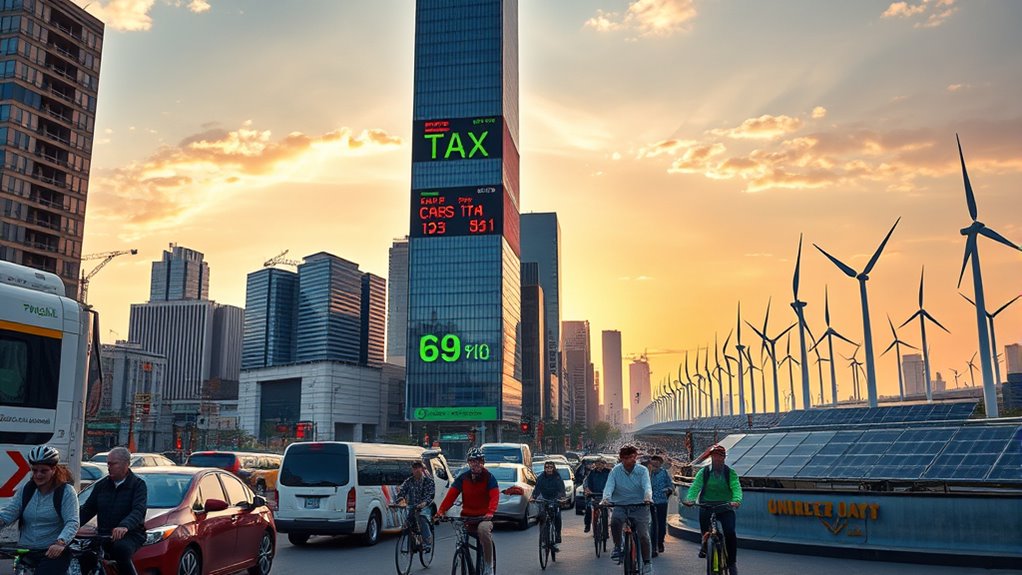
Have you ever wondered how putting a price on carbon emissions can help fight climate change? It’s a powerful approach that incentivizes companies and individuals to reduce their greenhouse gas output by making pollution financially costly. But before jumping into the specifics, it’s important to understand the broader implications, especially the economic impact and political feasibility of different carbon pricing methods. These factors determine whether such policies can be effectively implemented and sustained over time.
When considering the economic impact, both tax and cap-and-trade systems aim to internalize the cost of carbon emissions, encouraging cleaner choices. A carbon tax sets a clear, predictable price per ton of emissions, allowing businesses to plan accordingly. This predictability can foster innovation and investment in low-carbon technologies, potentially spurring economic growth. However, critics argue that a tax might disproportionately affect certain industries or consumers, especially if the tax is set too high initially. Conversely, cap-and-trade systems create a market for emission allowances, which can fluctuate in value based on supply and demand. This flexibility can help mitigate economic shocks by allowing companies to trade allowances, providing cost certainty on a broader level. Still, cap-and-trade schemes can be complex to manage, requiring robust oversight to prevent market manipulation and ensure environmental integrity. Both approaches can influence economic activities, but their impacts depend heavily on implementation details and how revenues are used—whether they are reinvested in renewable energy or returned to taxpayers. Additionally, understanding the regulatory framework involved in each system is crucial for effective enforcement and transparency.
From a political feasibility perspective, implementing a carbon tax often faces resistance because it directly increases costs for consumers and businesses, leading to concerns over competitiveness and job losses. Politicians may hesitate to back a tax that could be unpopular, especially without clear benefits or compensation measures. Cap-and-trade systems, on the other hand, tend to be more politically palatable because they resemble existing market mechanisms and can be designed with offsets or free allowances for certain industries. This flexibility makes it easier to gain consensus, but it can also be criticized for allowing companies to buy their way out of genuine emissions reductions. Ultimately, both systems require strong political will and public support to succeed. The feasibility also hinges on transparent communication about benefits and fair distribution of costs and revenues.

Casio MS-80B Calculator – Desktop Calculator with Tax & Currency Tools | General Purpose | Large Display | Ideal for Home, Office & Everyday Math
- Large 8-Digit Display: Clear, easy-to-read display for accurate calculations
- Tax & Currency Functions: Handle tax calculations and currency conversions easily
- Versatile Use: Suitable for basic math, business, and personal tasks
As an affiliate, we earn on qualifying purchases.
As an affiliate, we earn on qualifying purchases.
Frequently Asked Questions
How Do Carbon Pricing Policies Impact Economic Growth?
Carbon pricing policies can boost economic growth by enhancing market competitiveness and encouraging innovation incentives. When you implement these policies, you’re incentivizing businesses to develop cleaner technologies, which can lead to new markets and job opportunities. While some may worry about costs, in reality, these policies often drive efficiency and sustainability, ultimately supporting long-term economic resilience. Your commitment to carbon pricing can position your economy as a leader in green innovation.
Which Countries Have Successfully Implemented Cap-And-Trade Systems?
You’ll be amazed at how countries like the European Union and California have revolutionized emissions reduction with their cap-and-trade systems. They’ve created markets so efficient that emissions drop dramatically while supporting economic growth. These systems harness market efficiency to set clear limits, driving innovation and reducing pollution at an unprecedented pace. Their success proves that well-designed cap-and-trade policies can deliver powerful environmental benefits without sacrificing economic resilience.
What Are the Main Challenges in Setting Carbon Tax Rates?
You face challenges setting carbon tax rates because balancing economic impact and environmental goals isn’t easy. You need to prevent carbon leakage, where emissions shift elsewhere, and manage administrative complexity to guarantee fair implementation. Accurate measurement and adjustments are vital, but they’re often difficult to achieve. You must also consider industry competitiveness and public acceptance, making it a complex task to set effective, sustainable carbon tax rates.
How Do Carbon Pricing Mechanisms Affect Low-Income Communities?
Did you know that low-income communities often face higher energy costs, making them more vulnerable to carbon pricing mechanisms? You might feel that equity concerns arise, as these groups could bear a disproportionate burden. However, well-designed policies can bolster community resilience by directing revenues into support programs. Ultimately, balancing environmental goals with fairness guarantees that everyone benefits from cleaner air and a sustainable future.
Can Carbon Pricing Be Integrated With Other Climate Policies Effectively?
You can effectively integrate carbon pricing with other climate policies by fostering industry innovation and ensuring policy coherence. When you align carbon pricing with regulations, renewable energy incentives, and efficiency standards, you create a unified approach that drives emission reductions. This integration motivates industries to adopt cleaner technologies, supports economic growth, and strengthens climate action, making your efforts more impactful and sustainable over time.
Conclusion
Whether you choose a tax or cap-and-trade, you’re taking a step toward reducing emissions, encouraging innovation, and fostering a sustainable future. You can set clear costs, create flexibility, and motivate change. You can simplify compliance, stimulate economic growth, and promote fairness. You can provide certainty, drive innovation, and support long-term goals. Ultimately, your choice shapes the future—so choose wisely, act decisively, and lead the way toward a cleaner, greener world.