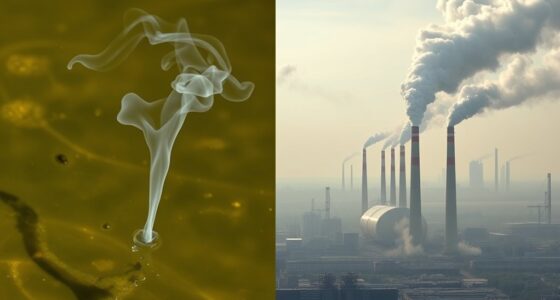
The carbon cycle shows how carbon moves between the atmosphere, oceans, soil, plants, and rocks, helping regulate Earth’s climate and support life. Plants absorb CO₂ during photosynthesis, while oceans soak up carbon from the air. When humans burn fossil fuels or cut down forests, more CO₂ gets released, causing climate change. Understanding this cycle helps you see how natural processes balance carbon, but human actions are disrupting it. Keep exploring to learn how we can protect this essential system.
Key Takeaways
- The carbon cycle describes how carbon moves between the atmosphere, plants, oceans, soil, and rocks.
- Plants absorb CO₂ during photosynthesis, storing carbon in their tissues.
- Oceans absorb CO₂ from the air, storing it as dissolved carbon or in deep waters.
- Carbon is stored long-term in rocks like limestone and released through processes like weathering and volcanic activity.
- Human activities, such as burning fossil fuels, increase atmospheric CO₂, leading to climate change.

Have you ever wondered how carbon moves through our planet? It’s a fascinating process that involves different parts of the Earth, known as carbon reservoirs, and impacts the amount of greenhouse gases in our atmosphere. Carbon reservoirs are large storage areas where carbon is held for varying periods, including the atmosphere, oceans, soil, plants, and rocks. These reservoirs constantly exchange carbon through natural processes, creating a dynamic cycle that sustains life and influences climate.
Carbon moves through Earth’s reservoirs, exchanging and balancing carbon levels that influence our climate and support life.
In the atmosphere, carbon primarily exists as carbon dioxide, a greenhouse gas that traps heat and keeps our planet warm enough to support life. When humans burn fossil fuels like coal, oil, and natural gas, we release extra carbon into the atmosphere, increasing greenhouse gases and intensifying global warming. This added carbon can stay in the air for decades, making it a significant driver of climate change. On the other hand, plants and trees absorb carbon dioxide during photosynthesis, pulling it out of the atmosphere and storing it in their tissues. Forests act as essential carbon reservoirs, helping to regulate atmospheric carbon levels.
Oceans are also indispensable carbon reservoirs. They absorb a large portion of the carbon dioxide from the atmosphere, dissolving it into their waters. This process helps reduce greenhouse gases in the air but also causes ocean acidification, which can harm marine life. Additionally, carbon can be stored in the deep ocean for hundreds or thousands of years, acting as a long-term sink for excess carbon. Soil and organic matter serve as another reservoir, storing carbon in decomposed plants and animals. When organic material breaks down, some carbon is released back into the atmosphere, but some remains trapped in the soil for long periods, balancing out the cycle.
Rocks and sediments form the largest carbon reservoir over geological timescales. Carbonates, like limestone, contain stored carbon that can be released through weathering or volcanic activity. Over millions of years, carbon moves between these reservoirs, maintaining a delicate balance that supports life on Earth. Human activities, especially burning fossil fuels and deforestation, have disrupted this balance by adding more carbon to the atmosphere faster than natural processes can remove it. This excess greenhouse gas causes global temperatures to rise, leading to climate change and environmental impacts.
Understanding how carbon moves through these reservoirs and influences greenhouse gases is key to tackling climate change. Efforts to reduce emissions and increase natural carbon sinks, like reforestation and ocean conservation, aim to restore balance to the carbon cycle. Recognizing the importance of natural carbon sinks can help guide effective climate strategies. By staying aware of these processes, you can better grasp the importance of managing our planet’s carbon footprint for a sustainable future.

NewPath Water Cycle 3-D Paper Model Making Kit – Individual Student Edition (17-7817)
Hands-On Learning Tool: Assemble and explore 3-D paper models to investigate key science concepts related to the water…
As an affiliate, we earn on qualifying purchases.
As an affiliate, we earn on qualifying purchases.
Frequently Asked Questions
How Does the Carbon Cycle Affect Climate Change?
You might not realize it, but the carbon cycle plays a vital role in climate change. About 50% of human-emitted CO₂ is absorbed by natural processes like carbon sequestration in forests and oceans. This influences climate feedback, where increased CO₂ warms the planet, leading to more emissions from natural sources. Understanding this cycle helps you see how human actions disrupt balance, accelerating global warming and impacting ecosystems worldwide.
What Role Do Oceans Play in Carbon Absorption?
Oceans play a vital role in carbon absorption by taking in atmospheric CO2 through oceanic absorption. This process helps regulate climate by reducing greenhouse gases. Once absorbed, CO2 reacts with seawater to form carbonate compounds, a process called carbonate formation. This natural mechanism stores carbon deep in the ocean, preventing it from contributing to global warming. Your actions can influence this balance, impacting the planet’s climate health.
How Do Humans Impact the Natural Carbon Cycle?
You impact the natural carbon cycle mainly by releasing excess carbon into the atmosphere through activities like burning fossil fuels and deforestation. These actions disrupt the balance of carbon reservoirs, reducing the amount stored in plants and soils. As a result, photosynthesis processes slow down, and more carbon stays in the air, contributing to climate change. Your choices directly influence how efficiently the cycle functions and maintains Earth’s climate stability.
Can the Carbon Cycle Be Accelerated or Slowed?
You can definitely speed up or slow down the carbon cycle through carbon cycle modification, but it’s like trying to control the weather—huge natural variability makes it unpredictable. Human activities, like burning fossil fuels or planting forests, can accelerate the process, while deforestation or reduced emissions slow it down. Still, the cycle’s natural fluctuations mean it’s constantly shifting, almost like an unpredictable tide that’s tough to tame.
What Are the Consequences of Disrupting the Carbon Cycle?
Disrupting the carbon cycle can lead to serious consequences like climate change, as excess carbon dioxide traps heat. When natural processes like carbon sequestration and carbon storage are disturbed, it diminishes Earth’s ability to absorb and store CO₂. This imbalance accelerates global warming, causes extreme weather, and harms ecosystems. You need to protect these natural mechanisms to maintain climate stability and ensure a healthy environment for future generations.

Extech SD800 CO2, Humidity and Temperature Datalogger
30 to 130dB measurement range
As an affiliate, we earn on qualifying purchases.
As an affiliate, we earn on qualifying purchases.
Conclusion
Now that you see how the carbon cycle flows like a crucial river through Earth’s life, remember it’s a delicate dance you’re part of. Just as a single drop can cause ripples, your actions impact the entire system. Protecting this cycle means safeguarding our future—because without it, the vibrant world we recognize would fade into silence. So, embrace your role as a guardian of this invisible, yet powerful, life force that keeps our planet alive.

5Strands Blue Green Algae Test Kit (2 Pack), On Site Lake & Pond Water Testing, Water Safety Test, Algae Detection, Fast 15 Minute Results
What Is Blue-Green Algae? Blue-green algae is a type of cyanobacteria found in warm, nutrient-rich bodies of water…
As an affiliate, we earn on qualifying purchases.
As an affiliate, we earn on qualifying purchases.

Gas Leak Detector by Forensics | 10ft Drop Test Pass | Natural Gas, Alcohols, Methane, Combustibles, Acetone, Ethanol, Propane, Butane, Gasoline, Diesel, IPA, Toluene, LPG, LNG |
⚛️ ACCURATE: Made in Japan sensor. Methane Calibrated.
As an affiliate, we earn on qualifying purchases.
As an affiliate, we earn on qualifying purchases.