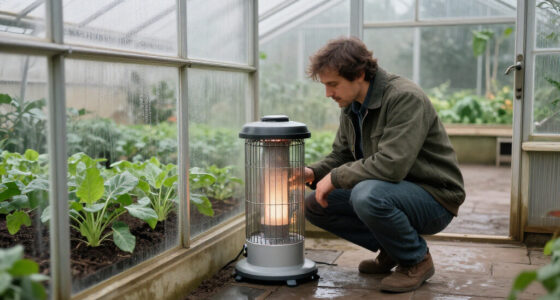
Low-energy heaters are best for warming a person or a small, enclosed area—not replacing central heat throughout a home. My best overall pick is the NewAir 400-Watt Oil-Filled Space Heater, whose low wattage suits gradual, personal heating; the Gaiatop 500W Mini Space Heater is a compact ceramic alternative, while the DREO 1500W Ceramic Heater offers more reach and control but draws more power at full output. The main tradeoff is between lower electricity use with limited coverage and higher wattage for faster, broader warmth. Safety features, noise, heat delivery, and controls also separate these options. Read on for the full breakdown and guidance on matching a heater to your room and routine.

Get garden gear delivered free with Prime
- Fast, free delivery on millions of items
- Prime Video, Amazon Music and more included
- Member-only deals all year
Complete the kit


Key Takeaways
- The NewAir 400-watt oil-filled model uses the least power in this lineup, making it a fit for personal, gradual heating rather than fast room warm-up.
- Three 500-watt Amazon Basics or Gaiatop mini heaters are better suited to desks and close-range use than the 1500-watt models; their smaller output also limits coverage.
- The DREO, WINHL, and 23-inch OLIXIS add controls or oscillation, features that can spread warmth or reduce manual adjustments, but do not make a high-wattage heater low-consumption.
- Fan-assisted ceramic heaters trade quiet operation for quicker-feeling heat movement; the oil-filled option avoids that airflow but warms more gradually.
- The strongest choice depends on where heat is needed: a desk favors low-wattage personal models, while a larger occupied area may call for a higher-output unit and careful runtime management.




| lowenergy heater | Safety features | Power | Dimensions |
|---|---|---|---|
| Gaiatop Mini Space Heater | Overheat shutoff and 45° tip-over protection | 500W | — |
| GiveBest Portable Ceramic Spac | Overheat shutoff and tip-over protection | — | — |
| Amazon Basics Ceramic Space He | Overheat and tip-over protection | 1500W maximum | 7.52 × 6.34 × 9.45 in. |
| DREO Portable Ceramic Space He | Tip-over protection, overheat protection, flame-retardant materials, and safety plug | — | — |
| 1500W Electric Space Heater wi | Overheat protection and tip-over switch | 1500W | — |
| NewAir Portable 400-Watt Oil-F | Automatic shut-off and tip-over switch | 400 watts | — |
| Amazon Basics Ceramic Portable | — | 500 watts | 5.87 × 3.15 × 5.95 inches (D × W × H) |
| OLIXIS 23" Space Heater for In | Tip-over protection, overheat shut-off, and child lock | 1500 watts | — |
| Amazon Basics Portable Ceramic | Tip-over protection, overheat protection, and power indicator light | — | 7.52 × 6.34 × 9.45 inches |
| WINHL Portable 1500W Ceramic S | — | — | 5.91 × 5.91 × 9.85 inches (D × W × H) |
| QQT Space Heater | Overheat protection and tipping protection | 1200 W | 8.2 x 5.9 x 5.5 in. |
| Amazon Basics Ceramic Space He | — | 500 W | 5.87 x 3.2 x 6 in. |
| Space Heater | Overheat protection and tip-over shutoff | — | 5.91 x 5.91 x 8.46 in. |
| Space Heater | Auto shutoff and tilt protection | — | 5.28 x 4.45 x 8.5 in. |
More Details on Our Top Picks
Gaiatop Mini Space Heater, 500W Portable PTC Ceramic Desk Heater for Indoor Use
The Gaiatop Mini is the low-wattage choice here: at 500W, it suits warming the space around one desk or chair rather than trying to heat an entire room. That lower output can make sense when I want targeted warmth without running a 1500W heater like the GiveBest Portable Ceramic Space Heater at its higher setting. Its PTC ceramic element, compact form, and quiet operation fit close-range use in an office or dorm. Overheat and 45-degree tip-over protection add useful safeguards for a small heater placed on a desktop or floor. The tradeoff is limited reach: it lacks the GiveBest’s thermostat and selectable heat settings, so I would skip it if I need adjustable room-wide comfort. Its fire-resistant material is a plus, but it does not change that small-space limitation.
Pros:- 500W output suits targeted personal heating rather than high-output room heating
- Compact design takes up little desk or floor space
- Quiet operation is appropriate for work or study
- Overheat and 45-degree tip-over protection are specified
Cons:- Limited heating reach compared with 1500W models such as the GiveBest
- No adjustable temperature settings are specified
Best for: Desk workers, students, and anyone who wants low-wattage warmth close to a single seat in a small indoor space.
Not ideal for: People seeking adjustable temperature control or warmth across a larger room; its 500W output is intended for small spaces.
- Power:500W
- Heating technology:PTC ceramic
- Safety features:Overheat shutoff and 45° tip-over protection
- Material:V0 class fireproof material
- Color:Black
- Intended use:Indoor use; small rooms, offices, and dorms
Our verdict“Choose the Gaiatop for quiet, close-range warmth at a desk, not for heating a whole room.”
GiveBest Portable Ceramic Space Heater with Fan
The GiveBest Portable Ceramic Space Heater offers more control than the 500W Gaiatop Mini: I can choose 750W for a lower-output setting, step up to 1500W, or use the cool-air fan. Its electronic thermostat also makes it a more adaptable pick for a room where warmth needs change, and the listed coverage is up to 200 square feet. That flexibility is useful, but a 1500W heater is not inherently a low-energy choice; the lower setting is the more relevant option for buyers focused on limiting heater output. Compared with the DREO, it has fewer listed convenience features and no stated fine temperature increments, but its carry handle and simple modes keep the setup straightforward. I would choose it for practical, portable heating, while skipping it if I need a specifically low-wattage personal heater.
Pros:- 750W and 1500W heat settings allow a choice of output
- Electronic thermostat provides temperature control
- Cool-air fan adds a fan-only operating option
- Carry handle supports moving it between indoor rooms
Cons:- Maximum 1500W output is higher than the Gaiatop Mini’s 500W
- Two-prong cord may limit convenient outlet placement
- No precise thermostat range or increments are listed
Best for: Renters or home-office users who want a portable heater with a lower heat setting, thermostat, and fan-only option.
Not ideal for: Buyers who need a 500W personal heater or precise thermostat increments; its maximum output is 1500W and its temperature range is not specified.
- Heating settings:750W and 1500W
- Fan mode:Cool air
- Heating coverage:Up to 200 sq. ft.
- Thermostat:Electronic
- Safety features:Overheat shutoff and tip-over protection
- Power source:Corded electric, 120V, 12.5A
- Cord length:6 ft
- Material and color:Flame-retardant ABS; silver
Our verdict“Pick the GiveBest if you want multiple operating modes and a lower heat setting, but not if minimum wattage is your main goal.”
Amazon Basics Ceramic Space Heater, Portable Indoor Heating Solution, 1500W, with Overheat and Tip-Over Protection, Thermostat, Non-Oscillating
The Amazon Basics Ceramic Space Heater keeps its controls straightforward with High, Low, and Fan Only modes. Low is listed at 900W, making it a lower-output option than its 1500W high setting, though still well above the Gaiatop Mini’s 500W draw. That makes this a better fit for someone who wants a compact heater that can serve a small indoor area, rather than strictly personal desk warmth. At 3 pounds and under 10 inches tall, it is easy to move between home and office spaces. Its non-oscillating design means the warm airflow stays in one direction; compared with the GiveBest, the three clearly listed modes are simple to understand, but the supplied details do not specify an electronic thermostat. I would avoid using it in humid rooms, which the product data excludes.
Pros:- Three listed modes include 900W Low, 1500W High, and Fan Only
- At 3 pounds, it is easy to carry between rooms
- Compact dimensions suit a home or office setup
- Overheat and tip-over protection are specified
Cons:- Its 900W low setting draws more power than the Gaiatop Mini’s 500W
- Non-oscillating design directs heat in one direction
- Not suitable for humid environments such as bathrooms
Best for: People who want a lightweight indoor heater with a clearly defined lower-power mode and a fan-only setting.
Not ideal for: Buyers seeking very low wattage, oscillation, or bathroom use; its low setting is 900W, it does not oscillate, and it is unsuitable for humid environments.
- Power:1500W maximum
- Heating settings:High: 1500W; Low: 900W; Fan Only
- Dimensions:7.52 × 6.34 × 9.45 in.
- Weight:3 lb
- Noise level:43 dB
- Heating technology:Ceramic
- Safety features:Overheat and tip-over protection
- Use restrictions:Indoor use in dry environments; non-oscillating
Our verdict“Choose this Amazon Basics model for portable, uncomplicated heating with a 900W low mode, not for the lowest available wattage.”
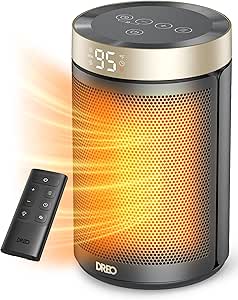
DREO Portable Ceramic Space Heater with Thermostat, 1500W, Gold
The DREO Portable Ceramic Space Heater is the most control-focused option in this group. Its thermostat adjusts in 1°F increments across a listed 41°F–95°F range, while ECO mode, a timer, and a remote make it easier to tailor operation than the simpler Amazon Basics three-mode heater. The 34 dB noise specification also makes it a strong candidate for bedrooms or focused work, compared with the Amazon Basics model’s listed 43 dB. However, its 1500W maximum does not make it a low-wattage heater; the value for energy-conscious buyers comes from adjustable control and an ECO mode, not a lower maximum draw. It is rated for rooms up to 200 square feet and includes a child lock and safety features. I would skip it if I only need basic, close-range warmth like the Gaiatop provides.
Pros:- Thermostat adjusts in 1°F increments across a 41°F–95°F range
- Listed 34 dB noise level is lower than the Amazon Basics model’s 43 dB
- ECO mode, 12-hour timer, remote, and child lock add control options
- Tip-over and overheat protection, flame-retardant materials, and safety plug are specified
Cons:- 1500W maximum output is not a low-wattage alternative to the Gaiatop Mini
- Corded electric operation limits placement to reach of an outlet
- Listed coverage is limited to rooms up to 200 sq. ft.
Best for: Bedroom and home-office users who want fine thermostat adjustment, quiet operation, and remote or timer controls.
Not ideal for: Shoppers prioritizing the lowest power draw or a basic personal desk heater; its maximum output is 1500W and its added controls may be unnecessary for close-range use.
- Model:HSH006
- Heating element and output:PTC ceramic; 1500W
- Heating coverage:Up to 200 sq. ft.
- Temperature range:41°F–95°F
- Noise level:34 dB
- Modes:Power heat, ECO, and fan only
- Dimensions and weight:6.02 × 6.02 × 10 in.; 3 lb
- Additional features:Remote, 12-hour timer, child lock, mute, memory function, and carry handle
- Safety features:Tip-over protection, overheat protection, flame-retardant materials, and safety plug
Our verdict“Choose the DREO if precise controls and quiet operation matter more than minimizing maximum wattage.”
1500W Electric Space Heater with Thermostat, Portable Ceramic Room Heater with Fan Modes for Indoor Use
This 1500W PTC ceramic heater is a basic middle ground for buyers who want more control than the Gaiatop Mini provides but do not need the DREO’s remote, timer, or child lock. It has an adjustable thermostat, multiple heat settings, and fan mode, so I can tailor how it operates without relying on a single fixed output. The compact body and ergonomic handle also make it practical to move between an office and bedroom. Its overheat protection and tip-over switch address two relevant safety risks. The main uncertainty is the lack of detailed noise information, unlike the DREO’s stated 34 dB rating, and the data gives no wattage for its lower settings. I would treat it as a convenient portable heater, not assume that its thermostat or “multiple” modes mean it draws less power than the listed 1500W maximum.
Pros:- PTC ceramic heating with multiple heat settings and fan mode
- Adjustable thermostat allows heat control
- Compact form and ergonomic handle make it portable
- Overheat protection and tip-over switch are specified
Cons:- No noise-level information is provided, unlike the DREO
- No wattage figures are given for its lower heat settings
- Requires a flat, stable surface for safe operation
Best for: Indoor users who want a portable ceramic heater with a thermostat and fan mode but do not need remote operation or a timer.
Not ideal for: Noise-sensitive bedroom users or buyers seeking a documented low-wattage setting; no noise level or mode-specific wattages are provided.
- Power:1500W
- Heating technology:PTC ceramic
- Operating modes:Multiple heat settings and fan
- Thermostat:Adjustable
- Safety features:Overheat protection and tip-over switch
- Portability:Compact design with ergonomic handle
- Intended use:Indoor use
Our verdict“Pick this model for portable thermostat-controlled heating, but choose the Gaiatop or DREO if low wattage or documented quietness is the priority.”
NewAir Portable 400-Watt Oil-Filled Space Heater
For a desk or bedside spot where quiet operation matters more than room-wide warmth, the NewAir’s 400-watt, fan-free oil-filled design is the most restrained choice in this group. It uses substantially less power than the 1500-watt OLIXIS or WINHL, which suits targeted supplemental heating, though it also means this is not a quick fix for a chilly room. Its diathermic oil heating avoids fan noise, while the carry handle and slim pedestal shape make it easier to reposition than a fixed heater. Compared with the 500-watt Amazon Basics Mini, NewAir is the quieter option, but the mini ceramic heater is described as heating quickly. Automatic shut-off and tip-over protection add useful safeguards; the tradeoff is a corded, indoor-only design that needs an outlet nearby.
Pros:- 400-watt draw is lower than the 1500-watt heaters in this lineup
- Fan-free oil-filled operation avoids fan noise
- Slim shape and carry handle help with placement and moving
- Automatic shut-off and tip-over protection are included
Cons:- Designed for personal or small-area heating rather than whole-room warmth
- Corded design requires access to an outlet
- Indoor use only
Best for: People working or sleeping near a heater who want quiet, low-watt supplemental warmth in a small area
Not ideal for: Buyers who need rapid heat across a room or want a heater that can run away from a wall outlet
- Power:400 watts
- Heating technology:Diathermic oil
- Operation:Fan-free, silent operation
- Safety features:Automatic shut-off and tip-over switch
- Power source:Corded electric
- Use:Indoor
- Form factor:Pedestal
Our verdict“Choose the NewAir for quiet, targeted warmth with lower wattage, not for quickly heating a whole room.”
Amazon Basics Ceramic Portable Mini Space Heater for Office Desk, Indoor Use, 500W, Tip-Over Protection, Black
The Amazon Basics Mini is a small, lightweight 500-watt option for warming the immediate area around a desk or table, rather than trying to heat an entire room. At 1.4 pounds and just under six inches tall, it is easier to tuck away or move between work spots than the larger 1500-watt OLIXIS and WINHL models. Its ceramic coils are described as providing fast heat, making it a practical alternative to the lower-watt NewAir, whose fan-free oil-filled design prioritizes quiet operation. That difference matters: this mini heater’s listed 48 dB noise level may be noticeable in a quiet office or bedroom. Tip-over protection is a useful safety feature, but the product data does not list the broader safety controls included with some larger heaters. Its compact size is also its main limit: coverage stays personal.
Pros:- Compact dimensions fit on a desk or table
- Lightweight at 1.4 pounds for easy repositioning
- 500-watt ceramic heating is intended for small spaces
- Tip-over protection is built in
Cons:- Limited power and size make it unsuitable for larger areas
- Listed 48 dB noise level may be distracting in quiet spaces
- Product data lists tip-over protection but not overheat protection
Best for: Desk workers who want a lightweight ceramic heater for warming the area near their chair
Not ideal for: People seeking quiet bedroom heat or warmth that reaches across a larger room
- Power:500 watts
- Heating technology:Ceramic coils
- Weight:1.4 lbs
- Dimensions:5.87 × 3.15 × 5.95 inches (D × W × H)
- Noise level:48 dB
- Safety feature:Tip-over protection
- Use:Indoor
Our verdict“Pick this mini ceramic heater for portable desk-side warmth if its noise and limited coverage suit your workspace.”
OLIXIS 23″ Space Heater for Indoor Use, 70° Oscillation, 4 Modes
Among these 1500-watt options, the OLIXIS is the pick for buyers who want warmth spread across a wider area rather than concentrated in one direction. Its 70° oscillation and adjustable 50°F–95°F temperature range give it more room-coverage flexibility than the non-oscillating Amazon Basics 1500W tabletop heater. A 12-hour timer and listed child lock, tip-over protection, and overheat shut-off also suit households that want more controls than the basic 400-watt NewAir offers. The tradeoff for that broader distribution is a 1500-watt draw, so it is not the low-power choice for minimizing electricity use; lower-watt heaters such as NewAir are better for strictly personal warmth. It also needs at least three feet of clearance from combustible materials and must connect directly to an outlet, not an extension cord or power strip.
Pros:- 70° oscillation spreads warmth beyond a single fixed direction
- Temperature control spans 50°F to 95°F
- 12-hour timer supports scheduled operation
- Tip-over protection, overheat shut-off, and child lock are listed
Cons:- 1500-watt power draw is much higher than the 400-watt NewAir
- Requires at least three feet of clearance from combustible materials
- Indoor-only use and no extension cords or power strips
Best for: Households wanting an oscillating supplemental heater with adjustable temperature, timer, and child lock
Not ideal for: Buyers prioritizing low wattage, or anyone who needs a heater for outdoor use or an extension-cord setup
- Power:1500 watts
- Oscillation:70°
- Temperature range:50°F to 95°F
- Timer:12 hours
- Modes:4
- Safety features:Tip-over protection, overheat shut-off, and child lock
- Use:Indoor
Our verdict“Choose the OLIXIS when spreading supplemental heat and having multiple controls matter more than keeping wattage low.”
Amazon Basics Portable Ceramic Space Heater, 1500W, Black
This Amazon Basics heater suits buyers who want three straightforward operating settings without moving up to the remote and oscillation features of the WINHL. Its low setting uses 900 watts, below its 1500-watt high setting, so it offers a way to reduce power use when full output is unnecessary; the fan-only mode provides airflow without heat. At 2.8 pounds, it is easy to move between indoor spots, and tip-over and overheat protection are included. Compared with the oscillating OLIXIS, this model has no side-to-side distribution, so warmth stays more directional. It also lacks a listed timer or remote, keeping the controls simpler. The 43 dB noise level may matter in quiet rooms, and the product is specifically unsuitable for bathrooms, laundry rooms, and other humid areas.
Pros:- 900-watt low setting draws less power than the 1500-watt high setting
- Fan-only mode adds an option without heat
- Lightweight 2.8-pound tabletop design is easy to move
- Tip-over and overheat protection are included
Cons:- Non-oscillating design directs heat in one direction
- Not suitable for bathrooms, laundry rooms, or other humid environments
- No timer or remote is listed
Best for: People who want a portable heater with a lower-power setting and fan-only mode for dry indoor rooms
Not ideal for: Buyers who need oscillation, remote control, or a heater for bathrooms and other humid spaces
- Heating power:1500 watts
- Settings:High (1500W), low (900W), and fan only
- Dimensions:7.52 × 6.34 × 9.45 inches
- Weight:2.8 pounds
- Voltage:120V
- Amperage:12.5A
- Noise level:43 dB
- Safety features:Tip-over protection, overheat protection, and power indicator light
- Usage:Indoor; avoid humid environments
Our verdict“Choose this Amazon Basics model for simple, movable heat with a lower-power setting, provided you do not need oscillation or humid-room use.”
WINHL Portable 1500W Ceramic Space Heater with Oscillation and Remote
The WINHL combines 70° oscillation, a remote, thermostat, and 12-hour timer in a compact tabletop heater, making it the most control-focused option here. Its five heating modes and ECO mode give buyers more ways to manage supplemental heat than the Amazon Basics 1500W model, which has high, low, and fan-only settings but no listed remote or oscillation. The WINHL still reaches 1500 watts, so it should not be mistaken for a low-watt alternative to the 400-watt NewAir or 500-watt Amazon Basics Mini. Instead, its appeal is convenience and broader warmth in a small room or personal area. Direct connection to a 15A wall outlet is required; extension cords and power strips are not recommended. The remote also needs two AAA batteries, which are not included.
Pros:- 70° oscillation distributes warmth across a wider area
- Remote, thermostat, ECO mode, and 12-hour timer add control options
- Compact tabletop dimensions suit desks and nightstands
- Overheat protection and tip-over shutoff are included
Cons:- 1500-watt draw is much higher than the low-watt NewAir and 500-watt mini heater
- Must plug directly into a 15A wall outlet; extension cords and power strips are not recommended
- Remote requires two AAA batteries, which are not included
Best for: People who want a compact supplemental heater with remote operation, oscillation, and timer control
Not ideal for: Buyers seeking genuinely low-watt heating, whole-house warmth, or a heater they can plug into an extension cord
- Heating power:1500 watts
- Heating element:PTC ceramic
- Oscillation:70°
- Heating modes:5
- Maximum temperature:95°F
- Timer:12 hours
- Dimensions:5.91 × 5.91 × 9.85 inches (D × W × H)
- Weight:1.47 kg
- Safety and certification:Overheat protection, tip-over shutoff, and ETL listed
Our verdict“Pick the WINHL for convenient, adjustable supplemental heat in a small space, not for minimizing wattage or heating an entire home.”
QQT Space Heater, Portable PTC Ceramic Indoor Space Heater for Office and Home, Quiet, Energy-Saving, Overheat & Tipping Protection, White
The QQT pairs a 1200W ceramic element with two heat settings, giving buyers a quieter small-room option without jumping to the 1500W maximum of the remote-controlled Space Heater with Thermostat. Its stated noise level below 30 dB suits a bedroom or focused work area where fan sound can be distracting, while tip-over and overheat shutoffs add practical safeguards. At a stated coverage of up to 200 sq. ft., it is aimed at warming a modest room, not replacing whole-home heating. The tradeoff is limited control: unlike the thermostat-equipped model, it has no listed thermostat, remote, or timer. I’d choose it for quiet, simple spot heating, but skip it if precise temperature management or smart-home functions matter.
Pros:- 1200W rating offers a lower maximum draw than 1500W heaters in the roundup.
- Claimed noise below 30 dB is suited to quiet work and sleep spaces.
- Two heating settings allow a lower-output option.
- Tip-over and overheat protection are listed, and the compact body has a built-in handle.
Cons:- No thermostat, timer, or remote is listed for more precise temperature control.
- Coverage is limited to indoor spaces stated to be up to 200 sq. ft.
- Warranty details are not provided.
Best for: People who want a quiet, straightforward heater for a bedroom or home office and can use its two settings for local comfort.
Not ideal for: Buyers who want a thermostat, timer, remote, smart-home control, or dependable heat for larger or drafty rooms.
- Power:1200 W
- Heating method:PTC ceramic
- Stated room coverage:Up to 200 sq. ft.
- Voltage:110 V
- Heating settings:2
- Noise level:Less than 30 dB (claimed)
- Safety features:Overheat protection and tipping protection
- Dimensions:8.2 x 5.9 x 5.5 in.
Our verdict“Choose the QQT for quiet, lower-wattage spot heating in a modest room, but pick the thermostat-equipped Space Heater with Remote if convenience and temperature control matter more.”
Amazon Basics Ceramic Space Heater, Portable Mini Heater for Office Desk, 500W with Tip-Over Protection
At 500W, this mini heater is the lowest-draw choice in this group, making it better suited to warming one person at a desk than trying to heat a room. That distinction matters: the QQT’s 1200W output and the remote-controlled heater’s settings up to 1500W offer more reach, while this Amazon Basics model keeps output modest and stays light at 1.4 lb. Tip-over protection suits tabletop placement, and its compact size is easy to move between a desk and nearby work area. The compromise is a single heat setting, so there is no lower mode or thermostat to adjust comfort. Its listed 48 dB is also louder than the QQT’s claimed under-30 dB operation. I’d pick it for personal warmth, not quiet room-wide heating.
Pros:- 500W output is the lowest listed draw among these four heaters.
- At 1.4 lb, it is easy to carry and reposition.
- Tip-over protection is useful for tabletop use.
- Compact dimensions fit a desk or small work surface.
Cons:- One heat setting gives less control than the two- and three-setting alternatives.
- Its modest output is not suited to warming a larger room.
- The stated 48 dB is louder than the QQT’s claimed noise level below 30 dB.
Best for: Desk workers who want a light, low-wattage heater aimed at personal warmth near a tabletop outlet.
Not ideal for: People heating a bedroom or larger room, or anyone who wants multiple heat settings, a thermostat, or especially quiet operation.
- Power:500 W
- Listed heating output:750 W
- Voltage:120 V
- Amperage:4.17 A
- Dimensions:5.87 x 3.2 x 6 in.
- Weight:1.4 lb
- Stated coverage:107.6 sq. ft.
- Heating settings:1
- Safety feature:Tip-over protection
Our verdict“Choose this Amazon Basics mini heater for low-wattage warmth at one desk, not for heating a whole room or managing temperature precisely.”
Space Heater, Portable Electric Heater with Remote, Thermostat, and Safety Features
This model gives buyers the most control of these four: its 700W, 1000W, and 1500W settings let them choose lower output for spot heating or more power when a small room needs a quicker warm-up. The built-in thermostat, remote, and 12-hour timer add day-to-day convenience that the simpler QQT lacks. That flexibility comes with a tradeoff for low-energy use: its highest setting draws more than the QQT’s 1200W maximum and far more than the 500W Amazon Basics desk heater. The listed 200 sq. ft. coverage also sets a modest-room limit, and remote operation requires batteries that are not included. I’d rank it ahead for buyers who value control, but not for someone whose main goal is the lowest possible wattage or simplest operation.
Pros:- Three wattage settings include a 700W option for lower-output heating.
- Thermostat and remote make adjustments easier than on the QQT.
- A 12-hour timer adds scheduling flexibility.
- Tip-over and overheat shutoffs are listed.
Cons:- The 1500W maximum draws more than the QQT’s 1200W maximum and the Amazon Basics 500W mini heater.
- Stated coverage is limited to 200 sq. ft.
- Remote requires batteries that are not included.
Best for: People who heat a small bedroom or office and want remote adjustments, a thermostat, a timer, and a lower-power setting.
Not ideal for: Buyers focused on minimum electrical draw, or those needing heat for a large room or an outdoor space.
- Heating settings:700 W, 1000 W, and 1500 W
- Heating method:Radiant
- Stated room coverage:200 sq. ft.
- Thermostat:Built-in
- Remote control:Yes; batteries not included
- Timer:12-hour
- Safety features:Overheat protection and tip-over shutoff
- Dimensions:5.91 x 5.91 x 8.46 in.
- Weight:2.2 lb
Our verdict“Pick this heater if adjustable output and remote convenience outweigh keeping wattage as low as possible.”
Space Heater, Portable Small Heaters for Indoor Use, Electric Desk Heater with Overheat and Tip-Over Protection, Mini Personal Heaters for Home Office Workspace, Blue
This blue PTC ceramic heater keeps its footprint small while offering two modes: 700W Eco for lower-output use and 1000W High when a little more heat is needed. That makes it a more flexible personal heater than the single-setting Amazon Basics 500W model, though it draws more even on its lower mode. Its listed 40 dB operation is quiet enough for many home-office settings, but it is not as quiet on paper as the QQT’s claimed level below 30 dB. Tip-over protection and auto shutoff add useful safety measures, while the built-in handle helps with moving it around indoors. A four-foot cord can limit where it sits, and two modes provide less fine control than the three settings, thermostat, and remote on the adjustable Space Heater.
Pros:- Eco mode runs at 700W, below its 1000W High setting.
- Compact dimensions and a built-in handle make it easy to reposition.
- Claimed 40 dB noise level suits many work areas.
- Auto shutoff and tilt protection are listed.
Cons:- The four-foot cord can restrict placement near an outlet.
- Two modes provide less adjustment than the remote-controlled heater’s three settings and thermostat.
- Its 700W Eco mode draws more than the Amazon Basics mini heater’s listed 500W.
Best for: Home-office users who want a compact ceramic heater with a lower Eco mode, a handle, and basic safety shutoffs.
Not ideal for: Buyers who need a long reach from the outlet, fine temperature control, or the lowest possible wattage for desk heating.
- Heating technology:PTC ceramic
- Heating modes:Eco: 700 W; High: 1000 W
- Stated coverage:Up to 200 sq. ft.
- Dimensions:5.28 x 4.45 x 8.5 in.
- Cord length:4 ft.
- Noise level:40 dB (claimed)
- Safety features:Auto shutoff and tilt protection
- Color:Blue
Our verdict“Choose this compact ceramic model for portable, two-level personal heating, but opt for the 500W Amazon Basics heater if minimizing wattage is the priority.”

How We Picked
I compared these heaters by how well their stated output, heat style, and controls fit the promise of lower-energy use. Wattage was a key ranking factor, but I also looked at intended scale: a 400W or 500W personal heater can use less power than a 1500W model, yet it is not a like-for-like replacement when heating a larger room. I weighed thermostat and mode controls, oscillation, portability, and listed safety features because they affect how buyers can direct heat and manage operation.
The ranking favors practical fit over feature count: low-wattage heaters lead for localized warmth, while higher-output models earn a place for buyers who need broader or faster-feeling heat. Among similar wattages, simpler models suit buyers who want fewer controls, while remote, oscillating, or more adjustable options offer added convenience with extra complexity. Product titles provide limited detail on construction, coverage, and control behavior, so I avoid treating unlisted performance claims as proven. No portable electric heater is automatically inexpensive to run; actual use depends on wattage, runtime, thermostat cycling, and the user’s electricity rate.
Factors to Consider When Choosing Lowenergy Heaters
Choosing a low-energy heater starts with matching its power to the area you occupy and how long you plan to use it. The following factors help separate genuinely useful personal heating from a higher-wattage room heater with extra features.
Match Wattage to the Space You Actually Use
Wattage gives a useful ceiling for electricity draw while a heater is running, but it does not tell you how comfortably it will heat your particular space. A 400W or 500W model is most sensible near a desk, chair, or other fixed spot; expecting it to warm a drafty room can lead to long runtimes and disappointment. Higher-output models can deliver more heat, but they may use more electricity while operating at full power. Room size, ceiling height, insulation, outside temperature, and open doorways all change the result. A common mistake is buying the lowest-wattage option for a room that needs broader heating. Choose for the area you occupy, then use central heating or another source for the rest of the home if needed.
Think About Heat Style and Warm-Up Time
Ceramic heaters use a fan to move warmth into the nearby area, which can make heat feel more immediate but also creates airflow and some operating noise. Oil-filled heaters warm more gradually and do not depend on a fan to circulate heat, which may suit someone sitting close by for longer periods. Neither design is automatically more energy-efficient at the same power draw; comfort, thermostat behavior, and runtime matter. If you need a quick burst at a desk, fan-assisted heat may feel more responsive. If fan noise or moving air bothers you, a slower, quieter style may be a better match. Do not judge efficiency by how warm the air feels in the first few minutes alone.
Use Controls to Limit Unneeded Runtime
A thermostat, multiple heat modes, and a timer or remote can make it easier to run a heater only when and where warmth is needed. These controls do not reduce the maximum wattage by themselves, but a lower setting or automatic cycling may reduce the time spent drawing full power. Check what each control actually offers rather than assuming every heater with a thermostat can hold a precise temperature. A remote is convenient when the heater is across the room, while basic manual controls may be simpler for a fixed desk setup. Avoid choosing a feature-rich model if you will not use its adjustments. For lower consumption, operating habits matter as much as the control panel.
Treat Safety Features as a Baseline, Not a Bonus
Tip-over and overheat protection are useful safeguards, especially in busy rooms or near pets, but they do not remove the need for careful placement. Keep heaters on a stable, level surface and away from bedding, curtains, paper, and other combustible materials. Follow the manufacturer’s instructions for clearance, outlet use, and continuous operation. Do not use an extension cord unless the manual explicitly permits it, and avoid placing a heater where it can be knocked over or blocked. A low-wattage heater still produces heat and needs safe surroundings. If the listed safety information is unclear, consult the product manual before use.
Consider Noise, Airflow, and Placement
For a bedroom, shared office, or study area, fan noise and moving air can matter as much as heating capacity. Oscillation may distribute warmth across a wider part of an occupied space, but it does not reduce the heater’s power draw. Compact desk models are easier to position close to one person, though placing any heater too near the body or objects can create safety concerns. Think about where the unit can sit without blocking walkways, vents, or furniture. If you want heat across a larger area, check the manufacturer’s stated coverage rather than relying on the heater’s size or oscillation alone. A quiet, well-positioned heater can be more useful than a more powerful model aimed at an empty part of the room.
Estimate Running Cost Before Choosing Features
To estimate energy use, multiply the heater’s kilowatt rating by the number of hours it runs, then multiply that figure by your electricity rate. For example, a 500W unit is 0.5 kilowatts, so one hour at full output uses 0.5 kilowatt-hours; a thermostat may reduce actual usage by cycling the heater off. Compare that estimate with how often you expect to use the unit, not just its wattage label. Buying a higher-wattage heater for occasional quick warmth may make sense, while long daily sessions call for closer attention to settings and runtime. Avoid assuming that a heater labeled energy-saving will cost less to run without checking its power and your usage pattern. Added remotes and modes can improve convenience, but the savings come from using less energy overall.
Frequently Asked Questions
Can a 400W or 500W heater warm an entire bedroom?
These low-wattage models are primarily suited to personal or close-range warmth, and their ability to affect a whole bedroom depends on room size, insulation, drafts, and outdoor conditions. They are unlikely to replace a higher-output heater or central heating in a larger or poorly insulated room. For a small, enclosed space, a 500W unit may make the occupied area feel more comfortable over time. Keep doors and windows closed where practical, and avoid expecting fast whole-room heating. If broad coverage is your main need, compare the higher-output models and check manufacturer coverage guidance.
Does a lower-wattage heater always cost less to run?
A lower-wattage heater uses less electricity per hour when operating at its stated output, but total cost also depends on runtime and how often the thermostat cycles. A small heater that runs continuously may use more energy over a long session than a more powerful model that warms a space quickly and switches off. Compare kilowatt-hours, not just the wattage printed on the product. Your electricity rate and the room’s heat loss also affect the bill. Pick a unit that can make the area comfortable without needing excessive runtime.
Is an oil-filled heater more efficient than a ceramic heater?
Oil-filled and ceramic heaters convert electricity into heat, so the design alone does not guarantee lower energy use. The NewAir model’s 400W rating limits its power draw compared with the 1500W ceramic options, but it also provides less output and warms more gradually. Ceramic fan heaters can feel faster because they move warm air, while an oil-filled unit may suit someone who prefers heat without fan airflow. The more useful comparison is wattage, how long each heater must run, and the comfort you need. Choose by use case rather than assuming one technology is always cheaper.
Should I choose a heater with oscillation or a remote?
Oscillation can spread warmth across a wider part of a room, and a remote makes it easier to adjust settings without walking to the unit. Neither feature cuts the heater’s power draw by itself, so they matter most when they help you use the heater more conveniently or direct warmth where people are sitting. A fixed desk setup may not benefit much from oscillation, while a shared space may. Simpler models can be a better fit if you want basic heat with fewer controls to manage. Check whether the settings you value are clearly specified before choosing a feature-rich model.
What should I do if I need low-energy heat for a larger room?
Start by checking the room’s insulation, drafts, and the manufacturer’s stated coverage for the heater; low-wattage personal models are not intended to heat a large area quickly. A higher-output ceramic unit may offer broader or faster-feeling warmth, but it can draw more electricity at full power. Heating only the occupied zone, closing doors, and using thermostat or lower-mode settings can help limit unnecessary use. If the space needs sustained whole-room heat, compare the heater’s running cost with your existing heating system rather than relying on wattage alone. Keep the unit safely positioned and follow its manual regardless of room size.
Conclusion
For most buyers seeking a balance of low draw and personal comfort, my best overall pick is the NewAir 400-Watt Oil-Filled Space Heater; its limited output suits gradual, close-range warmth rather than whole-room heating. For best value and best for beginners, I would start with a straightforward 500W mini heater such as the Gaiatop or an Amazon Basics desk model, provided the goal is to warm one person’s workspace. The best premium-style choice in this lineup is the DREO 1500W ceramic heater for buyers who want more control and higher output, with the clear tradeoff of greater potential energy use. Choose the OLIXIS or WINHL if oscillation is useful for spreading warmth, and favor a low-wattage mini model for a compact desk setup. If you need broad, sustained heat for a large room, none of the lowest-wattage picks should be treated as a substitute for a correctly sized heating plan.