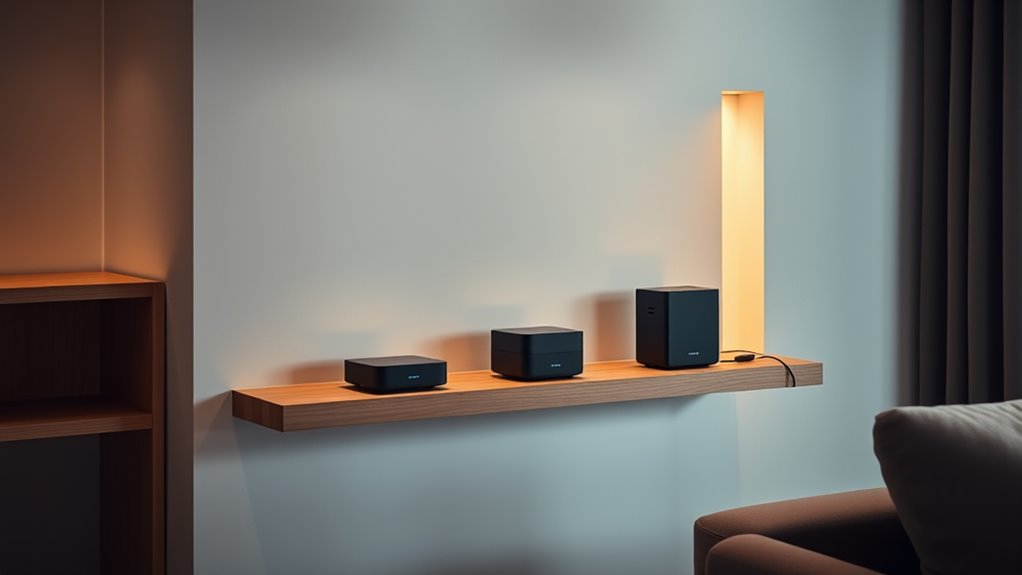

For those seeking a reliable, high-performance mesh WiFi system with ethernet backhaul, this category offers numerous options that promise seamless coverage and faster speeds. The best overall pick, the TP-Link Deco X15, balances affordability with solid WiFi 6 performance and easy setup. The Tenda BE5100 stands out for its WiFi 7 support, ideal for future-proofing, while the AX1800 WiFi 6 System offers impressive gigabit Ethernet ports for more wired flexibility. However, tradeoffs include higher costs for advanced features or limited coverage for smaller setups. Continue reading for a detailed breakdown of each option to match your specific needs.
Complete the kit


Key Takeaways
- Ethernet backhaul significantly improves mesh network stability and speed, especially in large homes or environments with interference.
- WiFi 6 and WiFi 7 systems offer future-proofing with higher speeds and better device handling, but come at a premium price.
- Most top products include multiple gigabit Ethernet ports, enabling wired backhaul and device connections for better performance.
- Coverage range varies widely, so selecting a kit with enough nodes to cover your space is crucial—more nodes generally mean better coverage but higher cost.
- Ease of setup and management features are key differentiators; systems with user-friendly apps tend to offer smoother installation and ongoing control.
| DBIT AC1200 Whole Home Mesh WiFi System, Covers up to 6,000 Sq Ft, Dual-Band 1200Mbps, 3-Pack |  | Best Overall for Large Homes with Extensive Device Support | Speed: 1200Mbps | Coverage: 6000 sq ft | Number of Nodes: 3 | VIEW ON AMAZON | See Our Full Breakdown |
| AX1800 WiFi 6 Whole Home Mesh Wi-Fi System (3-Pack, 6 Gigabit Ethernet Ports) |  | Best for Future-Proof Speed and Large Device Support | Speed: up to 1.8 Gbps | Coverage: 6500 sq ft | Number of Units: 3 | VIEW ON AMAZON | See Our Full Breakdown |
| TP-Link Deco X15 Dual-Band AX1500 WiFi 6 Mesh Wi-Fi System, 2-Pack |  | Best for Easy Setup and Moderate Coverage | Wi-Fi Standard: Wi-Fi 6 (AX1500) | Coverage: up to 3,900 sq ft | Number of Units: 2 | VIEW ON AMAZON | See Our Full Breakdown |
| WAVLINK AX3000 WiFi 6 Mesh System 1 Pack |  | Best for High-Speed Single-Room or Small Homes with Wired Flexibility | Speed: Up to 3.0 Gbps | Coverage: 2,500 sq ft | Number of Ports: 3 | VIEW ON AMAZON | See Our Full Breakdown |
| TP-Link Deco X55 AX3000 WiFi 6 Mesh System (3-Pack) |  | Best for Extensive Coverage with Wired Backhaul Support | Wi-Fi Standard: Wi-Fi 6 (AX3000) | Coverage: 6500 sq ft | Number of Units: 3 | VIEW ON AMAZON | See Our Full Breakdown |
| TP-Link Deco X15 Dual-Band AX1500 WiFi 6 Mesh Wi-Fi System, 3-Pack |  | Best Overall for Extensive Coverage and Device Support | Wi-Fi Standard: Wi-Fi 6 (AX1500) | Coverage: up to 5,600 sq.ft. | Number of Units: 3 | VIEW ON AMAZON | See Our Full Breakdown |
| Tenda AX3000 WiFi 6 Mesh System Nova MX12 (3-Pack) |  | Best Value for Large Coverage and High Device Capacity | Wi-Fi Standard: Wi-Fi 6 (802.11ax) | Speed: 2976 Mbps | Coverage: 7000 sq.ft. | VIEW ON AMAZON | See Our Full Breakdown |
| WAVLINK AX3000 WiFi 6 Mesh System 2 Pack |  | Best for Speed and Large Device Support in Medium to Large Homes | Speed: up to 3.0 Gbps | Coverage: 5,000 sq.ft. | Bands: Dual-Band | VIEW ON AMAZON | See Our Full Breakdown |
| TP-Link Deco 7 BE23 Dual-Band WiFi 7 Mesh System (3-Pack) |  | Best for Future-Proofing and High-Speed Gaming | Wi-Fi Technology: Wi-Fi 7 | Maximum Speed: 3.6 Gbps | Coverage: up to 6,500 sq.ft. | VIEW ON AMAZON | See Our Full Breakdown |
| Tenda BE5100 WiFi 7 Mesh WiFi System – 3-Pack |  | Best for Large Homes Needing Wired Backhaul and VPN Support | WiFi Generation: WiFi 7 | Coverage: 6,600 sq.ft. | Number of Ports: 3 | VIEW ON AMAZON | See Our Full Breakdown |
| ethernet backhaul mesh wifi kit | Coverage | Speed | Number of Units | Wi-Fi Standard |
|---|---|---|---|---|
| DBIT AC1200 Whole Home Mesh Wi | 6000 sq ft | 1200Mbps | — | — |
| AX1800 WiFi 6 Whole Home Mesh | 6500 sq ft | up to 1.8 Gbps | 3 | Wi-Fi 6 (802.11ax) |
| TP-Link Deco X15 Dual-Band AX1 | up to 3,900 sq ft | — | 2 | Wi-Fi 6 (AX1500) |
| WAVLINK AX3000 WiFi 6 Mesh Sys | 2,500 sq ft | Up to 3.0 Gbps | — | — |
| TP-Link Deco X55 AX3000 WiFi 6 | 6500 sq ft | — | 3 | Wi-Fi 6 (AX3000) |
| TP-Link Deco X15 Dual-Band AX1 | up to 5,600 sq.ft. | — | 3 | Wi-Fi 6 (AX1500) |
| Tenda AX3000 WiFi 6 Mesh Syste | 7000 sq.ft. | 2976 Mbps | — | Wi-Fi 6 (802.11ax) |
| WAVLINK AX3000 WiFi 6 Mesh Sys | 5,000 sq.ft. | up to 3.0 Gbps | — | — |
| TP-Link Deco 7 BE23 Dual-Band | up to 6,500 sq.ft. | — | 3 | — |
| Tenda BE5100 WiFi 7 Mesh WiFi | 6,600 sq.ft. | — | — | — |
More Details on Our Top Picks
DBIT AC1200 Whole Home Mesh WiFi System, Covers up to 6,000 Sq Ft, Dual-Band 1200Mbps, 3-Pack
This system stands out for its impressive coverage of up to 6,000 sq ft, making it ideal for large residences. Compared with the TP-Link Deco X15, it offers a higher maximum device capacity (>90 vs. 120 devices), but lacks explicit WiFi 6 support, which can be a drawback for future-proofing. The 12 Gigabit Ethernet ports facilitate robust wired backhaul and device connections, enhancing stability. Setup is straightforward via app or web GUI, and security features like WPA3 are included. However, compatibility may depend on your ISP plan, and deploying multiple units is necessary for complex layouts or very large homes. Overall, this system suits those who prioritize extensive coverage and wired connectivity over the latest WiFi standards.
Pros:- Extensive coverage up to 6,000 sq ft
- Supports over 90 devices simultaneously
- Includes 12 Gigabit Ethernet ports for wired backhaul
Cons:- Compatibility may vary depending on ISP plan
- No explicit WiFi 6 or WiFi 6E support, limiting future upgrades
Best for: Large households seeking broad coverage and reliable wired backhaul for many devices
Not ideal for: Users with small apartments or those wanting WiFi 6 features at a lower price point
- Speed:1200Mbps
- Coverage:6000 sq ft
- Number of Nodes:3
- Frequency Band:Dual-Band
- Ports:12 Gigabit Ethernet
- Security Protocol:WPA3-SAE
- Compatibility:Most major U.S. ISPs
- Control Method:App Control
Our verdict“This system is best suited for large homes needing extensive wired and wireless coverage, with a focus on device capacity and coverage area.”
AX1800 WiFi 6 Whole Home Mesh Wi-Fi System (3-Pack, 6 Gigabit Ethernet Ports)
This mesh system shines with WiFi 6 support, providing speeds up to 1.8 Gbps, ideal for heavy streaming and gaming. Compared to the TP-Link Deco X15, it offers faster WiFi 6 speeds but in a similar 3-pack setup, with the added benefit of MU-MIMO and OFDMA technology supporting up to 150 devices. Its 6 Ethernet ports allow flexible wired backhaul, though fewer than the 12 on the DBIT AC1200, which may matter for users with many wired devices. Setup is straightforward via app or push button, but only compatible with WiFi 6 devices to fully realize the speed benefits. This makes it a solid choice for tech-savvy households needing high-speed, future-ready wireless coverage, but less appealing if your devices are older or if you require more than three units for larger spaces.
Pros:- Supports WiFi 6 speeds up to 1.8 Gbps
- Coverage up to 6,500 sq ft.
- Supports up to 150 devices with MU-MIMO and OFDMA
Cons:- Requires compatible WiFi 6 devices to maximize benefits
- Limited to 3 units, possibly requiring more for very large homes
Best for: Tech-savvy users with WiFi 6 devices and large device counts who want fast, reliable internet
Not ideal for: Users with predominantly WiFi 5 devices or small homes that don’t need high speed or extensive coverage
- Speed:up to 1.8 Gbps
- Coverage:6500 sq ft
- Number of Units:3
- Ethernet Ports:6
- Wi-Fi Standard:Wi-Fi 6 (802.11ax)
- Security Protocol:WPA3
Our verdict“Ideal for households with WiFi 6-compatible devices that need fast speeds and wide coverage, but less suited for older device ecosystems.”
TP-Link Deco X15 Dual-Band AX1500 WiFi 6 Mesh Wi-Fi System, 2-Pack
The Deco X15 2-pack offers reliable dual-band WiFi 6 coverage up to 3,900 sq ft, making it suitable for medium-sized homes. Compared with the AX1800 system, it’s slightly less speedy but benefits from a well-established app for setup and voice control support, making it more accessible to less technical users. Its AI-driven mesh technology helps optimize network performance, but with only 2 units, larger homes might require an additional node or wired backhaul for better performance. It supports up to 120 devices, which is sufficient for most households, but the limited Ethernet ports per unit can restrict wired device connectivity. Overall, it’s a balanced choice for those seeking straightforward setup with decent coverage without the latest WiFi 6E features.
Pros:- Simple setup via Deco app and voice control
- Supports WiFi 6 with up to 3,900 sq ft coverage
- AI mesh technology for self-optimization
Cons:- Limited to 2 units, possibly insufficient for very large homes
- Fewer Ethernet ports per unit, restricting wired device connections
Best for: Homeowners seeking easy setup and solid WiFi 6 performance in medium-sized homes
Not ideal for: Power users looking for maximum device capacity or extensive wired backhaul options
- Wi-Fi Standard:Wi-Fi 6 (AX1500)
- Coverage:up to 3,900 sq ft
- Number of Units:2
- Maximum Speed:1,201 Mbps on 5 GHz and 300 Mbps on 2.4 GHz
- Supports Ethernet Backhaul:Yes
- Device Support:up to 120 devices
Our verdict“A good pick for users wanting straightforward WiFi 6 coverage and easy management in medium-sized homes.”
WAVLINK AX3000 WiFi 6 Mesh System 1 Pack
The WAVLINK AX3000 offers impressive WiFi 6 speeds up to 3 Gbps, with coverage of 2,500 sq ft, making it suitable for smaller homes or single-room upgrades. Its support for multi-device environments (over 256 devices) and flexible wired or wireless backhaul options provide versatility. Compared to multi-node systems like the Deco X15, it’s a straightforward 1-pack, which simplifies setup for smaller spaces but limits coverage unless additional units are added. The inclusion of multiple control options, including remote management, adds convenience. However, without additional nodes, it’s less effective for larger homes, and the price is not specified, which may influence value. This system fits users wanting fast, wired/wireless connectivity in a compact form, but not those requiring extensive multi-room coverage without expansion.
Pros:- Fast WiFi 6 speeds up to 3 Gbps
- Supports over 256 devices simultaneously
- Flexible wired or wireless backhaul options
Cons:- Limited to a single unit, restricting coverage in larger homes
- Price not specified, potentially affecting value perception
Best for: Small homes, apartments, or users needing high-speed wired and wireless connectivity in a limited space
Not ideal for: Large homes or multi-room setups that require multiple nodes for coverage
- Speed:Up to 3.0 Gbps
- Coverage:2,500 sq ft
- Number of Ports:3
- Wi-Fi Generation:WiFi 6
- Security:WPA3
- Control Methods:App, Push Button, Remote
Our verdict“Best for small homes or apartments seeking high-speed WiFi 6 with flexible wired connectivity options, but lacks multi-node coverage for larger spaces.”
TP-Link Deco X55 AX3000 WiFi 6 Mesh System (3-Pack)
The Deco X55 3-pack offers comprehensive coverage of up to 6,500 sq ft, making it ideal for very large homes or multi-story setups. Its support for Ethernet backhaul enhances speed stability and reduces interference compared to wireless-only systems like WAVLINK. With WiFi 6 speeds up to 3 Gbps and support for 150 devices, it strikes a balance between capacity and coverage. The setup via Deco app simplifies management, and the inclusion of advanced security features supports safe browsing. Compared to the AX1800, it provides higher coverage and more Ethernet ports per unit, but at a likely higher price. This system appeals to those needing extensive coverage, wired flexibility, and future-proof WiFi 6 technology, though it requires a modem for most ISPs.
Pros:- Coverage up to 6,500 sq ft
- Supports up to 150 devices with WiFi 6
- Supports Ethernet backhaul for improved speeds
Cons:- Requires a modem for most ISPs
- Price may be higher compared to simpler systems
Best for: Large households or multi-story homes requiring wired backhaul and extensive coverage
Not ideal for: Small apartments or users seeking budget-friendly, basic WiFi solutions
- Wi-Fi Standard:Wi-Fi 6 (AX3000)
- Coverage:6500 sq ft
- Number of Units:3
- Ethernet Ports per Unit:3
- Total Ethernet Ports:6
- Maximum Devices Supported:150
- Backhaul Support:Ethernet
Our verdict“Excellent for large homes needing wired backhaul and extensive WiFi coverage, with support for many devices and future-ready WiFi 6 technology.”
TP-Link Deco X15 Dual-Band AX1500 WiFi 6 Mesh Wi-Fi System, 3-Pack
The TP-Link Deco X15 stands out for offering expansive coverage up to 5,600 sq.ft., making it ideal for large homes. Its support for up to 120 devices with Wi-Fi 6 ensures high-speed connectivity even with many gadgets, surpassing some models like the WAVLINK AX3000 in device capacity. The AI-driven mesh technology helps optimize network performance, but setup may challenge less tech-savvy users. Compared to the TP-Link Deco 7 BE23, it provides broader coverage and better device support, though it requires a modem and may be complex to configure.
Pros:- Extensive coverage up to 5,600 sq.ft.
- Supports up to 120 devices with Wi-Fi 6
- AI-driven mesh for performance optimization
- Includes security and parental controls
Cons:- Requires a modem for internet connection
- Setup may be complicated for non-technical users
Best for: Homeowners with large properties needing robust, high-capacity Wi-Fi coverage and multiple device support
Not ideal for: Users seeking a simple plug-and-play setup without technical configuration, as setup can be complex
- Wi-Fi Standard:Wi-Fi 6 (AX1500)
- Coverage:up to 5,600 sq.ft.
- Number of Units:3
- Ethernet Ports per Unit:2 Gigabit
- Supports Ethernet Backhaul:Yes
- Device Support:up to 120 devices
Our verdict“This system suits large homes and tech-savvy users who prioritize broad coverage and high device capacity.”
Tenda AX3000 WiFi 6 Mesh System Nova MX12 (3-Pack)
The Tenda AX3000 Nova MX12 offers impressive coverage of up to 7,000 sq.ft., making it a compelling choice over smaller systems like the WAVLINK AX3000. With Wi-Fi 6 speeds reaching 2976 Mbps and support for over 160 devices, it excels at supporting busy households or small offices. The setup process is straightforward via app or web, but it’s incompatible with other mesh systems like MW series and requires manual firmware updates for peak performance. Compared to the TP-Link Deco X15, it provides larger coverage and higher device capacity at potentially a better price point for extensive setups.
Pros:- Large coverage up to 7,000 sq.ft.
- Supports over 160 devices with Wi-Fi 6
- Easy setup via app or web interface
- Supports MU-MIMO and OFDMA for efficiency
Cons:- Incompatible with MW series mesh network products
- Requires manual firmware updates for best performance
Best for: Families or small offices needing large coverage and support for many devices without complex networking requirements
Not ideal for: Users seeking seamless compatibility with other mesh brands or who prefer plug-and-play simplicity
- Wi-Fi Standard:Wi-Fi 6 (802.11ax)
- Speed:2976 Mbps
- Coverage:7000 sq.ft.
- Number of Ports:9
- Antenna Count:6
- Security Protocol:WPA3
Our verdict“This mesh system offers excellent coverage and capacity for large homes and busy environments with a preference for straightforward management.”
WAVLINK AX3000 WiFi 6 Mesh System 2 Pack
The WAVLINK AX3000 offers fast dual-band Wi-Fi 6 speeds up to 3.0 Gbps for streaming, gaming, and large file transfers, outperforming some basic mesh kits. Its coverage of 5,000 sq.ft. is suitable for medium to large homes, and supporting over 256 devices makes it ideal for busy environments. The system’s wired or wireless backhaul flexibility adds reliability, but setup can be complex for less experienced users. Compared to the TP-Link Deco X15, WAVLINK emphasizes speed and large device support, though it’s more expensive and requires compatible devices to realize Wi-Fi 6’s full benefits.
Pros:- Fast Wi-Fi 6 speeds up to 3.0 Gbps
- Supports over 256 devices simultaneously
- Coverage up to 5,000 sq.ft.
- Flexible wired or wireless backhaul
Cons:- Requires compatible Wi-Fi 6 devices to maximize benefits
- Setup process may be complex for novices
Best for: Tech-forward users who need high-speed coverage over large areas with many connected devices
Not ideal for: Simplistic users or those seeking a straightforward setup, as the process can be somewhat involved
- Speed:up to 3.0 Gbps
- Coverage:5,000 sq.ft.
- Bands:Dual-Band
- Number of Antennas:5
- Wi-Fi Generation:WiFi 6
- Security:WPA3
Our verdict“Ideal for users prioritizing speed and large device capacity in a sizable home or office environment.”
TP-Link Deco 7 BE23 Dual-Band WiFi 7 Mesh System (3-Pack)
The TP-Link Deco 7 BE23 introduces Wi-Fi 7 technology, making it a forward-looking choice for high-speed streaming and gaming. Covering up to 6,500 sq.ft., it surpasses many Wi-Fi 6 systems like the Deco X15 in speed and bandwidth, supporting over 150 devices. The multi-link operation and wired backhaul provide extremely stable connections, but its reliance on Wi-Fi 7 devices limits immediate use for most consumers. Compared to Wi-Fi 6 options, it comes at a higher price but promises future compatibility and top-tier performance for demanding users.
Pros:- Fast Wi-Fi 7 speeds up to 3.6 Gbps
- Wide coverage up to 6,500 sq.ft.
- Supports over 150 devices
- Advanced security features including WPA3
Cons:- Requires compatible Wi-Fi 7 devices
- Price point may be higher than Wi-Fi 6 systems
Best for: Tech enthusiasts and gamers seeking the latest Wi-Fi standard with maximum coverage and speed
Not ideal for: Average users or those on a tight budget who do not plan to upgrade to Wi-Fi 7 devices soon
- Wi-Fi Technology:Wi-Fi 7
- Maximum Speed:3.6 Gbps
- Coverage:up to 6,500 sq.ft.
- Number of Units:3
- Ports:2× 2.5G Ethernet
- Supported Devices:over 150
Our verdict“Best suited for early adopters aiming for maximum future-proofing and top speeds in large areas.”
Tenda BE5100 WiFi 7 Mesh WiFi System – 3-Pack
The Tenda BE5100 offers extensive coverage up to 6,600 sq.ft. combined with Wi-Fi 7 speeds, matching high-end systems like the Deco 7 but at a competitive price. Its support for wired Ethernet backhaul provides more reliable connections, especially in large or obstacle-filled homes. The system supports over 150 devices and includes VPN compatibility, making it suitable for security-conscious users. Where it differs from other Wi-Fi 7 options, it emphasizes wired backhaul and VPN features, though it does not support the new 6GHz band, which could limit future speeds.
Pros:- Extensive coverage up to 6,600 sq.ft.
- Supports Wi-Fi 7 speeds and over 150 devices
- Supports wired Ethernet backhaul for stability
- VPN ready with WPA3 security
Cons:- No support for 6GHz band
- Setup and management require app use
Best for: Large households needing wired backhaul and enhanced security features for smart home or small office setups
Not ideal for: Users without Ethernet wiring or those who don’t need VPN support, as these features are less relevant
- WiFi Generation:WiFi 7
- Coverage:6,600 sq.ft.
- Number of Ports:3
- Port Types:1× 2.5G, 2× 1G
- Supported Protocols:Wi-Fi 6, Wi-Fi 7
- Wired Backhaul Support:Yes
Our verdict“This system is well-suited for large homes with wired infrastructure and a focus on security and reliability.”
How We Picked
The products in this roundup were selected based on a combination of performance, build quality, and versatility. We prioritized systems that support ethernet backhaul, ensuring wired stability in addition to WiFi coverage. Performance in real-world environments, such as speed and range, was evaluated through available specifications and user feedback. Cost-effectiveness was also considered, balancing features against price. The ranking reflects how well each kit balances these factors, with extra weight given to future-proofing features like WiFi 6 and WiFi 7, as well as ease of setup for typical users.| ethernet backhaul mesh wifi kit | Wi-Fi Standard |
|---|---|
| DBIT AC1200 Whole Home Mesh Wi | — |
| AX1800 WiFi 6 Whole Home Mesh | Wi-Fi 6 (802.11ax) |
| TP-Link Deco X15 Dual-Band AX1 | Wi-Fi 6 (AX1500) |
| WAVLINK AX3000 WiFi 6 Mesh Sys | — |
| TP-Link Deco X55 AX3000 WiFi 6 | Wi-Fi 6 (AX3000) |
| TP-Link Deco X15 Dual-Band AX1 | Wi-Fi 6 (AX1500) |
| Tenda AX3000 WiFi 6 Mesh Syste | Wi-Fi 6 (802.11ax) |
| WAVLINK AX3000 WiFi 6 Mesh Sys | — |
| TP-Link Deco 7 BE23 Dual-Band | — |
| Tenda BE5100 WiFi 7 Mesh WiFi | — |
Factors to Consider When Choosing Ethernet Backhaul Mesh Wifi Kits
Choosing the right ethernet backhaul mesh WiFi kit involves understanding several key factors that influence performance and value. Beyond basic coverage, consider how future device demands, wired connectivity options, and ease of installation can impact your experience. Making informed decisions on these aspects helps avoid common pitfalls like underestimating coverage needs or overspending on unnecessary features.Coverage and Scalability
Assess your home’s size and layout to determine how many nodes you’ll need. Larger spaces or homes with multiple floors benefit from more nodes or higher power units. Consider whether the system allows easy expansion, so you can add nodes later without replacing the entire setup. Avoid systems with limited mesh scalability if you anticipate future growth in device count or coverage area.
Wired Ethernet Backhaul Support
Ensure the system explicitly supports ethernet backhaul—this feature allows wired connections between nodes, significantly improving stability and speed. Not all mesh kits include this feature or make setup straightforward. Wired backhaul is especially beneficial in dense environments where wireless signals may struggle, or if you plan to connect high-bandwidth devices directly to the mesh points.
WiFi Standard and Speed
WiFi 6 and WiFi 7 standards deliver future-proofing with higher throughput and better device handling. WiFi 7, being newer, offers even greater performance but often at a higher cost. Consider your current device ecosystem and future needs—upgrading to a system with a newer standard can be a worthwhile investment if you demand maximum speeds or have many connected devices.
Ease of Setup and Management
User-friendly apps and straightforward installation processes are often overlooked but make a big difference, especially for non-technical users. Look for systems with intuitive controls, good customer support, and features like remote management. Poor setup experiences can lead to frustration and subpar network performance, so prioritize brands known for smooth onboarding.
Price and Value
While premium systems offer advanced features, they also come with higher price tags. Balance your budget with your coverage and performance needs. Sometimes, a mid-range WiFi 6 system with ethernet backhaul provides the best value for most households, whereas specialized setups or future-proofing might justify higher investments. Watch for hidden costs like additional nodes or accessories.
Frequently Asked Questions
Is ethernet backhaul necessary for a mesh WiFi system?
Ethernet backhaul is not strictly necessary but provides a significant boost in stability and speed, especially in larger or interference-prone environments. Wireless backhaul can suffice for smaller homes or less demanding setups, but wired connections eliminate common issues like signal interference and congestion. If your home has the infrastructure for wired backhaul, opting for it will generally deliver a more reliable network experience.
Can I upgrade my existing mesh system to include ethernet backhaul?
Upgrading depends heavily on the system’s design. Some mesh kits support adding wired connections easily, while others require replacing the entire setup. Check whether your current nodes have Ethernet ports and if the system’s firmware or management app supports wired backhaul. Installing wired backhaul can be a straightforward upgrade on systems designed for it, but incompatible models might need a full replacement to gain this feature.
How does WiFi 6 or WiFi 7 improve mesh performance over older standards?
WiFi 6 and WiFi 7 standards dramatically increase network efficiency, speed, and device capacity. They handle multiple concurrent devices more effectively, reducing lag and congestion. For mesh systems, this means smoother streaming, gaming, and file transfers, especially in busy households. Investing in these standards future-proofs your setup, ensuring compatibility with upcoming devices and higher bandwidth demands.
What should I consider if I have a multi-story home?
Multi-story homes benefit from systems with strong coverage and the ability to place nodes on different floors. Ethernet backhaul becomes particularly valuable here, as wired connections between floors can drastically improve reliability. Additionally, look for units with high power and coverage range. Proper placement of nodes to minimize interference and maximize signal strength is also critical, so choose a system with flexible placement options.
Is WiFi 7 worth the extra cost right now?
WiFi 7 offers faster speeds and lower latency, making it appealing for future-proofing, especially if you have or plan to buy high-bandwidth devices like 8K streamers or gaming PCs. However, current devices may not fully utilize WiFi 7’s capabilities, so the benefits might be limited unless you upgrade your entire ecosystem. If you prioritize cutting-edge performance and want to invest in a system that will stay relevant longer, WiFi 7 can be a good choice, but for most users, WiFi 6 remains a more cost-effective option today.
Conclusion
For most households seeking a reliable, high-speed mesh network with wired backhaul support, the TP-Link Deco X15 offers a strong balance of features, coverage, and affordability. Those who prioritize future-proofing and have a higher budget should consider the Tenda BE5100 with WiFi 7 for the latest technology. Beginners or less tech-savvy users will benefit from systems with intuitive apps and straightforward setup, such as the WAVLINK AX3000. Larger homes or multi-floor layouts will gain from systems with multiple Ethernet ports and expandable mesh options. Ultimately, choosing the right kit depends on your coverage needs, device ecosystem, and budget—this roundup helps clarify those tradeoffs.