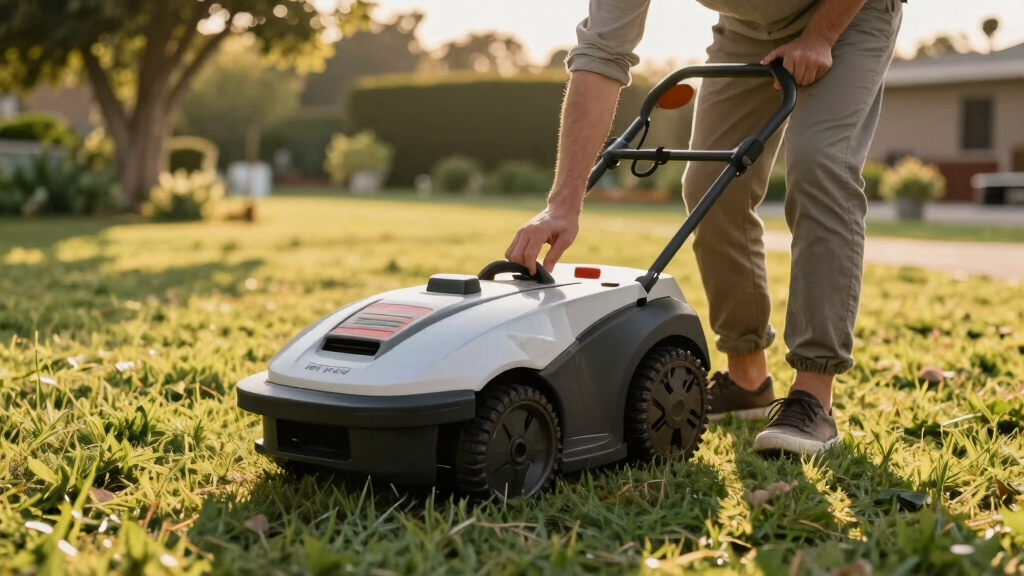

If you’re searching for the best robotic lawn mower for sloped lawns, you need a model that can handle steep inclines without sacrificing cutting quality or reliability. The Segway Navimow X430 stands out for its impressive 84% slope capability and all-wheel drive, making it ideal for challenging terrain. The Sunseeker X5 AWD offers RTK precision for precise navigation on slopes, but comes at a higher price point. Meanwhile, the WORX Robot Lawn Mower provides a wire-free setup perfect for moderate slopes and smaller yards. The main tradeoffs often involve balancing slope capacity with cost, ease of installation, and terrain complexity. Continue reading for a detailed breakdown of these top options and what suits your specific needs.

Get garden gear delivered free — and shop member deals
- Fast, free delivery on millions of items
- Access to Prime Big Deal Days deals on October 6–7
- Prime Video, Amazon Music and more included
Complete the kit


Key Takeaways
- The highest slope capacity among these models is the Segway Navimow X430, handling up to 84% inclines with all-wheel drive technology.
- Wired boundary systems tend to provide more reliable navigation on complex slopes, but wire-free options like WORX simplify installation for moderate terrains.
- RTK and LiDAR navigation significantly improve precision on uneven slopes, yet they come with higher price tags and setup complexity.
- Battery life and mowing area vary; models designed for larger slopes often have larger batteries to cover more ground without frequent recharging.
- Ease of use and maintenance are crucial; models with fewer moving parts or self-cleaning features reduce long-term hassle.
| V3 AI Vision Robotic Lawn Mower, 1600 Sq.Ft, Dark Grey |  | Best for Small, Obstacle-Rich Yards | Coverage Area: 1600 sq.ft | Color: Dark Grey | Included Accessories: 32FT magnetic strip, charger, replacement blades, user manual | VIEW LATEST PRICE | See Our Full Breakdown |
| WORX Robot Lawn Mower for 1/4 Acre, Wire-Free with Brushes |  | Best for Larger Lawns and Custom Zones | Coverage Area: 1/4 Acre | Technology: RTK Cloud, Vision AI, Neural Processing | Navigation: RTK Cloud, V-SLAM, RadioLink | VIEW LATEST PRICE | See Our Full Breakdown |
| Segway Navimow X430 Robot Lawn Mower, All-Wheel Drive, for Up to 1 Acre, 4WD for 84% Slopes, Zero-Turn, Dual 180W Motors, 0.75–4 in Cutting Height |  | Best for Sloped and Uneven Large Lawns | Coverage Area: Up to 1 Acre | Slope Capability: 84% | Cutting Height: 0.75–4 inches | VIEW LATEST PRICE | See Our Full Breakdown |
| ECOVACS GOAT A2000 LiDAR PRO Robot Lawn Mower, Dual LiDAR Navigation |  | Best for Dense, Complex Yard Layouts | Navigation System: Dual LiDAR | Battery: 3.0Ah | Charging Time: 50 minutes | VIEW LATEST PRICE | See Our Full Breakdown |
| Sunseeker X5 AWD Robot Lawn Mower, RTK, Vision AI, 0.5 Acre, Wire-Free |  | Best for Precise, Sloped, and Contoured Lawns | Yard Size: 0.5 acres | Navigation: RTK, Vision AI, VSLAM | Slope Capability: Up to 30° / 60% | VIEW LATEST PRICE | See Our Full Breakdown |
| Segway Navimow i206 AWD Robot Lawn Mower, 0.15 Acre, 45% Slopes |  | Best for Steep Slopes and Precise Zone Management | Coverage Area: 0.15 acres | Slope Capacity: 45% | Cutting Height: 2–3.6 inches | VIEW LATEST PRICE | See Our Full Breakdown |
| YARDCARE AI Vision Robotic Lawn Mower, 1600 Sq.Ft, Dark Grey |  | Best for Small, Flat Lawns with Obstacle Navigation Needs | VIEW LATEST PRICE | See Our Full Breakdown |
| robotic lawn mower for sloped lawn | Coverage Area |
|---|---|
| V3 AI Vision Robotic Lawn Mowe | 1600 sq.ft |
| WORX Robot Lawn Mower for 1/4 | 1/4 Acre |
| Segway Navimow X430 Robot Lawn | Up to 1 Acre |
| ECOVACS GOAT A2000 LiDAR PRO R | — |
| Sunseeker X5 AWD Robot Lawn Mo | — |
| Segway Navimow i206 AWD Robot | 0.15 acres |
| YARDCARE AI Vision Robotic Law | — |
More Details on Our Top Picks
V3 AI Vision Robotic Lawn Mower, 1600 Sq.Ft, Dark Grey
The V3 AI Vision stands out for its obstacle recognition and no-boundary wire setup, making it ideal for small yards with tricky flower beds or garden features. Unlike the WORX model, which requires more setup and covers a larger area, the V3 excels in environments where precise obstacle avoidance prevents turf damage. Its AI vision technology allows for smooth navigation without boundary wires, but it’s limited to yards up to 1600 sq.ft., which could frustrate those with expanding lawns. The app control makes scheduling straightforward, yet it lacks the advanced mapping capabilities of higher-end models like the Sunseeker X5. This pick is best suited for homeowners with compact lawns that need careful navigation around obstacles.
Pros:- Obstacle recognition prevents turf damage
- No boundary wires needed
- Easy app control for scheduling
- Compact size fits small yards
Cons:- Limited to 1600 sq.ft. coverage
- Requires magnetic boundary strips
- Basic feature set compared to premium models
Best for: Homeowners with small, obstacle-dense yards needing easy setup and reliable obstacle avoidance.
Not ideal for: Those with larger lawns or seeking a model capable of high-tech mapping for extensive areas, as the V3’s coverage is limited.
- Coverage Area:1600 sq.ft
- Color:Dark Grey
- Included Accessories:32FT magnetic strip, charger, replacement blades, user manual
- Battery:18V
Our verdict“This is a smart choice for small yards with lots of obstacles that demand precise navigation without complicated wiring.”
WORX Robot Lawn Mower for 1/4 Acre, Wire-Free with Brushes
The WORX robot mower offers advanced navigation with RTK Cloud and Vision AI, making it suitable for larger lawns up to a quarter-acre, especially when compared to the smaller coverage of the V3. Its auto mapping and zone editing give it a flexible edge for lawns with complex layouts. However, its setup can be complex, and the higher price reflects its advanced technology. While the Segway Navimow X430 handles slopes up to 84%, WORX’s focus on precise, customizable mowing makes it a better fit for homeowners who want detailed control over lawn zones. If you value high accuracy and zone flexibility over simplicity, WORX is a compelling option.
Pros:- High-precision centimeter navigation
- Auto mapping with customizable zones
- Obstacle avoidance with neural processing
- Multiple mowing patterns and app control
Cons:- Complex setup process
- Higher cost due to advanced tech
- Limited to 1/4 acre coverage
Best for: Homeowners with medium to large lawns who want customizable zones and precise navigation without boundary wires.
Not ideal for: Users seeking simple, plug-and-play solutions or lawns larger than 1/4 acre, where the setup complexity and cost may outweigh benefits.
- Coverage Area:1/4 Acre
- Technology:RTK Cloud, Vision AI, Neural Processing
- Navigation:RTK Cloud, V-SLAM, RadioLink
- Includes:Charging Station, Spare Blades, Brushes, Accessories
Our verdict“Ideal for tech-savvy homeowners seeking detailed lawn control and accuracy within a moderate-sized yard.”
Segway Navimow X430 Robot Lawn Mower, All-Wheel Drive, for Up to 1 Acre, 4WD for 84% Slopes, Zero-Turn, Dual 180W Motors, 0.75–4 in Cutting Height
The Segway Navimow X430 offers unmatched slope handling with its all-wheel drive system, making it the best choice for lawns with steep inclines up to 84%. Its smart GPS and obstacle avoidance outperform the simpler obstacle detection of the V3, providing damage-free zero-turns that protect turf in complex terrains. Compared to the Sunseeker X5’s RTK and Vision AI, the X430’s strength lies in steep slopes rather than ultra-precise mapping, but it’s more user-friendly for terrain with significant elevation changes. Its high motor power and adaptive blade control make it suitable for tall or dense grass. This model is best for large, sloped lawns where terrain complexity demands advanced maneuverability.
Pros:- Handles slopes up to 84%
- All-wheel drive ensures traction on uneven terrain
- Zero-turn maneuverability prevents turf tearing
- Smart obstacle avoidance for damage-free operation
Cons:- High-tech features require learning curve
- Expensive compared to basic models
- Heavy weight may affect portability
Best for: Homeowners with large, sloped lawns up to 1 acre needing powerful, terrain-adaptive mowing.
Not ideal for: Small yard owners or those with minimal slope, as the advanced features may be overkill and costlier than necessary.
- Coverage Area:Up to 1 Acre
- Slope Capability:84%
- Cutting Height:0.75–4 inches
- Motors:2 × 180W
- Navigation:GPS, GeoFence, Voice Control
- Features:All-Wheel Drive, Zero-Turn, Obstacle Avoidance
Our verdict“Perfect for large, hilly lawns that demand robust, terrain-adaptive mowing with minimal turf damage.”
ECOVACS GOAT A2000 LiDAR PRO Robot Lawn Mower, Dual LiDAR Navigation
The ECOVACS GOAT A2000 LiDAR PRO excels in mapping complex yards thanks to its dual LiDAR navigation, making it ideal for dense grass and intricate landscape features. Its edge trimming feature reduces manual effort, and fast charging minimizes downtime. Unlike the Segway or WORX models, which focus more on precision or larger coverage, the ECOVACS offers a balance of accurate mapping and convenient operation for medium to large yards. Its reliance on smartphone app control might pose a challenge for less tech-savvy users, but it provides detailed zone customization for tailored lawn care. This model suits homeowners seeking detailed yard mapping and efficient border trimming.
Pros:- Dual LiDAR for detailed yard mapping
- Built-in edge trimmer for clean borders
- Fast charging reduces downtime
- App control with customizable zones
Cons:- Potentially expensive
- Requires smartphone app for full features
- Setup may be complex for some users
Best for: Homeowners with dense, irregularly shaped yards needing precise mapping and automated edging.
Not ideal for: Those who prefer simple, cord-free models without the need for smartphone app control or extensive setup.
- Navigation System:Dual LiDAR
- Battery:3.0Ah
- Charging Time:50 minutes
- Cutting Platform:32V dual-blade disc
- Edge Trimming:Built-in TruEdge
- Coverage:Medium to large yards
Our verdict“An excellent choice for complex yards that demand detailed mapping and edge trimming, especially if manual trimming is a concern.”
Sunseeker X5 AWD Robot Lawn Mower, RTK, Vision AI, 0.5 Acre, Wire-Free
The Sunseeker X5 AWD integrates RTK and Vision AI for precise navigation, making it ideal for yards up to 0.5 acres with slopes up to 30°. Its floating blade system and all-terrain tires help it adapt to contours and uneven terrain, outperforming simpler models like the V3 in complex landscapes. Compared with the Navimow X430, which handles steeper slopes, the X5 is better suited for more moderate inclines and detailed boundary control via virtual boundaries and schedules. Its quiet operation at 60 dB suits residential environments, but the high-tech features can come with a learning curve. This model suits homeowners with varied terrain seeking accuracy and versatility in a smaller yard.
Pros:- Handles slopes up to 30%
- RTK and Vision AI for reliable navigation
- Floating blade system for contours
- Quiet at 60 dB
Cons:- Price may be high for some budgets
- Requires some technical understanding
- Limited to 0.5 acres
Best for: Homeowners with sloped, irregularly shaped yards up to 0.5 acres requiring precise navigation and contour handling.
Not ideal for: Large, flat lawns or owners seeking ultra-high slope capability above 30°, as the X5’s slope handling maxes out at 30%.
- Yard Size:0.5 acres
- Navigation:RTK, Vision AI, VSLAM
- Slope Capability:Up to 30° / 60%
- Cutting Height:1.6–3.2 inches
- Operation Noise:60 dB
- Warranty:2 years
Our verdict“A solid choice for sloped lawns up to 30% where precise, adaptive mowing is prioritized over extreme terrain handling.”
Segway Navimow i206 AWD Robot Lawn Mower, 0.15 Acre, 45% Slopes
The Segway Navimow i206 stands out for tackling slopes up to 45%, making it ideal for properties with challenging terrain. Its all-wheel drive system and zero-turn steering ensure turf is cut evenly without damage, even on steep inclines. Compared to the YARDCARE AI Vision, which is better for smaller, flatter lawns, the i206’s advanced GPS mapping and zone management make it more suitable for complex landscapes. However, its limited coverage of 0.15 acres per charge and higher price reflect its specialized capabilities. This mower is best suited for those who need to maintain steep, uneven terrains without sacrificing precision or turf health.
Pros:- Handles slopes up to 45% with exceptional stability thanks to AWD system
- Advanced GPS mapping allows precise zone management and customization
- Zero-turn steering prevents turf damage and improves cutting accuracy
- Automated zone setup and real-time GPS alerts enhance security and convenience
Cons:- Limited coverage area per charge, making it unsuitable for larger yards
- Higher price point may deter budget-conscious buyers
- Requires initial setup for zone mapping, which can be complex
Best for: Homeowners with steep, uneven lawns up to 0.15 acres who prioritize slope handling and zone control
Not ideal for: Owners of large, flat lawns or those on a tight budget, as its coverage is limited and cost is high
- Coverage Area:0.15 acres
- Slope Capacity:45%
- Cutting Height:2–3.6 inches
- Deck Size:7.1 inches
- Battery Capacity:2.5Ah
- Mapping Technology:EFLS Network RTK and Vision
- Zones Managed:Up to 20
Our verdict“This model makes the most sense for homeowners needing reliable slope handling and zone control in small to medium slopes, despite its limited coverage.”
YARDCARE AI Vision Robotic Lawn Mower, 1600 Sq.Ft, Dark Grey
The YARDCARE AI Vision excels in quiet, user-friendly operation for lawns up to 1600 sq.ft, making it a strong choice for smaller properties. Its AI obstacle sensing allows safer mowing around garden features, a feature that surpasses the basic obstacle detection found in less sophisticated models like the WORX Robot Lawn Mower. Compared with the Segway Navimow i206, which is designed for steeper slopes and larger areas, the YARDCARE’s simplicity and app-controlled features are more suitable for flat, uncomplicated yards. Its limited coverage and reliance on a smartphone app for full control are tradeoffs that owners should consider. This mower benefits those who want a quiet, easy-to-operate device for small lawn areas with obstacles.
Pros:- AI obstacle sensing provides safer, smoother mowing around obstacles
- Wireless setup and app control simplify installation and operation
- Customizable no-go zones with magnetic strip enhance lawn management
- Low-noise operation minimizes disturbance
Cons:- Limited to 1600 sq.ft, unsuitable for larger properties
- Dependent on smartphone app for full functionality, which may be inconvenient for some users
- Includes multiple accessories that might require replacement over time
Best for: Homeowners with small, obstacle-rich lawns up to 1600 sq.ft who prefer smartphone control and AI obstacle sensing
Not ideal for: Larger or sloped yards where coverage and terrain handling are priorities, or users who dislike app dependency
Our verdict“This mower is best for small, obstacle-filled lawns where quiet, convenient, app-controlled operation is valued over large coverage or extreme terrain handling.”
How We Picked
These products were evaluated based on their ability to handle steep inclines, overall build quality, navigation technology, area coverage, and user safety features. We prioritized models with proven slope ratings, reliable navigation systems like LiDAR or all-wheel drive, and positive user feedback on terrain performance. Cost was considered in relation to performance, ensuring options ranged from budget-friendly to premium. The ranking reflects a balance of high slope capacity, ease of installation, and value for the specific challenge of sloped lawns.Factors to Consider When Choosing Best Robotic Lawn Mower For Sloped Lawns
Choosing the right robotic mower for a sloped lawn involves more than just slope ratings. You should consider the terrain type, navigation technology, power and battery life, and ease of installation. Understanding these factors helps prevent costly mistakes such as underestimating slope capacity or overpaying for features you won’t use. A good fit balances performance with your yard’s specific needs and your budget, ensuring reliable, safe operation over time.Slope Capacity and Navigation Technology
Look for models that specify their maximum slope handling, ideally above the steepest part of your yard. Navigation technology like LiDAR, RTK, or all-wheel drive can dramatically improve accuracy and stability on uneven terrain, reducing the risk of the mower tipping or losing its way. Wired boundary wires often offer more reliable boundary definition on complex slopes, but wire-free models are easier to install in irregular yards. Always match the mower’s rated slope capacity with your yard’s steepest incline for best results.
Battery Life and Area Coverage
Robotic mowers designed for sloped terrain typically feature larger batteries to ensure consistent coverage across hilly areas without frequent recharging. Match the mower’s area capacity to your yard size, considering that slopes can reduce effective coverage. A mower with longer battery life provides more autonomous operation, especially important on larger or more rugged terrains. Check for quick-charging features if your yard is extensive and requires multiple cutting sessions per day.
Ease of Installation and Maintenance
Models with wireless boundary options simplify setup, especially on uneven or rocky slopes where installing boundary wires can be challenging. Consider how often you’ll need to perform maintenance; models with self-cleaning decks or fewer moving parts tend to require less upkeep. Also, evaluate the availability of customer support and parts, particularly for advanced navigation systems like LiDAR or RTK, which may need professional calibration or servicing.
Safety and Additional Features
On steep slopes, safety features such as obstacle detection, auto shut-off, and secure locking are vital to prevent accidents or damage. Some models include app controls or GPS tracking, offering added peace of mind and easier management. Additional features like rain sensors or mulching capabilities can enhance the mower’s versatility but may add to the cost. Prioritize safety and convenience to ensure a smooth, worry-free mowing experience on challenging terrain.
Frequently Asked Questions
Can a robotic lawn mower really handle steep slopes?
Yes, some robotic mowers are specifically engineered for steep inclines, with ratings up to 84% slope handling. These models use specialized drive systems like all-wheel drive or advanced navigation technology such as LiDAR or RTK to maintain stability and traction. However, it’s important to verify the maximum slope rating and ensure your terrain does not exceed it, as attempting to mow beyond a mower’s capability can cause tipping or damage.
What is the most reliable navigation system for slopes?
LiDAR and RTK navigation systems are considered the most precise for complex, uneven terrains. LiDAR offers real-time obstacle detection and mapping, while RTK provides centimeter-level accuracy through GPS correction signals. These technologies are especially beneficial on steep or irregular slopes where standard boundary wires or simple sensors may struggle. Expect to pay more for these features, but their reliability can significantly improve mowing performance on challenging terrain.
Do I need a wired boundary system for sloped lawns?
Wired boundary systems typically offer more dependable boundary delineation on complex slopes and rocky terrains, helping prevent the mower from straying or getting stuck. Wire-free options are easier to install but may be less effective on very steep or irregular slopes unless equipped with advanced navigation tech. For hilly yards with unpredictable features, a wired system often reduces the risk of boundary breaches and enhances overall safety.
How important is battery life for sloped lawns?
Battery life becomes more critical when mowing on slopes because the mower works harder against gravity, consuming more power. A larger battery ensures consistent coverage without frequent recharging stops, especially on larger or more rugged yards. Additionally, some models offer quick-charging, which minimizes downtime between mowing sessions. Always choose a mower with sufficient battery capacity for your yard’s size and terrain complexity.
Are there safety concerns I should consider on steep slopes?
Absolutely. Mowers should have obstacle detection, auto shut-off, and secure locking mechanisms to prevent accidents on steep inclines. Some models also feature sensors that detect tipping risks and automatically stop the blades. Implementing safety features is especially important if children or pets are nearby. Reading product specifications carefully and choosing models with robust safety features can prevent accidents and protect your investment.
Conclusion
For general use, the Segway Navimow X430 offers the best combination of slope capacity and navigation technology, making it ideal for steep or irregular terrains. If you’re looking for a more budget-friendly option, the WORX Robot Lawn Mower handles moderate slopes with wire-free setup, great for smaller yards. For those who want the most precise navigation and are willing to invest, the Sunseeker X5 AWD with RTK provides exceptional accuracy. Beginners or homeowners with less challenging slopes should prioritize models with simpler setup, while large or very steep yards benefit from higher-end, robust systems. Ultimately, selecting the right mower depends on your slope degree, yard size, and budget, but these options cover a broad spectrum of needs.Fall yard work Picks
leaf blowers
As an affiliate, we earn on qualifying purchases.