The best perennial flower seeds depend on whether you want a reliable mix, a specific flower, or broad color across a larger bed. My best overall pick is Seed Needs Perennial Wildflower Seed Mix for a perennial-focused blend; Sow Right Seeds Blanket Flower stands out for gardeners who prefer one named species, while Burpee Wildflower Bulk Seed Mix offers a wide selection for larger sowings. The main tradeoff is breadth versus predictability: mixes offer variety but may include annuals or plants unsuited to your site, while single-species packets give you more control but less diversity. Seed count alone also says little about coverage without knowing planting density and seed viability. Read on for the full comparison and guidance on matching seeds to your climate, space, and maintenance plans.

Get garden gear delivered free with Prime
- Fast, free delivery on millions of items
- Prime Video, Amazon Music and more included
- Member-only deals all year
Complete the kit


Key Takeaways
- Perennial-focused labels matter: Seed Needs is positioned as a perennial wildflower mix, while Burpee and NatureZ Edge explicitly include annuals, so buyers seeking returning plants should check the mix composition rather than assume every flower is perennial.
- Large seed counts do not guarantee a better fit: NatureZ Edge lists 340,000 seeds, but a smaller, clearly targeted packet may be easier to plan for a home bed.
- Single-species packets offer more control: Blanket flower, lavender, Texas bluebonnet, hollyhock, columbine, and sweet William suit gardeners who want a defined plant rather than an unpredictable mix.
- There are two sweet William choices: Mixrug and Outsidepride both offer 5,000-seed perennial Dianthus options, so buyers should compare packet details and growing guidance rather than treating the names as different flower types.
- Broad variety packs trade precision for range: Gardeners Basics lists 35 flower types and plant markers, while focused options may be simpler for gardeners building a coordinated bed or planting for a specific site.




| perennial flower seed | Seed count | Sunlight | Bloom period |
|---|---|---|---|
| Purple Alyssum Seeds | — | — | Spring to fall |
| Burpee Wildflower Bulk Seed Mi | 25,000 | — | — |
| NatureZ Edge Wildflower Seeds | 340,000 | — | — |
| Seed Needs Perennial Wildflowe | 30,000 | — | Summer to fall |
| 99 pcs Perennial Aquilegia | 99 | — | — |
| Groundio Wildflower Seeds Mix | 25,000+ | Full sun | — |
| Sow Right Seeds Blanket Flower | — | Full sun | Summer to fall |
| Mixrug 5000+ Sweet William See | 5,000+ | Full sun | — |
| Outsidepride Sweet William Dia | 5,000 | Full sun | — |
| Hollyhock Seeds 3000+ Bulk Pac | 3,000+ | Full sun to partial shade | Summer to early fall |
| Organo Republic 16 Perennial W | 100,000+ | Partial sun | Spring to fall |
| Gardeners Basics Heirloom Flow | — | Full sun | Spring to fall |
| 2000 English Lavender Heirloom | 2,000 | Full sun | Spring to summer |
| Sow Right Seeds | Approximately 75 seeds (1.5 g) | Full sun | — |
More Details on Our Top Picks
Purple Alyssum Seeds – Survival Garden Seeds (1 Pack)
Purple alyssum is the compact, fragrant choice in this group, with plants reaching about 6 inches and blooms listed from spring to fall. Its low growth makes it a better fit for edging, containers, and filling gaps than the taller Seed Needs Perennial Wildflower Seed Mix, which can reach 60 inches. The flowers attract bees and butterflies, and self-seeding can bring color back in later seasons without replanting each spot.
The tradeoff is scale: one pack is not the bulk solution offered by Burpee Wildflower Bulk Seed Mix or NatureZ Edge. This seed is also described as frost-sensitive, so gardeners in colder areas may need to protect plants. I’d choose it for a defined border or small pollinator planting, not for quickly covering a large meadow.
Pros:- Low, approximately 6-inch growth suits borders and containers.
- Fragrant blooms attract bees and butterflies.
- Self-seeding can provide color in later seasons.
- Heirloom, non-GMO, untreated seed.
Cons:- A single pack is less suited to large-scale planting than the bulk mixes.
- Frost sensitivity may require protection in cold climates.
- Moderate watering is listed, so it is not a no-water planting.
Best for: Gardeners filling sunny-to-partly-shaded borders, containers, or small gaps with low, fragrant pollinator flowers.
Not ideal for: Gardeners who need bulk seed for a large area or dependable frost tolerance in cold conditions.
- Use:Outdoor
- Bloom period:Spring to fall
- Sun exposure:Full sun
- USDA hardiness zones:4–9
- Expected height:6 inches
- Soil type:Loam or sandy
- Moisture needs:Moderate watering
- Seed features:Heirloom, non-GMO, untreated
Our verdict“Choose this pack for a small, fragrant, low-growing perennial-style border, but pick a bulk mix for broad coverage.”
Burpee Wildflower Bulk Seed Mix – 25,000 Non-GMO Seeds, 18 Varieties
Burpee’s defining advantage is its stated coverage: 25,000 seeds across 18 perennial varieties for up to 1,000 square feet. That makes it a more straightforward pick for sowing a broad sunny patch than the small-pack Purple Alyssum Seeds. The mix is designed for easy sowing in most soil types and brings pollinators such as bees and butterflies into the planting.
Compared with NatureZ Edge Wildflower Seeds, Burpee offers fewer varieties and less stated coverage, but its listed seed count and coverage make the scale easier to plan around. The blend includes cornflower and zinnia, so the lineup is not presented as exclusively perennial despite the product’s perennial-wildflower description. It also needs a sunny site for best growth. I’d choose it for a large, sunlit planting rather than a carefully specified, all-perennial border.
Pros:- Stated coverage of up to 1,000 square feet suits broad plantings.
- Includes 18 varieties for a mixed wildflower display.
- Non-GMO seed mix attracts bees and butterflies.
- Described as easy to sow in most soil types.
Cons:- Requires a sunny location for optimal growth.
- The description names zinnia, so the mix is not clearly all perennial.
- Fewer listed varieties and less coverage than NatureZ Edge.
Best for: Gardeners sowing a large, sunny area who want a high seed count and a pollinator-friendly mix.
Not ideal for: Buyers seeking a clearly perennial-only blend, a shade-tolerant planting, or a small, tightly controlled flower bed.
- Seed count:25,000
- Varieties:18
- Coverage:Up to 1,000 sq ft
- Plant type:Perennial wildflowers
- Non-GMO:Yes
- Sun requirement:Sunny location for optimal growth
Our verdict“Pick Burpee for a large sunny patch where broad coverage matters more than a strictly perennial species list.”
NatureZ Edge Wildflower Seeds, 1/2 lb – 340,000 seeds, 35 varieties of perennial and annual flowers
NatureZ Edge is the scale-and-variety pick: its half-pound pack lists 340,000 seeds, 35 varieties, and coverage up to 1,500 square feet when mixed with filler. That gives it a broader reach than Burpee Wildflower Bulk Seed Mix, which lists 18 varieties and up to 1,000 square feet. The blend attracts bees, butterflies, and hummingbirds, making it suited to a large pollinator planting rather than a small ornamental bed.
The key distinction is that this is a mix of annual and perennial flowers, not a perennial-only selection. That can add variety to the display, but buyers focused on plants returning year after year may prefer Seed Needs Perennial Wildflower Seed Mix. NatureZ Edge also requires filler to reach its stated coverage and moderate watering during establishment, adding preparation and upkeep. I’d choose it when area and variety outweigh simplicity.
Pros:- Lists 340,000 seeds and up to 1,500 square feet of coverage with filler.
- 35 varieties provide a wider mix than Burpee’s 18.
- Attracts butterflies, hummingbirds, and bees.
- Non-GMO seed from a family-owned business.
Cons:- Includes annuals as well as perennials.
- Requires filler to reach the advertised coverage.
- Moderate watering is needed to establish seedlings.
Best for: Gardeners establishing a broad pollinator area who value a large seed quantity and a wide mix of annual and perennial flowers.
Not ideal for: Buyers wanting only perennial species, a small ready-to-sow pack, or a mix that needs no filler for its stated coverage.
- Weight:8 ounces
- Seed count:340,000
- Varieties:35
- Coverage:Up to 1,500 sq ft when mixed with filler
- Plant types:Annual and perennial flowers
- Non-GMO:Yes
- Planting season:Spring
- Water needs:Moderate
Our verdict“Choose NatureZ Edge for a large, diverse pollinator planting if you accept annuals and the extra step of mixing in filler.”
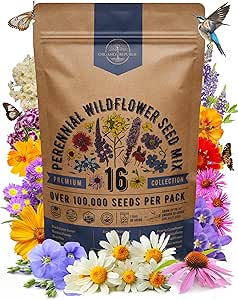
Seed Needs Perennial Wildflower Seed Mix 30,000 Seeds 2 Ounce Bulk Pack
This is the clearest fit for a perennial-first roundup: Seed Needs specifies 16 perennial wildflower species and 100% pure live seed with no fillers. That distinction separates it from NatureZ Edge Wildflower Seeds, which combines annuals and perennials, and from Burpee’s mix, whose description also names zinnia. Black-eyed Susan and purple coneflower are among the listed examples, with blooms described from summer to fall.
The mix favors gardeners who want a defined perennial blend over maximum seed volume or the widest variety count. Its stated 30,000 seeds and 2-ounce pack are smaller in scale than NatureZ Edge’s 340,000 seeds, while plants may reach 60 inches, giving the planting a taller profile than Purple Alyssum Seeds. Full sun and regular watering are specified, so this is not the lowest-maintenance option. I’d select it for a sunny bed where perennial identity matters more than minimal watering.
Pros:- Specifies 16 perennial wildflower species.
- 100% pure live seed with no fillers or inert matter.
- Lists a broad USDA hardiness range of zones 1–10.
- Includes black-eyed Susan and purple coneflower.
Cons:- Regular watering is needed for optimal growth.
- Full sun is specified, limiting suitability for shaded sites.
- Its 30,000-seed pack is smaller than NatureZ Edge’s bulk quantity.
Best for: Gardeners seeking a clearly perennial wildflower mix for a sunny bed and willing to water regularly.
Not ideal for: People planting a dry, low-maintenance site, a compact container, or a very large area requiring bulk seed.
- Package size:2 ounces
- Seed count:30,000
- Species:16 perennial wildflower species
- Plant height:Up to 60 inches
- Bloom period:Summer to fall
- Sun exposure:Full sun
- Water needs:Regular watering
- USDA hardiness zones:1–10
- Seed composition:100% pure live seed, no fillers
Our verdict“Choose Seed Needs when you want a specifically perennial, filler-free mix for a sunny garden and can provide regular water.”
99 pcs Perennial Aquilegia (Columbine) McKana Giants Seeds – Colorful Giant Blooms, Hummingbird & Butterfly Attractant, Cottage Garden Flowers
McKana Giants columbine offers a focused alternative to the broad wildflower mixes: this pack centers on one perennial flower type with oversized, multicolored blooms. That makes it a better match for gardeners planning a distinct cottage-garden accent than Seed Needs Perennial Wildflower Seed Mix, which spreads its planting across 16 species. The stated 99 seeds also give buyers a count to work with, while the nectar-rich flowers are described as attracting hummingbirds and butterflies.
The tradeoff is less planting flexibility. Unlike Burpee or NatureZ Edge, this is not a large-area, many-variety mix, and the product details do not specify hardiness zones, sunlight, or water needs. The description also flags the large flowers as needing ample space. I’d choose it for a planned feature planting and check local growing guidance before sowing, rather than treating it as an easy, fully specified meadow blend.
Pros:- McKana Giants are described as producing oversized, multicolored blooms.
- Perennial columbine can return in later years.
- Flowers attract hummingbirds and butterflies.
- The pack contains 99 seeds for multiple planting spots.
Cons:- Large blooms require ample garden space.
- Offers one flower type rather than the variety of the wildflower mixes.
- Product details do not specify hardiness zones, sunlight, or water needs.
Best for: Cottage-garden growers who want a defined planting of multicolored columbine and can allow space for large blooms.
Not ideal for: Buyers needing a broad wildflower mix, detailed cultivation specifications, or a compact ground-cover flower.
- Plant:Aquilegia (columbine), McKana Giants
- Seed count:99
- Plant type:Perennial
- Use:Outdoor
- Bloom description:Oversized, multicolored flowers
- Pollinators:Attracts hummingbirds and butterflies
Our verdict“Pick these columbine seeds for a spacious cottage-garden feature, but choose a mixed blend for broader coverage and more growing guidance.”
Groundio Wildflower Seeds Mix – 1 Oz, 25,000+ Seeds, 24 Varieties
For gardeners who want a varied planting rather than one signature flower, Groundio’s 24-variety mix combines annual, perennial, and biennial seeds, with a stated 25,000-plus seed count and coverage of about 194 square feet. That makes it more useful for filling a modest sunny patch than the single-species Sow Right Blanket Flower, though the mix gives you less control over which flowers dominate or when each one returns. The listed 5–10-day germination and 35–75-day bloom window point to quicker color than slower-establishing perennial-only choices, but this is not a pure perennial mix. Full sun is required, and the one-ounce pack is a poor fit for a large meadow. I’d choose it for variety and pollinator appeal, not predictable perennial persistence.
Pros:- Mixes 24 annual, perennial, and biennial varieties for a varied display.
- Lists 25,000-plus seeds and coverage of about 194 square feet.
- Includes a stated 99% pure live seed guarantee and no fillers.
- Resealable foil packaging and planting guidance support storage and sowing.
Cons:- The mix includes annuals and biennials, so not every flower will return as a perennial.
- Full-sun requirement limits suitable planting locations.
- A one-ounce package may fall short for larger meadow or landscape projects.
Best for: Gardeners with a sunny, roughly 194-square-foot area who want a diverse pollinator planting and are comfortable mixing annuals with perennials.
Not ideal for: Buyers seeking only perennial flowers, shaded-garden options, or enough seed for a large landscape project.
- Seed count:25,000+
- Varieties:24 annual, perennial, and biennial varieties
- Package weight:1 oz (0.04 kg)
- Coverage area:Approximately 194 sq. ft.
- Germination time:5–10 days
- Bloom time:35–75 days
- Plant height:12–48 inches
- Sunlight:Full sun
- Seed purity:99% pure live seed
Our verdict“Choose Groundio for a varied, pollinator-friendly sunny patch, but pick a single-species perennial if reliable repeat blooms matter more than variety.”
Sow Right Seeds Blanket Flower Seed – Perennial Wildflower (Gaillardia aristata)
Sow Right’s blanket flower is the most focused pick here: rather than spreading a blend across a garden like Groundio’s wildflower mix, it gives you one recognizable red-and-yellow perennial suited to hot, sunny, drier sites. Its stated USDA range of zones 3–10 makes it a broadly adaptable choice, and summer-to-fall flowering can bring color when some spring-focused options, such as Mixrug Sweet William, are winding down. The tradeoff is less variety: this is not a multi-color meadow mix, and full sun is non-negotiable. Germination is listed at 14–21 days at 70–75°F, so it may take longer to sprout than Groundio’s stated 5–10 days. Choose it for a dependable species planting and pollinator visits, not for instant or mixed-flower coverage.
Pros:- Drought and heat tolerance suit exposed sunny beds.
- Red flowers with yellow tips provide a recognizable, consistent look.
- Listed for USDA zones 3–10.
- Summer-to-fall bloom period offers color later in the growing season.
Cons:- Full-sun needs rule out shaded garden locations.
- A single flower type offers less visual variety than Groundio’s 24-variety mix.
- Listed germination time of 14–21 days is slower than Groundio’s stated range.
Best for: Gardeners in zones 3–10 who have a sunny, heat-prone bed and want a drought-tolerant perennial with defined flower colors.
Not ideal for: People planting in shade or seeking a large, varied wildflower mix with multiple flower types and bloom habits.
- Botanical name:Gaillardia aristata
- Seed type:Non-GMO heirloom
- USDA zones:3–10
- Sunlight:Full sun
- Flower colors:Red with yellow tips
- Bloom period:Summer to fall
- Plant height:18–22 inches
- Germination time:14–21 days at 70–75°F
Our verdict“Pick Sow Right Blanket Flower for a sunny, heat-tolerant perennial planting; skip it if you want shade flexibility or a mixed meadow effect.”
Mixrug 5000+ Sweet William Seeds (Dianthus) – Non-GMO Heirloom Perennial Flower Seeds for Outdoor Garden
Mixrug Sweet William stands apart from the single-color focus of Sow Right Blanket Flower by offering fragrant clusters in several colors, making it the more useful choice for borders and cut-flower arrangements. The large stated seed count also gives gardeners room to sow a broader patch. There is a timing tradeoff: the description identifies this as biennial, so plants typically flower the year after sowing rather than providing immediate blooms. Its listed bloom season runs from mid-spring to mid-summer, earlier than Sow Right’s summer-to-fall window. I’d also treat the hardiness range cautiously: the supplied data conflicts between zones 3–9 and 4–10. Full sun and well-drained soil are specified, and seeds need light to germinate, so sowing depth matters. It’s a better fit for patient gardeners who value fragrance and color variety than for anyone wanting a simple, fast-blooming perennial.
Pros:- Produces fragrant flowers in white, pink, purple, red, and violet.
- The 5,000-plus seed count can support a substantial border or cutting patch.
- Suited to cut arrangements as well as beds and borders.
- Listed germination time is approximately 10 days under suitable conditions.
Cons:- As a biennial, it typically blooms the year after planting.
- Requires full sun and well-drained soil.
- Hardiness information conflicts between zones 3–9 and 4–10.
Best for: Patient gardeners who want fragrant, multicolored flowers for sunny borders or cutting and can wait until the following year for blooms.
Not ideal for: Gardeners who need flowers in the first season, have heavy or poorly drained soil, or need a clearly stated hardiness range.
- Seed count:5,000+
- Plant type:Biennial/perennial
- Hardiness zones:Conflicting listing: 3–9 in title; 4–10 in description
- Sunlight:Full sun
- Soil:Sandy, well-drained
- Germination time:Approximately 10 days
- Germination temperature:60–70°F (15–21°C)
- Bloom season:Mid-spring to mid-summer
- Plant height:12–24 inches
Our verdict“Choose Mixrug for a fragrant, colorful cutting patch if delayed flowering and inconsistent zone data are acceptable.”
Outsidepride Sweet William Dianthus Seeds – 5000 pcs Perennial Wildflower Mix
Outsidepride’s Sweet William mix suits gardeners who want a colorful, upright border planting without much supplemental watering once established. Compared with Mixrug’s Sweet William, it has clearer stated hardiness information—zones 3–9—and lists little to no watering, while Mixrug provides more detail about fragrance and germination but gives conflicting zone ranges. Outsidepride’s description calls it perennial, though Sweet William is often grown as a biennial, so I would not choose it on the assumption that every plant will return reliably. The listed 18–24-inch height adds vertical presence, but the reported bloom period is only several weeks and the timing details differ between the description and specs. It is a practical pick for a sunny, lower-water border, not the best option for extended seasonal color or highly precise bloom scheduling.
Pros:- Listed for USDA zones 3–9.
- Low watering needs and drought tolerance suit lower-water gardens.
- Red, pink, white, and purple flower clusters add color and vertical interest.
- Stated height of 18–24 inches works well in borders or meadow plantings.
Cons:- The stated bloom window is relatively short.
- The listing calls it perennial, but Sweet William may behave as a biennial.
- Bloom timing differs between the product description and specifications.
Best for: Gardeners in zones 3–9 who want multicolored, upright Sweet William for a sunny border and prefer a low-water planting.
Not ideal for: Buyers seeking a long bloom season, dependable repeat perennial performance, or detailed, consistent flowering dates.
- Seed count:5,000
- Botanical name:Dianthus barbatus
- USDA zones:3–9
- Plant height:18–24 inches
- Sunlight:Full sun
- Bloom colors:Red, pink, white, and purple
- Water needs:Little to no watering
- Soil type:Loam
- GMO status:GMO-free
Our verdict“Choose Outsidepride for a sunny, low-water border with upright Sweet William color, but not for a long or precisely timed bloom display.”
Hollyhock Seeds 3000+ Bulk Pack, Alcea rosea Mixed-Color Perennial Blooms
For height rather than a low border, EquSym’s hollyhocks are the standout in this group: plants can reach 8 feet, far taller than the 18–24-inch Sweet William from Outsidepride. That height can create a cottage-garden backdrop and bring flowers into view above shorter plantings, but it also calls for careful placement and may mean staking. The 3,000-plus open-pollinated seeds offer plenty for a large planting, and the mix of red, yellow, pink, and white gives more color choice than Sow Right’s single blanket-flower type. The tradeoff is a slower payoff: blooming is listed at 60–90 days, and the plants need consistent moisture and well-draining soil. Full sun to partial shade offers more placement flexibility than the full-sun-only picks, though this is still not a compact choice for small beds.
Pros:- Plants can reach 8 feet, creating a strong backdrop behind shorter flowers.
- More than 3,000 open-pollinated seeds support large-scale sowing.
- Red, yellow, pink, and white flowers offer a broader palette than a single-color species planting.
- Full sun to partial shade gives it more placement flexibility than full-sun-only options.
Cons:- Tall growth may require staking and careful placement.
- Needs consistent moisture and well-draining soil.
- Listed bloom time of 60–90 days is slower than Groundio’s stated 35–75-day range.
Best for: Cottage-garden growers with room for tall flowers who want a large, mixed-color planting and can provide consistent moisture.
Not ideal for: Small-space gardeners, people who cannot support tall plants, or buyers seeking quick blooms with minimal watering.
- Brand:EquSym
- Seed count:3,000+
- Botanical name:Alcea rosea
- Plant type:Perennial
- Flower colors:Red, yellow, pink, and white
- Maximum plant height:Up to 8 feet
- Sunlight:Full sun to partial shade
- USDA zones:3–9
- Bloom period:Summer to early fall
Our verdict“Choose these hollyhocks for a roomy cottage garden that needs height and mixed colors, not for compact beds or low-maintenance, fast blooms.”
Organo Republic 16 Perennial Wildflower Seeds Mix – 4 oz Non-GMO Heirloom Blend for Indoor & Outdoor Gardens
For gardeners who want a perennial-focused mix rather than a packet assortment with annuals, Organo Republic offers 23 varieties and more than 100,000 seeds. Its stated hardiness range reaches far beyond the zone 3–11 range of the Gardeners Basics pack, which makes this a more flexible choice for gardeners comparing regional options. The mix is also described for containers as well as outdoor beds, and its spring-to-fall bloom period can provide a long stretch of color and pollinator activity.
The tradeoff is that a large, varied mix gives you less control over the final balance of flower types than buying individual seeds such as the English lavender. It also calls for partial sun and regular watering, so it is a weaker fit for hot, dry, full-sun sites. Choose it for variety and broad climate coverage, not for a specific flower or low-water planting.
Pros:- 23 perennial varieties provide more species variety than a single-flower seed packet.
- More than 100,000 seeds suit gardeners planning to cover larger areas.
- Listed for indoor containers and outdoor garden beds.
- Spring-to-fall bloom period supports extended seasonal color.
Cons:- The broad mix offers less control over which flowers dominate the planting.
- Partial-sun and regular-watering needs may not suit dry, exposed sites.
- The listed height of 15 inches may not deliver the taller background effect some gardeners want.
Best for: Gardeners seeking a large, mixed perennial planting for containers or beds across a wide range of listed hardiness zones.
Not ideal for: Gardeners wanting a particular flower, a carefully planned mix of colors, or a drought-tolerant planting for full sun.
- Weight:4 ounces
- Seed count:100,000+
- Varieties:23 perennial varieties
- Expected plant height:15 inches
- Bloom period:Spring to fall
- Sunlight:Partial sun
- Soil:Loam or potting mix
- Water needs:Moderate, regular watering
- USDA hardiness zones:1–10, 12
Our verdict“Choose Organo Republic if you want a large, varied perennial mix with broad listed zone coverage and can provide regular water.”
Gardeners Basics Heirloom Flower Seed Variety Pack – 35 Types (≈23,000 Seeds) with Plant Markers
Gardeners Basics is the most useful pick here for someone who wants to plan a garden by variety, rather than broadcast one blended mix. Its 35 separately packaged types, planting instructions, and matching markers make it easier to label beds and keep track of what is growing. That organization is a meaningful advantage over Organo Republic’s large perennial blend, which offers far more seeds but less control over individual placement.
There is an important distinction for perennial-seed shoppers: this collection includes both annuals and perennials, so it is not an all-perennial selection. Its full-sun requirement also narrows placement compared with the partial-sun Organo Republic mix. The paper packets need dry storage, and the approximate 23,000 seeds are spread across 35 varieties. Pick this pack for an organized, varied garden and skip it if every flower must return in future seasons.
Pros:- 35 separately packaged varieties make it easier to place flowers intentionally.
- Included plant markers help identify seedlings and keep beds organized.
- Planting instructions accompany the individual varieties.
- Heirloom, open-pollinated seeds are described as attracting bees and butterflies.
Cons:- The collection includes annuals as well as perennials, so it does not meet a strict perennial-only brief.
- Full-sun needs limit placement compared with the partial-sun Organo Republic mix.
- Paper packets may be vulnerable to moisture during storage.
Best for: Gardeners who want to arrange and label many flower varieties across sunny beds, borders, or containers.
Not ideal for: Buyers seeking only perennial flowers or gardeners without a full-sun planting area.
- Varieties:35 flower types
- Total seed count:Approximately 23,000
- Plant markers:35 included
- Plant types:Annuals and perennials
- USDA hardiness zones:3–11
- Sunlight:Full sun
- Bloom period:Spring to fall
- Moisture needs:Regular watering
- Seed attributes:Non-GMO, heirloom, open-pollinated
Our verdict“Choose this pack for labeled, variety-by-variety garden planning, but not if you want a collection made entirely of perennials.”
2000 English Lavender Heirloom Herb Seeds, Lavandula angustifolia
Unlike the mixed plantings from Organo Republic or Gardeners Basics, these seeds focus on one perennial: English lavender. That makes this a stronger choice for a gardener who wants fragrant purple spikes and a consistent look, rather than a changing assortment of flower shapes. The plants are listed to reach 24 inches and suit zones 3–9, while their drought tolerance once established offers a useful contrast with the regular-watering needs specified for both mixed-flower packs.
The single-species format is also its main limitation: it will not provide the variety or season-long spread of a wildflower blend, and lavender’s spring-to-summer bloom window is shorter than Organo Republic’s spring-to-fall listing. Cold stratification is needed for best germination, adding preparation that a beginner may prefer to avoid. Choose it for scent, a defined planting, and suitable sunny, well-drained conditions—not for instant color or a low-effort start from seed.
Pros:- Fragrant purple flower spikes give the planting a distinct sensory quality.
- Drought-tolerant once established, unlike the regular-watering mixed packs.
- Listed for USDA zones 3–9.
- A single species makes the garden’s look more predictable than a mixed seed blend.
Cons:- Cold stratification adds preparation before sowing.
- Spring-to-summer flowering gives a shorter stated bloom window than Organo Republic’s mix.
- Full sun and sandy, well-drained soil limit suitable planting sites.
Best for: Gardeners in zones 3–9 who want fragrant lavender, a consistent planting, and can prepare seeds with cold stratification.
Not ideal for: Beginners seeking easy, quick color or gardeners who want a varied mix that blooms from spring through fall.
- Plant:English lavender (Lavandula angustifolia)
- Seed count:2,000
- Expected plant height:Up to 24 inches
- USDA hardiness zones:3–9
- Sunlight:Full sun
- Soil:Sandy, well-drained soil
- Planting period:Spring
- Bloom period:Spring to summer
- Seed attributes:GMO-free, heirloom
Our verdict“Choose these seeds if fragrance and a defined lavender planting matter more than flower variety or the simplest germination routine.”
Sow Right Seeds – Texas Bluebonnet Wildflower Seeds (Lupinus texensis)
This is the most region-specific option in the group: Texas bluebonnet seeds are suited to zones 8–11 and bring a focused burst of vivid blue rather than the mixed colors offered by Organo Republic’s 23-variety blend. That narrower purpose is a strength for gardeners building a warm-climate meadow or a planting centered on the Texas state flower. The stated height of 12–18 inches keeps it in a similar low-to-mid range as Organo Republic’s 15-inch mix, while a spread of 15–20 inches gives buyers a sense of the room each plant may need.
The packet contains about 75 seeds, far fewer than the bulk blend, and maturity is listed at one to two years. Germination is described as taking 10–12 days under suitable conditions, but the stated temperature requirement and regular watering call for attentive sowing. Skip this pick outside its limited zone range or when quick, varied color is the priority.
Pros:- Distinctive blue blooms offer a more focused look than mixed wildflower blends.
- Listed as attracting bees and butterflies.
- Germination is listed at 10–12 days under suitable conditions.
- Planting instructions and customer support are included.
Cons:- Approximately 75 seeds provide much less coverage than Organo Republic’s 100,000+ seed mix.
- Maturity takes one to two years, delaying the full display.
- The zone 8–11 range excludes gardeners in many cooler climates.
- A stated soil-temperature target and regular watering add sowing constraints.
Best for: Gardeners in USDA zones 8–11 who want a focused planting of bluebonnets for a sunny bed or meadow.
Not ideal for: Gardeners outside zones 8–11, those seeking a large seed quantity, or anyone expecting flowers quickly.
- Plant:Texas bluebonnet (Lupinus texensis)
- Seed count:Approximately 75 seeds (1.5 g)
- Plant height:12–18 inches
- Plant spread:15–20 inches
- Germination time:10–12 days
- Maturity time:1–2 years
- Sunlight:Full sun
- USDA hardiness zones:8–11
- Soil:Loam
Our verdict“Choose these bluebonnets for a sunny, warm-climate garden where a specific regional flower is worth the small packet and slower maturity.”
How We Picked
I ranked these 14 options by how clearly they meet the promise of perennial flower seeds, then by the usefulness of the product details for planning a real planting. I gave stronger placement to choices identified as perennial or perennial-focused, with a clear flower type or mix purpose. Seed count, listed variety count, pack size, and practical extras such as plant markers helped distinguish options, but I did not treat a large count as proof of better coverage or seed quality.
The ranking also reflects buyer control and tradeoffs. A perennial mix can suit gardeners seeking varied color, while a single-species packet is easier to plan around but offers less variety. Products that explicitly combine annuals and perennials may create a broader display, yet they are less direct choices for someone who wants a bed made up only of plants expected to return. Because the supplied product information does not establish regional suitability, germination results, or exact species proportions, I avoid ranking by unsupported performance claims and recommend checking the packet directions and local growing conditions before planting.
| perennial flower seed | Bloom period | Sunlight |
|---|---|---|
| Purple Alyssum Seeds | Spring to fall | — |
| Burpee Wildflower Bulk Seed Mi | — | — |
| NatureZ Edge Wildflower Seeds | — | — |
| Seed Needs Perennial Wildflowe | Summer to fall | — |
| 99 pcs Perennial Aquilegia | — | — |
| Groundio Wildflower Seeds Mix | — | Full sun |
| Sow Right Seeds Blanket Flower | Summer to fall | Full sun |
| Mixrug 5000+ Sweet William See | — | Full sun |
| Outsidepride Sweet William Dia | — | Full sun |
| Hollyhock Seeds 3000+ Bulk Pac | Summer to early fall | Full sun to partial shade |
| Organo Republic 16 Perennial W | Spring to fall | Partial sun |
| Gardeners Basics Heirloom Flow | Spring to fall | Full sun |
| 2000 English Lavender Heirloom | Spring to summer | Full sun |
| Sow Right Seeds | — | Full sun |
Factors to Consider When Choosing Best Perennial Flower Seeds
Before choosing a packet, I would start with the planting site and the result you want, not the seed count. These decisions help separate a useful perennial planting from a mix that may not suit your garden or expectations.
Check Whether the Mix Is Truly Perennial
The word “wildflower” does not mean every plant in a mix is perennial. Some blends in this roundup explicitly combine annual and perennial flowers, which can give first-season color but may not return as a whole planting. Look for a species list and check each plant’s life cycle if repeat blooms are your main goal. Also distinguish reseeding from true perennial growth: an annual may reappear from dropped seed, but that is less predictable than an established perennial. If the packet does not make the mix composition clear, treat that uncertainty as a reason to choose a more specific option.
Match Species to Your Climate and Site
A plant’s perennial status depends partly on local winter conditions; a flower that returns in one region may act as an annual in another. Compare the packet’s hardiness and sowing guidance with your location before buying, especially for named species such as lavender or Texas bluebonnet. Sun exposure, soil drainage, and moisture also shape whether seedlings establish successfully. Avoid choosing only by flower color or a familiar name, since a poor site match can outweigh the appeal of a large packet. When local suitability is uncertain, consult regional gardening guidance or your local extension service.
Treat Seed Counts as Planning Clues, Not Coverage Guarantees
Packets range from modest quantities to very large counts, but seeds differ in size and recommended spacing, so counts cannot be compared as if they covered equal areas. A dense sowing can lead to crowded seedlings that need thinning, while sparse sowing may leave gaps. Check the stated coverage area and seeding rate when available; if neither is provided, plan a small test area rather than spreading the entire packet at once. Bulk packs make sense for a broad meadow-style planting, but they can be awkward for a narrow border. For a compact garden, a smaller pack with a clearly stated species may create less waste and simplify care.
Choose Between a Mixed Display and a Coordinated Bed
Mixed packets offer variety, but flowering times, heights, and growth habits can differ across the blend. That can make a naturalistic planting, though it may be harder to achieve an even, orderly border. Single-species seeds provide more control over placement and visual repetition, but you will need more than one packet to create a diverse display. For a design-led bed, sketch plant heights and grouping before you sow. For a casual patch, a mix can reduce planning work, provided you accept some variation in which plants establish best.
Plan for Establishment, Not Just the First Bloom
Perennial seed gardens often take patience: seedlings need time to establish, and some plants may not flower in their first season. That makes a packet promising immediate, full color a poor substitute for a realistic planting plan. Check whether the instructions call for direct sowing, indoor starting, or any pretreatment, and follow the timing that fits your local season. Keep the bed identifiable while seedlings are small so they are not mistaken for weeds. If you want color while slower plants establish, you can pair a perennial planting with annuals, but keep those separate if you want to track which plants return.
Decide When a Specialized Packet Is Worth It
A focused packet can be a better fit when you have a clear purpose, such as growing one named flower or attracting pollinators with a species suited to your site. It also makes spacing and bed design more predictable than a broad blend. A multi-type variety pack may suit gardeners who want to experiment, but more varieties mean more differences in sowing needs and eventual plant size. Extras such as markers can help keep an assortment organized, yet they do not replace clear labeling or planting records. Choose the added range only if you have room and time to manage a more varied planting.
Frequently Asked Questions
How can I tell whether a wildflower mix will come back next year?
Look for a species list and check whether each flower is described as perennial for your climate. A packet that includes both annuals and perennials can still produce returning plants, but the full display may change from year to year. Annuals may reappear through self-seeding, though weather and site conditions make that less certain than perennial regrowth. If you want a planting that is mostly dependable perennials, choose a mix labeled for perennial species and verify the details rather than relying on “wildflower” alone.
Should I buy a high-count bulk mix or several smaller packets?
Choose a bulk mix when you have a large area and want a broad, less formal planting. Several smaller packets make more sense when you need control over species, color, height, or placement. Seed counts are not directly comparable because seed size and sowing density vary, so check coverage guidance before deciding. For a small bed, smaller packets can also help prevent leftover seed from being stored poorly or sown too densely.
Will perennial flower seeds bloom in their first year?
Some may bloom in the first season, but others spend that time establishing roots and foliage before flowering later. Timing depends on the species, sowing date, local climate, and growing conditions, so a packet’s instructions are a better guide than a general promise about perennials. If first-year color matters, plan for the possibility of a slower display and consider adding annuals separately. Keep labels for each planting so you can identify which seedlings are still establishing.
Can I sow these seeds in containers instead of a garden bed?
Some flowers can grow in containers, but a packet’s suitability depends on mature plant size, root needs, and the container’s drainage and depth. Tall or spreading plants may be difficult to manage in a small pot, while compact plants can be easier to place on a patio. Check species-specific growing directions before sowing a whole packet into one container. A mixed packet can be especially unpredictable in a pot because its plants may differ in height, water needs, and growth rate.
How do I choose between a perennial mix and a single-flower packet?
Pick a mix if you want a varied, natural-looking planting and are comfortable with uneven results among species. Choose a single-flower packet when you want a defined color, height, or role in a planned bed, or when you need to learn the needs of one plant at a time. A mix can reduce the number of separate packets to manage, but it may also combine different life cycles and sowing requirements. For a middle ground, plant a focused species as the main feature and add a smaller mix in a separate area.
Conclusion
For most readers seeking a perennial-focused blend, I would start with Seed Needs Perennial Wildflower Seed Mix as the best overall choice in this lineup. For best value by breadth, Burpee Wildflower Bulk Seed Mix offers many listed varieties and a large seed count, though it includes annuals as well as perennials. The best premium-style choice is a focused single-species packet when control and a defined planting matter more than a broad assortment; among these options, blanket flower is a straightforward named-species pick. Beginners may prefer Gardeners Basics Heirloom Flower Seed Variety Pack for its range and included markers, while remembering that a variety pack asks for more planning. For specific needs, choose lavender for a named herb, Texas bluebonnet for a regional wildflower interest, or columbine for a distinctive cottage-garden flower. Match the final choice to your site and the packet’s growing instructions before sowing.