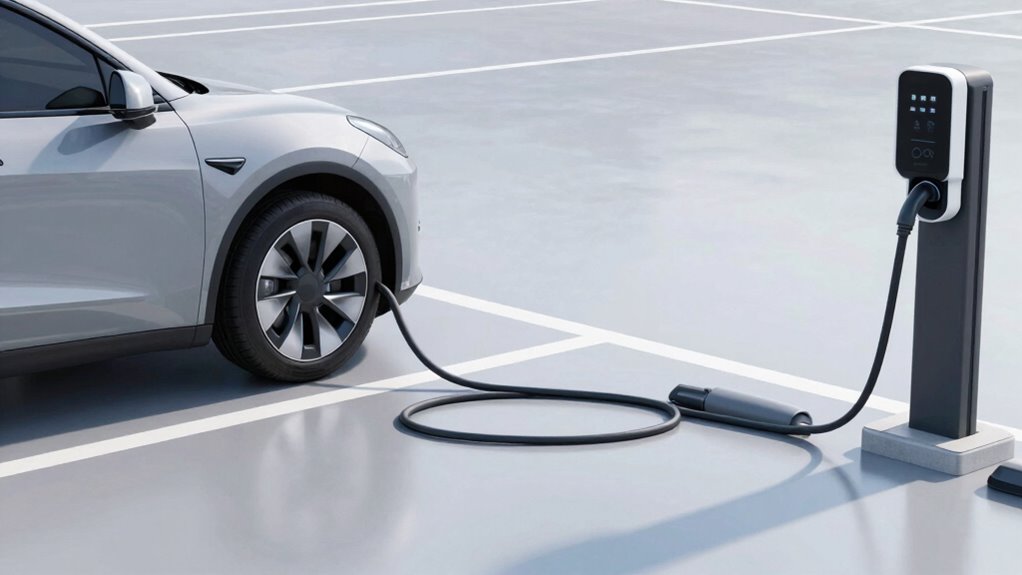

Many people make the mistake of choosing an EV charger cable that’s too short or too long for their parking layout. A cable that’s too short forces you to reposition your vehicle or stretch dangerously, while one that’s too long creates clutter and tripping hazards. The right length depends on the distance between your parking spot and the charging station. To avoid these common layout mistakes and make your charging smooth, you’ll want to take into account all these factors carefully.
Key Takeaways
- Selecting an inappropriate cable length can cause parking congestion or restrict vehicle positioning.
- Using a cable that’s too long increases trip hazards and clutter around the charging area.
- Underestimating required length may force vehicle repositioning, risking damage or inconvenience.
- Failing to measure the distance between the parking spot and charger leads to inefficient cable choices.
- Not considering future layout changes can result in frequent upgrades or safety issues.
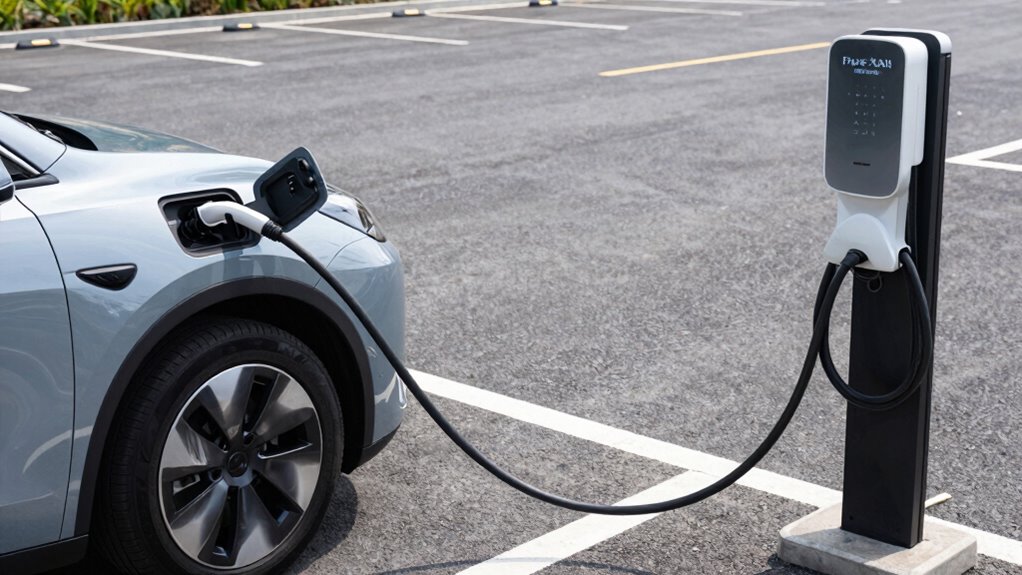
Choosing the right EV charger cable length is vital for convenient and safe charging. When you’re planning your charging setup, the placement of your charging station plays an important role. If the station is too far from your parking spot, you’ll struggle to connect comfortably, and if it’s too close, you might not optimize your space. To avoid these issues, carefully consider where you park and how the cable will reach your vehicle’s charging port. This involves evaluating your typical parking habits and guaranteeing the charging station is positioned within a reasonable distance, so the cable length isn’t a constant obstacle.
Many people overlook the importance of cable management strategies when selecting a cable length. Proper cable management isn’t just about aesthetics; it’s about safety and functionality too. If the cable is too long, it can create trip hazards or clutter your parking area, making it harder to maneuver. Conversely, if it’s too short, you’ll find yourself stretching or repositioning your vehicle, risking damage to the cable or connector. By choosing an appropriate length, you can keep the area tidy and reduce the risk of accidents, all while guaranteeing your vehicle charges without hassle.
Choosing the right cable length ensures safety, reduces clutter, and makes EV charging hassle-free.
Another common mistake is ignoring the natural layout of your parking space. A longer cable might seem like a safe bet, but it often leads to excess slack that can tangle or get caught on objects. On the other hand, a cable that’s too short might force you to park in a specific manner or reposition your vehicle, which isn’t always practical. To avoid this, measure the distance from your intended parking spot to the charging station, and add a few extra feet for flexibility. This way, you can maintain an organized space with minimal cable clutter, making daily charging smoother and safer.
Additionally, think about future needs. If you plan to move your charging station or change your parking layout later, opting for a slightly longer cable can save you from repeated upgrades. It’s also wise to consider weather conditions—longer cables are more exposed and susceptible to damage from the elements, so selecting a durable, appropriately sized cable is wise. Proper planning of charging station placement combined with effective cable management strategies guarantees that your EV charging experience remains convenient, safe, and clutter-free. Remember, the goal is to create a setup that fits seamlessly into your parking routine without sacrificing safety or functionality. Moreover, selecting a cable with high-quality insulation can improve durability and weather resistance, ensuring longevity in outdoor environments.

WenStorm 50A 25FT J1772 EV Extension Cable, Level 2 EV Charger Extension Cord, Heavy-Duty 240V EV Extension Cable for Fast Charging (25FT)
Extended Charging Reach – Park Freely, Charge Anywhere: Add 25FT reach with this extra long EV charging cable….
As an affiliate, we earn on qualifying purchases.
As an affiliate, we earn on qualifying purchases.
Frequently Asked Questions
How Do Cable Length Standards Vary by Region?
Regional standards influence cable variation, so cable length requirements differ depending on where you are. In some regions, standards prioritize longer cables to allow flexible parking and charging, while others emphasize shorter, safer cords due to safety regulations. You need to check your local codes to make certain of compliance. By understanding regional standards, you can select the right cable length, avoiding the common parking layout mistake of choosing improperly sized cables that hinder charging ease.
What Safety Concerns Are Associated With Longer Cables?
A longer cable is like a double-edged sword, creating safety risks you can’t ignore. It can compromise cable flexibility, increasing chances of damage or tripping hazards. Plus, extended cables are more vulnerable to theft, forcing you to implement theft prevention measures. Always guarantee your cables are properly rated for length, and secure them effectively to prevent accidents and unauthorized use, maintaining safety and security in your charging stations.
Can Cable Length Impact Charging Speed?
Yes, cable length can impact charging speed, affecting your charging efficiency. Longer cables may introduce resistance, which slows down the flow of electricity, making charging less efficient. Additionally, managing longer cables can become a challenge, leading to tangled or unsafe setups. To optimize your charging experience, choose an appropriate cable length that minimizes resistance and guarantees good cable management, helping you charge faster and safely.
Are There Portable Charging Options for Longer Distances?
Yes, you can find portable charging options that help you cover longer distances. These options often include an extra cable, giving you flexibility to connect your EV even when the built-in cable isn’t long enough. Portable chargers are compact and easy to carry, making them ideal for on-the-go charging. They guarantee you stay powered up regardless of parking layout constraints, so you won’t be limited by cable length or location.
How Does Cable Length Affect Weather Resistance and Durability?
Think of your EV charger cable as a shield in a storm. Longer cables face more exposure, so choose ones with weatherproof connectors and corrosion resistance to withstand rain, snow, and sun. A sturdy cable resists wear and tear, ensuring your connection stays reliable over time. Keep in mind, shorter cables reduce exposure, but if you need length, prioritize durability and weather resistance for long-lasting performance.

2026 Upgraded Level 1&2 Portable EV Charger, 8-16Amp Adjustable Current & Timer, 110V–240V, NEMA 5-15 & 6-20 Plug, 21Ft EV Charging Cable, J1772 Electric Car Charger for All PHEV/EV Charging Cord
[2026 INTELLIGENT CHARGING UPGRADE — PRECISION CONTROL MEETS SMART SCHEDULING] After surveying 100K+ U.S. EV owners, the Raylix…
As an affiliate, we earn on qualifying purchases.
As an affiliate, we earn on qualifying purchases.
Conclusion
Choosing the right EV charger cable length is vital to avoid parking layout mistakes. Did you know that over 60% of EV owners report struggling with cable reach? By planning ahead and selecting the proper cable length, you save time, frustration, and potentially costly modifications. Don’t let a simple oversight turn into a parking nightmare. Stay informed, measure carefully, and guarantee your charging setup complements your space—making every charge smooth and hassle-free.

EVIQO Level 2 EV Charger, 40 Amp, J1772 for Non-Tesla EVs, 25ft Cable, WiFi (2.4GHz) Smart App, Weatherproof Indoor/Outdoor (IP66, NEMA 4), UL & ETL Certified, NEMA 14-50 Plug-in 240V, 9.6kW
WAKE UP FULLY CHARGED: EVIQO Level 2 EV charger with a max output of 40A (9.6 kW) fully…
As an affiliate, we earn on qualifying purchases.
As an affiliate, we earn on qualifying purchases.

Ceiling Mounted & Wall Mounted EV Charger Cable Retractor – 11.5ft Automatic Retractable Cable Organizer for Electric Vehicle Charging, Universal Fits 95% of EV Charging Cables
Effortless One-Touch Retraction–The cable can extend up to 11.5 feet and automatically retracts when released, keeping it neatly…
As an affiliate, we earn on qualifying purchases.
As an affiliate, we earn on qualifying purchases.