Choosing between vertical and horizontal greenhouses depends on your space and goals. Vertical setups maximize limited land by stacking plant beds upward and are ideal if you have high ceilings and need higher yields per square foot. Horizontal greenhouses are easier to access, manage, and naturally benefit from sunlight, making them suitable for larger land areas. To discover which design best fits your needs and how to optimize each layout, explore more insights ahead.

Get garden gear delivered free with Prime
- Fast, free delivery on millions of items
- Prime Video, Amazon Music and more included
- Member-only deals all year
Key Takeaways
- Vertical greenhouses maximize space and yield in limited land areas with tall ceilings, while horizontal greenhouses are better suited for larger, flat land plots.
- Horizontal layouts offer easier access for maintenance and harvesting compared to vertical setups, which can be more complex and time-consuming.
- Vertical greenhouses require specialized lighting and reflective surfaces to ensure even light distribution across stacked layers.
- Horizontal greenhouses benefit from natural sunlight, simplifying lighting needs and reducing energy costs.
- The choice depends on land availability, ceiling height, and operational priorities, with vertical being ideal for space-constrained areas and horizontal for ease of management.
Greenhouses have revolutionized agriculture by extending growing seasons and optimizing plant production, but choosing the right design can be challenging. When it comes to layout options, vertical and horizontal greenhouses each offer unique advantages and drawbacks. Your decision will hinge on key factors like lighting efficiency and space optimization, which directly impact plant growth and operational costs.
Choosing between vertical and horizontal greenhouses depends on lighting efficiency and space optimization needs.
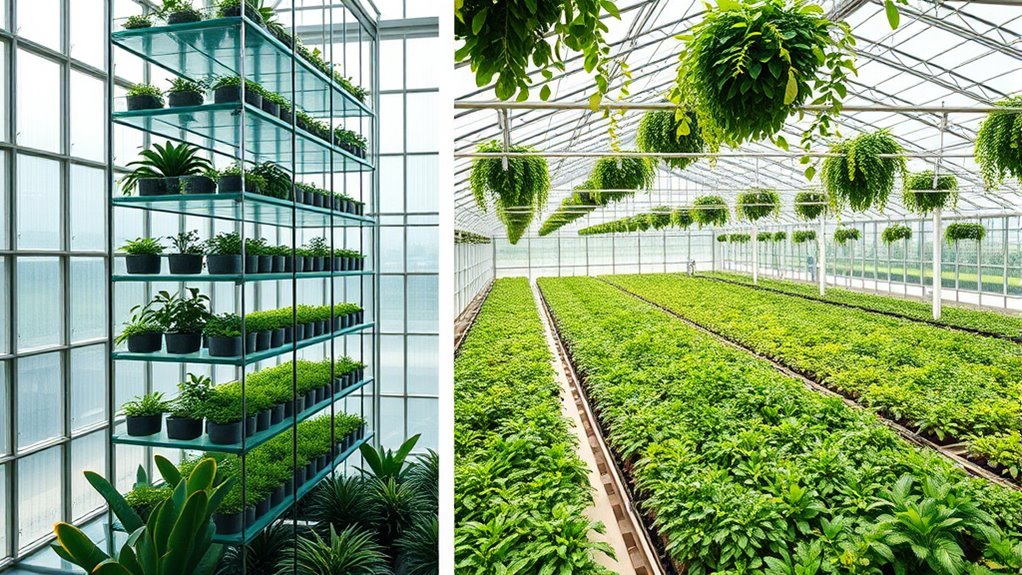
In a vertical greenhouse, space is utilized more efficiently by stacking layers of plant beds upward. This design maximizes vertical space, making it ideal for areas with limited land but ample ceiling height. Because plants are arranged in multiple tiers, you can grow more crops in a smaller footprint. However, this vertical stacking can complicate lighting. You’ll need to navigate that light penetrates to lower levels, which often requires specialized lighting systems or reflective surfaces. Proper lighting efficiency becomes critical here; without it, lower tiers may receive inadequate light, hampering growth. Additionally, maintenance and harvesting can be more challenging due to the multi-layered setup. You might find yourself spending extra time finding your way through narrow aisles or adjusting lighting to reach each level.
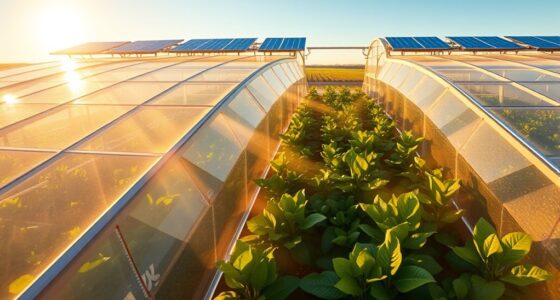
On the other hand, horizontal greenhouses follow a traditional layout with plants arranged in rows or beds on a flat plane. This setup offers straightforward access for planting, maintenance, and harvesting, making it easier to manage. Lighting tends to be more straightforward as well since natural sunlight can evenly reach all plants, especially in well-designed structures with proper orientation. Space optimization in horizontal greenhouses depends on the width and length of the structure; wider or longer layouts can accommodate more plants but require more land. If land availability isn’t a concern, horizontal setups can be scaled up easily by expanding the footprint. However, they may not make the most efficient use of vertical space, potentially limiting production in small areas.
When choosing between the two, consider your priorities. If you’re constrained by land but have high ceilings, a vertical greenhouse might give you a higher yield per square foot, provided you invest in effective lighting solutions. Conversely, if you prefer easier access and simpler lighting management, a horizontal design might be more suitable. Both layouts can be optimized with the right technology and planning, but understanding how lighting efficiency and space optimization play into each will help you make a more informed decision. Ultimately, your choice should align with your specific needs, resources, and goals for sustainable, productive cultivation.
vertical greenhouse lighting systems
As an affiliate, we earn on qualifying purchases.
As an affiliate, we earn on qualifying purchases.
Frequently Asked Questions
Which Greenhouse Layout Is More Suitable for Urban Farming?
When choosing a greenhouse layout for urban farming, consider how urban aesthetics and structural complexity impact your space. Vertical greenhouses maximize limited space, creating a striking visual that blends well with city environments, though they can be more complex to build. Horizontal greenhouses are simpler and integrate smoothly into existing structures. Your decision depends on balancing visual appeal and structural intricacies to suit your urban farm’s needs.
How Do Vertical and Horizontal Greenhouses Compare in Energy Efficiency?
You might think vertical greenhouses are less energy-efficient due to complex structures, but they excel in lighting efficiency by maximizing space and natural light exposure. Horizontal greenhouses, with their simpler design, often have better structural stability, reducing energy costs for heating and cooling. So, your choice depends on whether you prioritize lighting efficiency or structural stability, as each layout offers distinct energy benefits.
Are Maintenance Costs Higher for Vertical or Horizontal Greenhouses?
You might find that maintenance costs are higher for vertical greenhouses due to their structural complexity. This design often requires specialized equipment and more frequent upkeep, which can add to expenses. In contrast, horizontal greenhouses usually have simpler structures, making maintenance more straightforward and less costly. So, when considering the cost comparison, expect vertical setups to demand more investment in upkeep over time.
Which Layout Offers Better Pest Control Options?
Imagine a pest invasion so huge, it could wipe out your entire crop—now, you’re wondering which layout offers better pest control. Vertical greenhouses excel at pest management because their design minimizes insect exposure, keeping pests from spreading easily. Their stacked layers create natural barriers, making insect intrusion harder. So, if you want to keep pests at bay and protect your plants, vertical layouts give you a major advantage in pest control options.
Can Hybrid Designs Combine Vertical and Horizontal Advantages?
You can definitely combine vertical and horizontal designs into a hybrid layout, balancing crop density and reducing structural complexity. By integrating vertical stacking with horizontal pathways, you optimize space and ease of access. This approach lets you maximize crop yields while managing pest control and maintenance efficiently. A hybrid layout offers flexibility, allowing you to customize the structure to fit your specific needs and resources, creating a more adaptable greenhouse environment.
Conclusion
Remember, the grass isn’t always greener on the other side. Whether you choose vertical or horizontal greenhouses, consider your space, budget, and goals. Both layouts have their strengths—vertical setups save space, while horizontal ones are simpler to build. Ultimately, pick what works best for you. As the saying goes, “A journey of a thousand miles begins with a single step.” Make that step today and grow smarter tomorrow.
Fall yard work Picks
leaf blowers
As an affiliate, we earn on qualifying purchases.