
TL;DR

Get garden gear delivered free with Prime
- Fast, free delivery on millions of items
- Prime Video, Amazon Music and more included
- Member-only deals all year
Winterizing a seasonal rain barrel involves more than emptying and storing the container: the downspout must also be restored to a safe winter discharge route. Extension guidance recommends completing the work before the first hard freeze, following product-specific instructions and directing water away from buildings and walking paths.
Gardeners preparing a seasonal rain barrel for freezing weather should also reconnect the downspout or diverter so roof runoff has a safe place to go, according to winter-care guidance from Rutgers Cooperative Extension and the University of Minnesota. The task should be completed before the first hard freeze, because a drained barrel does not stop rain from leaving the roof.
The shutdown starts by tracing the system from the gutter to the outlet. Identify how water enters the barrel, what happens when it fills, and which parts need to be removed, switched or reconnected for winter. Designs vary, so homeowners should use the manufacturer’s instructions or ask the installer about unfamiliar arrangements rather than assuming a neighbor’s setup works the same way.
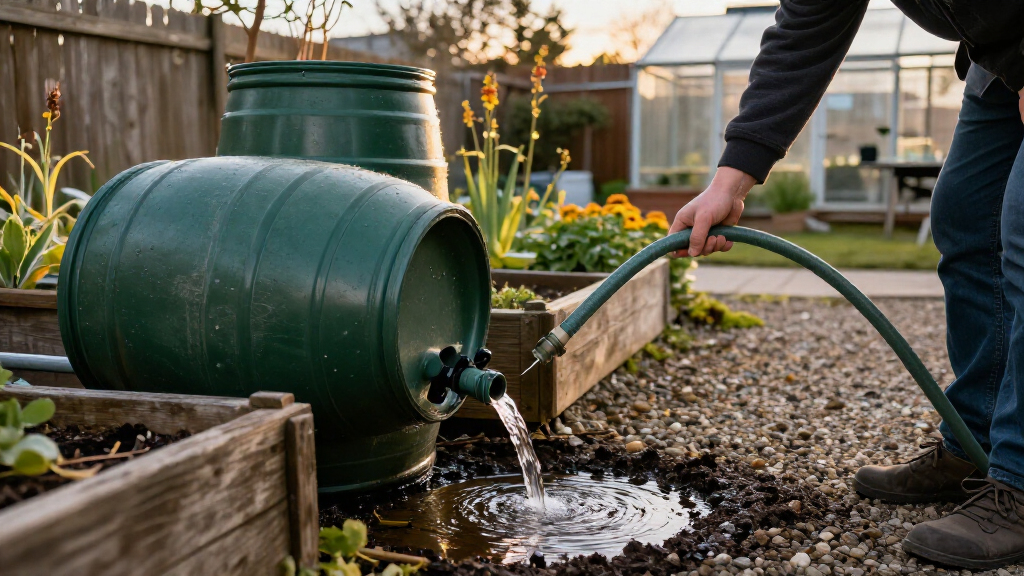
Drain the barrel as directed and deal separately with the hose, screen, tap and other removable fittings. Small components may retain water even after the container appears empty. The University of Minnesota’s guidance recommends removing the hose and screen, draining and cleaning the barrel, then storing it for winter. Keep small parts together and check them for damage while they are accessible.
Before putting the barrel away, restore the winter downspout arrangement specified for the installation. Rutgers describes replacing the ground elbow so water travels away from the house. Check that the outlet is secure and clear, and that it does not send water toward the building, a walkway or another place where runoff could pond or freeze. The barrel should also be stored so it cannot refill with rain or snow; follow the product directions, which may call for indoor storage or an empty, inverted or appropriately covered barrel outdoors.
The Downspout Still Needs an Outlet
The overlooked issue is what happens after the barrel is disconnected. Roof runoff continues during winter, and an outlet left beside a wall can send water toward the building. Water discharged onto a walkway may also create a slippery icy patch when temperatures fall. The route matters as much as the container’s storage.
Where water should go depends on the property and its drainage conditions. A controlled discharge should direct water away from the building without causing runoff or ice hazards. If the area already ponds, the outlet is unclear, or water has caused problems around the building, the general seasonal instructions may not be enough; site-specific advice may be needed.
Popular right now

Samsung 50-inch QN70H Neo QLED 4K Smart TV with Austere 2.5 m 8K HDMI Cable

Dyson Omni-Glide Cordless Stick Vacuum, Gold/Iron

Dyson PencilVac Fluffycones Cordless Hard Floor Vacuum
As an affiliate, we earn on qualifying purchases.
Seasonal Barrels Have Different Instructions
This guidance concerns a seasonal garden rain barrel in a freezing climate. It does not set winter procedures for permanently installed cisterns, underground systems or equipment specifically designed to remain in service during winter. Those systems may require different instructions.
Rutgers Cooperative Extension recommends winterizing a seasonal barrel before the first hard freeze. The University of Minnesota’s guidance covers draining and storing the barrel and removable components. Both sets of advice point to the need to consider where discharged water will travel, not just whether the container is empty. Homeowners should follow the directions for their own barrel and diverter.
The Right Outlet Depends on the Site
The guidance does not prescribe one discharge location or shutdown sequence for every property. Barrel and diverter designs differ, and local drainage conditions affect whether a route is suitable. The source report does not provide product-specific directions, local regulations or a way to assess a particular property.
It may also be difficult to tell from a dry inspection exactly where water will travel. The report advises checking the route during a later rain, from a safe position. Persistent ponding, water near a building or an unclear outlet calls for site-specific guidance rather than an improvised rerouting job.
Check the Route Before Winter Rain
Before the first hard freeze, homeowners can use the forecast to schedule enough time to drain the barrel, remove and store parts as directed, and restore the downspout’s winter arrangement. Confirm that the barrel cannot collect water again and that the winter outlet is secure and unobstructed.
If possible, check the discharge during a later rainfall from a safe location. Observe where the water actually goes, and seek local or professional advice if it ponds, flows toward the building or crosses a walking route. Keep the barrel’s instructions with its stored fittings so the system can be reassembled correctly when collection resumes.
Key Questions
When should I winterize a seasonal rain barrel?
Before the first hard freeze, according to Rutgers Cooperative Extension’s guidance summarized in the report. Scheduling the job around the forecast leaves time to drain the barrel and restore the downspout route.
Is emptying the barrel enough?
No. The roof will continue to shed water after the barrel is removed. Reconnect or reconfigure the downspout as directed for the installation so runoff has a safe winter outlet.
Where should winter runoff go?
There is no single destination suitable for every property. The route should send water away from the building and walking surfaces without creating ponding or another runoff problem. Get site-specific advice if the right outlet is unclear.
Can an empty barrel stay outdoors?
That depends on the product instructions. The guidance describes indoor storage or an empty barrel that is inverted or appropriately covered outdoors. Prevent it from refilling with rain or snow and secure it against wind.
Can I use collected rainwater for drinking?
The source report cautions that an ordinary garden rain barrel is not a drinking-water system. Follow its intended use and product instructions.
Source: planetnatural.com