TL;DR

Get garden gear delivered free with Prime
- Fast, free delivery on millions of items
- Prime Video, Amazon Music and more included
- Member-only deals all year
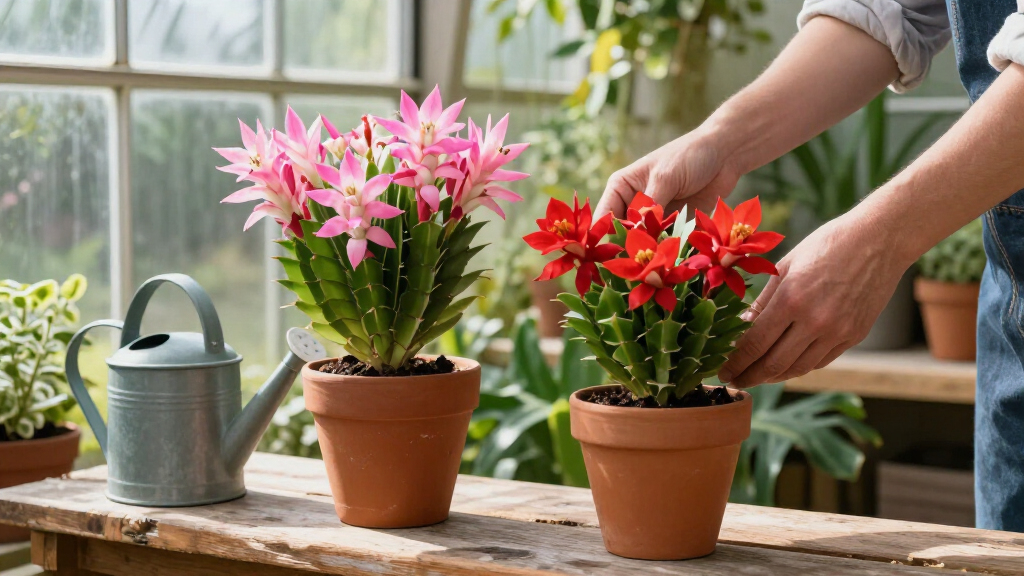
Thanksgiving and Christmas cacti can be distinguished mainly by the edges of their stem segments: pointed teeth suggest Thanksgiving type, while rounded scallops suggest Christmas type. Planet Natural’s guidance says to check for flower buds before changing care, since a plant with buds needs stable conditions and a bud-free plant may respond to a consistent autumn routine. A bloom date or store label alone does not establish a plant’s identity.
Pointed stem edges can help identify a Thanksgiving-type holiday cactus, while rounded scallops are associated with a Christmas type, according to a Planet Natural report advising owners to check the plant before changing its care. The report says existing flower buds are a more immediate guide to what to do: keep conditions steady rather than trying to force a bloom for a particular holiday.
Holiday cacti sold under a “Christmas cactus” label may have pointed segments and flower before Christmas. That does not, by itself, mean the plant is mislabeled or needs a new care routine. Retail names can be imprecise, growers can affect flowering time, and plants may be hybrids, the report says.
To inspect a plant, look in good light at several mature, undamaged stem segments. The flat green parts commonly called leaves are stems. Pronounced, pointed teeth suggest a Thanksgiving type associated with Schlumbergera truncata and related cultivars. Rounded, scalloped margins suggest the traditional Christmas cactus, generally identified as Schlumbergera × buckleyi. Intermediate edges warrant a qualified identification, not a care change intended to make the plant fit a name.
The report advises checking segment tips for developing flower buds before taking action. For a budded plant, use bright, indirect daytime light and avoid repeated moves, elective repotting, pruning, or abrupt shifts in temperature and moisture. Water when the mix’s surface begins to dry, then let excess water drain; avoid both a severely dry root ball and waterlogged soil. For a healthy plant without buds, a consistent autumn routine may support bud formation, but it cannot guarantee flowers by a chosen holiday.
Bud Status Guides Care Changes
The distinction matters because care advice depends on the plant’s current stage, not just the name on its pot. If buds have already formed, repeated moves or sudden changes can contribute to bud loss. The report recommends settling the plant in a suitable spot, away from heater airflow, cold drafts, and frequently opened exterior doors, then keeping its conditions steady.
If the plant has no buds, owners can instead focus on its autumn light and temperature routine. Thanksgiving and Christmas types generally need bright daytime conditions, long uninterrupted nights, and cooler temperatures to initiate buds. These steps may improve the chance of flowering, but they are not a reliable way to schedule blooms for a date only days away. Identifying an Easter cactus also matters: its spring-flowering pattern should not be judged against a Christmas deadline.
The guidance offers a practical way to avoid treating a forest cactus like a desert cactus. The report emphasizes checking soil moisture and drainage rather than withholding water simply because the plant is called a cactus. A few fallen buds do not prove a plant has been mislabeled; several conditions may contribute, so owners should check the plant’s position and potting mix before reacting.
Popular right now

Sony WH-1000XM6 Wireless Noise-Canceling Over-Ear Headphones, Blue, Bundle

Hisense 85 U6 Pro Series Mini-LED ULED 4K UHD HDR Gaming AI Smart Fire TV (85U6SF Pro)

Vitamix Propel Series 750 Professional-Grade Blender, 4 Programs, Black
As an affiliate, we earn on qualifying purchases.
Stem Shape Offers Better Clues
A single flowering date is weaker evidence of identity than stem shape, according to the report. Indoor conditions and commercial production can shift when plants flower. Flower form and a plant’s repeated flowering pattern can provide supporting clues, while hybrids may have traits between the usual categories.
The report describes a possible Easter cactus as having rounded segments with small bristles at the tips and star-shaped flowers, rather than the familiar tubular flowers of Thanksgiving and Christmas types. It belongs to a spring-flowering group and should not be assigned a Christmas target. The report points readers to the University of Illinois Extension’s holiday-cactus identification guide for visual comparison, and says supplier records or a specialist may help when precise botanical identification matters.
For plants without buds, the report suggests bright, indirect light by day and a repeated period of roughly 14 uninterrupted hours of darkness each night for several weeks as a conservative autumn routine. It gives a cool nighttime target of about 55–65°F, with warmer days, while warning against frost and advising owners to measure conditions near the plant. Recommendations for darkness can vary with cultivar and temperature.
Labels and Bloom Dates Can Mislead
The report does not establish the identity of any individual plant; its suggestions are visual clues, not a guarantee of cultivar or species. Hybrid plants may show intermediate segment margins, and a store label or one bloom date may not settle the question. Exact identification may require supplier information or specialist advice.
Nor can the autumn routine guarantee when a plant will flower. The report notes that darkness recommendations vary by temperature and cultivar, and that bud initiation and flower opening are separate stages. It does not offer a fixed schedule that will reliably produce blooms for Thanksgiving or Christmas. If buds fall, the cause is not confirmed by that symptom alone; changes in light, temperature, or moisture may be relevant.
Settle Care and Track Buds
Owners can first inspect several mature segments and check for buds, then choose care based on what they see. A budded plant should be moved only when needed to avoid a harmful position, such as direct heater airflow or a cold draft, and then left in a stable location. Protect a newly purchased plant from cold during transport before choosing a suitable permanent spot.
For a plant without buds, the report recommends keeping bright daytime light and a consistent, uninterrupted night period over several weeks, while avoiding frost and checking temperatures near the plant. Keeping a brief record of location, nighttime conditions, and the date buds appear can inform care next autumn. Major projects such as pruning or repotting can wait until after flowering, rather than being used to chase a particular holiday bloom.
Key Questions
How can I tell a Thanksgiving cactus from a Christmas cactus?
Check several mature stem segments in good light. Pointed teeth along the edges suggest a Thanksgiving type; rounded scallops suggest a Christmas type. Hybrids can have intermediate features, so the shape is a clue rather than a guarantee of precise identity.
Does a Christmas cactus label mean it will bloom at Christmas?
No. The report says retail names can be loose, and growers and indoor conditions can affect flowering time. A label or single bloom date does not confirm the plant’s type or guarantee when it will flower.
Should I change care if my cactus already has buds?
The report advises keeping a budded plant in stable, suitable conditions. Avoid repeated moves and elective repotting or pruning. Use bright, indirect daytime light, check the mix regularly, water when its surface begins to dry, and let excess water drain.
Can I make a bud-free cactus flower by a specific holiday?
Not reliably. Long, uninterrupted nights and cooler conditions over several weeks can support bud formation in Thanksgiving and Christmas types, but the timing varies. A routine started shortly before a holiday cannot promise flowers by that date.
Could my plant be an Easter cactus?
Possibly. The report describes an Easter cactus as having rounded segments with small bristles at the tips and star-shaped flowers. It belongs to a spring-flowering group, so a Christmas flowering deadline is not an appropriate measure.
Source: planetnatural.com