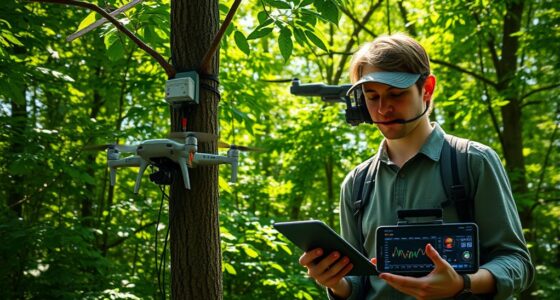

Climate models are powerful tools that help you understand Earth’s climate system and predict future changes. They incorporate data on atmospheric, oceanic, and land processes to simulate how the planet might evolve under different scenarios. However, they can’t perfectly capture small-scale events or sudden changes, and their accuracy depends on the quality of input data. To get a clearer picture of their capabilities and limitations, keep exploring what these models can and can’t do.
Prime for Young Adults — start your free trial
Fast free delivery, streaming and member deals for eligible 18–24 year olds.
As an affiliate, we earn on qualifying purchases.
Key Takeaways
- Climate models simulate Earth’s climate systems to forecast future changes and assess different scenarios.
- They replicate past climate patterns accurately but have limitations in capturing small-scale or sudden events.
- Models rely on high-quality input data but cannot fully represent complex processes like cloud formation and feedbacks.
- Uncertainty quantification provides probabilistic outcomes, highlighting confidence levels and potential risks.
- They are valuable tools for policy but must be used with awareness of their inherent assumptions and limitations.
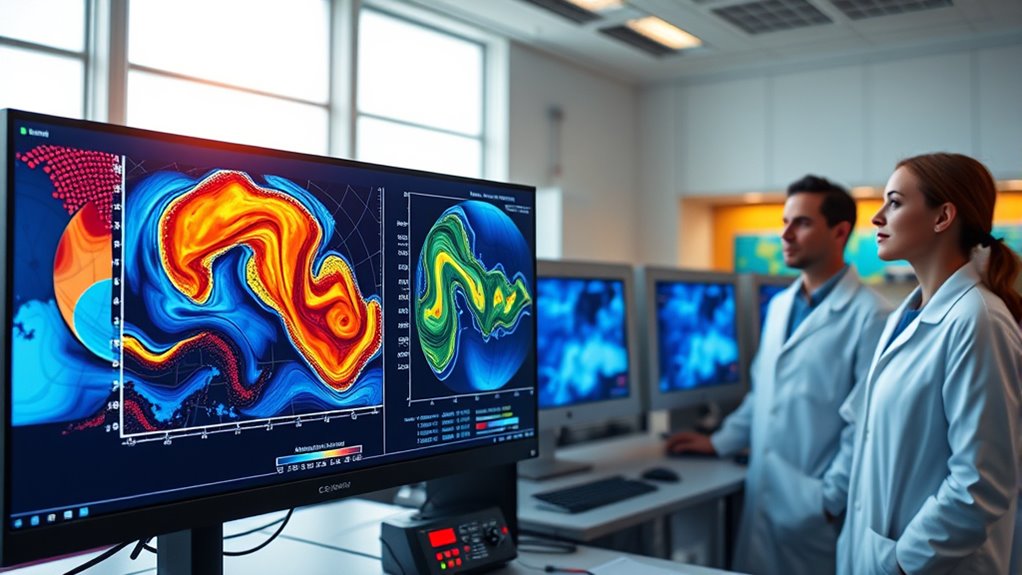
Have you ever wondered how scientists predict future climate changes? It all comes down to climate models—complex tools that simulate Earth’s climate systems to forecast how the planet might evolve. But understanding what these models can and can’t do requires insight into their core strengths and limitations, especially regarding model accuracy and uncertainty quantification. When scientists develop climate models, they aim for high model accuracy, meaning the models can reliably replicate past climate patterns and predict future trends. Achieving this accuracy involves incorporating detailed data on atmospheric processes, ocean currents, land surface interactions, and more. However, no model is perfect. There are always factors that they can’t fully capture, like small-scale phenomena or sudden, unpredictable events. This is where uncertainty quantification becomes essential. It’s a process that helps scientists measure and understand the degree of confidence they can place in a model’s predictions. Instead of offering a single, definitive forecast, models generate a range of possible outcomes, accounting for variables and their inherent unpredictability. This way, scientists can communicate not just what might happen, but how likely different scenarios are, giving policymakers and the public a clearer picture of potential risks. Despite these strengths, climate models have their limitations. They depend heavily on the quality of input data; gaps or errors in measurements can lead to less reliable outputs. Moreover, the complexity of Earth’s climate system means some processes are simplified within models, which can introduce biases or inaccuracies. For example, cloud formation and feedback mechanisms are notoriously difficult to simulate precisely, yet they markedly influence climate projections. Additionally, models often operate at different spatial and temporal scales, making it challenging to capture localized impacts or short-term fluctuations accurately. While uncertainty quantification helps manage these issues by providing probabilistic ranges, it also highlights the limits of our knowledge. This means that, although models are powerful tools for understanding potential future climates, they are not crystal balls. They offer insights based on current understanding, but unanticipated factors or breakthroughs could still alter the trajectory. Recognizing the importance of model accuracy and uncertainty quantification allows you to appreciate both the capabilities and the constraints of climate modeling. It’s a balancing act—using sophisticated simulations to guide decisions while acknowledging their inherent limitations. In essence, climate models are invaluable for shaping climate policies and understanding future risks, but they must always be interpreted within the context of their uncertainties and ongoing scientific refinement. An understanding of model limitations helps ensure that climate predictions are used responsibly and effectively in decision-making.
climate model simulation software
As an affiliate, we earn on qualifying purchases.
As an affiliate, we earn on qualifying purchases.
Frequently Asked Questions
How Do Climate Models Incorporate Future Technological Developments?
You can see that climate models incorporate future technological advancements through model integration, where researchers update models with new data, tools, and assumptions. They actively include potential innovations like renewable energy tech or carbon capture methods to improve accuracy. By adjusting parameters and scenarios based on expected technological progress, models better predict future climate impacts, helping you understand how upcoming advancements may shape climate outcomes over time.
Can Climate Models Predict Abrupt Climate Shifts Accurately?
You can’t rely solely on climate models to predict abrupt climate shifts accurately because of threshold uncertainties. These models struggle to pinpoint exact tipping points, making early warning systems essential. While they can suggest potential risks, rapid changes often happen faster than models can forecast, so staying alert and prepared is vital. Continuous research aims to improve prediction accuracy, but uncertainties remain a significant challenge in anticipating sudden climate shifts.
How Do Models Account for Human Behavioral Changes?
Think of climate models as weather vanes, shifting with new insights. You can see that they incorporate behavioral assumptions by adjusting inputs based on possible human actions, like reduced emissions. They also factor in policy impacts by simulating how new regulations might influence emissions and energy use. While not perfect, these models aim to reflect how human behavioral changes shape future climate scenarios, helping you understand potential outcomes and guide decision-making.
What Are the Limitations of Current Climate Model Resolutions?
Current climate model resolutions have detail limitations because they can’t capture small-scale phenomena like local weather events or detailed land processes. Higher resolution models provide more precise data but require significant computing power, which isn’t always feasible. As a result, you might notice less accuracy in regional predictions, especially in areas with complex terrain or urban landscapes. Improving resolution is essential, but balancing detail and computational resources remains a challenge.
Can Climate Models Forecast Regional Climate Impacts Precisely?
You can’t rely on climate models to forecast regional impacts precisely due to regional variability. While models provide valuable insights into broader trends, they often lack the resolution needed for detailed local predictions. This makes planning for local adaptation challenging. To address this, you should combine model data with local observations and expertise, ensuring your strategies are better tailored to specific regional climate impacts.
Conclusion
Climate models are powerful tools that help you understand potential future changes, yet they can’t predict every detail. Remember, they project broad trends rather than exact outcomes. For instance, over the past 50 years, global temperatures have risen about 1.2°C, illustrating the significance of these models in guiding climate action. While they have limitations, they’re essential for shaping policies and preparedness, giving you a clearer picture of what’s to come and how you can help make a difference.
NFL season / tailgating Picks
team gear
As an affiliate, we earn on qualifying purchases.