
TL;DR
Grow Organic’s onion-growing guide recommends testing soil before choosing fertilizer and adjusting feeding to the crop’s growth stage. It says excess nitrogen late in the season can delay ripening and leave thick necks that dry poorly; variety, sun, spacing and steady watering also affect bulb growth.
Grow Organic’s onion-growing guide recommends testing soil before applying fertilizer and limiting heavy nitrogen feeding late in the season, when it can delay bulb maturity. The advice matters to home growers because fertilizer alone cannot determine yield: onion variety, sunlight, spacing and steady watering also affect bulb development.

Get garden gear delivered free with Prime
- Fast, free delivery on millions of items
- Prime Video, Amazon Music and more included
- Member-only deals all year
The guide says to choose an onion variety suited to local day length. It gives approximate bulbing ranges of 10–12 hours of daylight for short-day onions, 12–14 hours for intermediate types and 14–16 hours for long-day types, while cautioning that ranges vary by variety. The aim is to establish healthy leaves before bulbing begins.
Before planting, Grow Organic advises testing soil and using the results to identify nutrient shortages as well as nutrients already present in sufficient amounts. It says onions generally suit well-drained soil and a pH of about 6.0–7.0. Mature compost may add organic matter, but its nutrient contribution should be included in the feeding plan.
The guide describes nitrogen as supporting leaf growth, phosphorus as supporting roots and potassium as serving several plant functions. It cautions that a balanced fertilizer is not automatically the right choice: additional phosphorus may be unnecessary when soil already has enough. Growers should compare products by nutrient content, follow label rates and account for every application, including compost.
Why Feeding Timing Affects Bulbs
Onion leaves help capture the energy needed for bulbs to grow, so a nutrient shortage can constrain development. But adding fertilizer without evidence of a shortage can waste product and may create problems rather than improve yield. The guide’s central point is that fertilizer should address what the soil lacks, not substitute for suitable growing conditions.
Timing matters, too. According to Grow Organic, heavy nitrogen feeding late in the season can delay maturity and leave thick necks that dry poorly. That can complicate curing and storage. The source notes that regional recommendations differ on whether to feed during early bulb formation, making local growing guidance relevant rather than assuming one schedule works everywhere.
For gardeners, this approach can help avoid overfeeding while keeping attention on other yield factors. Crowded plants, inadequate sunlight, inconsistent moisture, weeds and an unsuitable variety are not problems that extra fertilizer can reliably fix.
Popular right now

KitchenAid Artisan 5-Qt Tilt-Head Stand Mixer, Cardamom

De'Longhi Rivelia Automatic Espresso Machine with Milk Frother

Vitamix 5-Speed Immersion Blender, 625-Watt, Stainless Steel/Black
As an affiliate, we earn on qualifying purchases.
Soil Tests Shape Fertilizer Choices
The source presents its recommendations as a practical growing guide, not as a report of a new trial or a single fertilizer proven to increase yields. It does not name a specific product as best for all gardens. Instead, it links fertilizer choice to soil conditions, product labels and plant growth stage.
It distinguishes organic products, whose nutrient release can depend on material, soil warmth and moisture, from mineral options. Blood meal is described as a concentrated nitrogen source that needs careful measurement. Ammonium sulfate supplies nitrogen and sulfur and can lower soil pH over time; the guide explicitly says it is not an organic fertilizer. Growers are advised not to stack multiple feeds without accounting for their combined nutrients.
The guide also recommends four to six inches between bulb onions as a general spacing suggestion, while planting dates and set depth should follow local advice. For watering, it calls for moist but not soggy soil and suggests checking moisture before watering again. These measures provide context for why fertilizer is only one part of crop management.
“The best fertilizer for onions supplies nutrients your soil lacks.”
— Grow Organic guide
Local Feeding Advice Still Varies
The supplied source does not state when the guide was published, provide trial data comparing fertilizer products, or establish a universal application rate. It also does not specify a single schedule suitable for all onion varieties, soils and climates. The guide says regional recommendations differ on feeding once bulbing starts, so the appropriate timing for a particular garden remains dependent on local conditions and soil-test results.
It is also not possible from the source to predict how much any particular fertilizer will change yield. Soil nutrient levels, weather, watering, pest pressure and growing practices all vary. Its recommendations are general guidance; product labels and relevant local advice remain necessary for specific application decisions.
Check Soil Before Planting
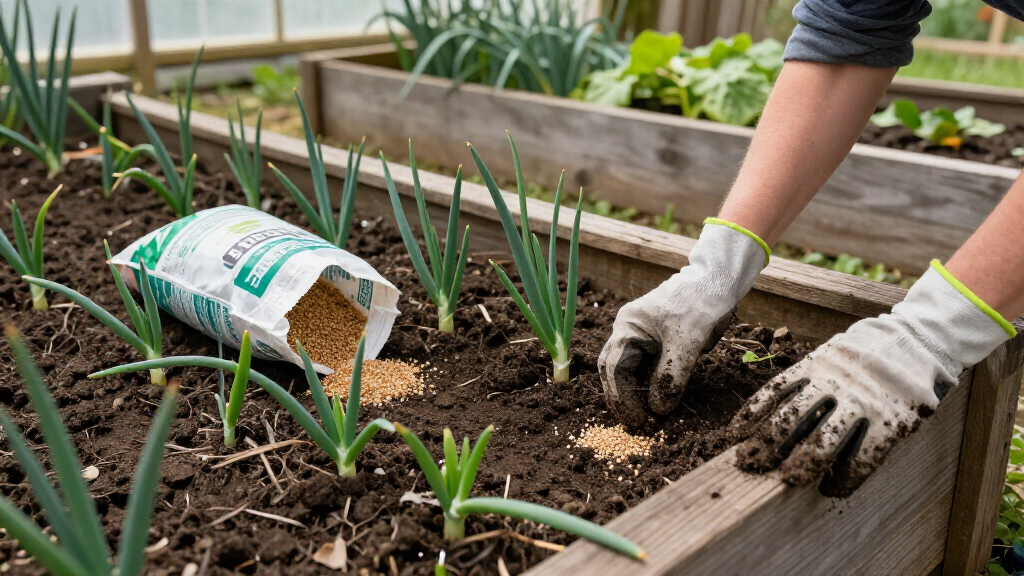
For growers preparing a bed, the next steps outlined in the guide are to test the soil, select a variety suited to local day length and apply only the nutrients indicated by the test. Measure the bed, check the fertilizer’s label rate and keep a record of applications, including compost. For side-dressing, place fertilizer beside the row rather than against stems or leaves, and water as directed.
As plants grow, gardeners can monitor leaf development, soil moisture, weeds and signs of pests rather than treating every pale leaf as a fertilizer problem. The guide advises avoiding heavy nitrogen late in the season, then harvesting storage onions when tops fall naturally and curing bulbs with good airflow until necks and skins dry. Local extension or regional growing guidance can help resolve differences in timing.
Key Questions
What fertilizer should I use for onions?
According to Grow Organic, choose a product that supplies nutrients shown to be lacking by a soil test. Compare nutrient content and follow the product label rather than assuming a balanced blend is right for every bed.
Does nitrogen help onions grow?
Nitrogen supports leaf growth, which contributes to bulb development. The guide cautions that too much late in the season can delay ripening and leave thick necks that dry poorly.
When should I stop fertilizing onions?
The source does not give one schedule for every region. It says some regional guides stop feeding when bulbing begins, while others allow an early bulbing application; follow local advice and avoid heavy late-season nitrogen.
Can fertilizer make onion bulbs larger?
Fertilizer can address a nutrient shortage, but the guide says it cannot fix shade, crowded rows or an unsuitable variety. Sunlight, spacing and steady watering also affect growth.
How far apart should bulb onions be planted?
Grow Organic cites four to six inches as a general spacing suggestion for bulb onions. The right spacing and planting dates can vary with variety and local conditions.
Source: rss