
If you’re aiming to boost your astrophotography, I recommend exploring the best field flatteners designed for refractor telescopes. These devices correct field curvature, providing sharp, distortion-free images across the entire sensor. From budget-friendly options like the SVBONY SV209 to advanced models like the Sky-Watcher Evolux 62ED, there’s a solution for every setup. Keep going, and you’ll discover how these flatteners can transform your astrophotography experience.
Key Takeaways
- Field flatteners correct field curvature for sharp, distortion-free images across the entire sensor, enhancing astrophotography quality.
- Compatibility with refractor telescopes, especially within f/4 to f/8 focal ratios, ensures optimal correction and focus.
- Fully multi-coated optical elements maximize contrast, light transmission, and reduce aberrations for detailed, high-contrast astrophotos.
- Precise threading and proper spacing are essential for optimal performance, minimizing vignetting and distortions.
- High-quality flatteners support full-frame sensors and wide fields, ideal for capturing large deep-sky objects with minimal post-processing.

Astromania 2" Field flattener - Provides Perfect Image Flatness for Your Astronomy Photos
Field flattener for refractors; suitable for telescopes from f4 to f8
As an affiliate, we earn on qualifying purchases.
Astromania 2″ Field Flattener for Astronomy Photos

If you’re an astrophotographer looking to capture sharp, distortion-free images across your entire field of view, the Astromania 2″ Field Flattener is a must-have. It corrects field curvature in refractor telescopes with f/4 to f/8, ensuring stars stay pinpoint from center to edge. With M48 threading, it offers full aperture illumination at 2 inches, making it compatible with a variety of accessories. Its multi-coated lenses reduce reflections and enhance image clarity. Weighing just 6.3 ounces, it’s lightweight and easy to handle. This flattener delivers consistent, high-quality images, making your astrophotography sessions more precise and enjoyable.
Best For: astrophotographers using refractor telescopes with f/4 to f/8 seeking to achieve sharp, distortion-free images across the entire field of view.
Pros:
- Corrects field curvature for uniformly sharp stars from center to edge
- Compatible with a variety of accessories via M48 threading and full aperture illumination
- Multi-coated lenses reduce reflections and improve overall image clarity
Cons:
- Slightly limited to telescopes within the f/4 to f/8 range, less versatile for other optics
- May add some complexity to setup for beginners unfamiliar with astrophotography accessories
- Customer reviews indicate mixed satisfaction, with an average rating of 3.8 out of 5 stars

SVBONY SV209 Field Flattener, 0.8X Focal Reducer, Corrects The Field Curvature and a Wider Field of View, Telescope Accessories for SV550 122mm APO Refractor Telescope
SV209 0.8X focal reducer field flattener is designed specifically for prime focus astrophotography with the SV550 122mm f/7...
As an affiliate, we earn on qualifying purchases.
SVBONY SV209 Field Flattener, 0.8X Focal Reducer for Refractor Telescopes

The SVBONY SV209 Field Flattener is an excellent choice for astrophotographers seeking sharper images across the entire frame, especially at the edges. Designed specifically for the SV550 122mm APO refractor, it corrects field curvature and expands the field of view, making your images clearer and more detailed. By reducing the focal length from 854mm to 683.2mm, it increases photographic speed and coverage. Its secure, easy-to-install 63×1 threaded connection ensures stability during imaging. Overall, this focal reducer enhances image quality, minimizes distortions, and boosts your astrophotography efficiency, delivering wider, sharper views of the night sky.
Best For: astrophotographers using the SV550 122mm APO refractor seeking to achieve sharper, wider, and more evenly focused images across their entire frame.
Pros:
- Corrects field curvature for sharper, consistent focus from center to edges
- Expands the field of view, allowing for wider astrophotography captures
- Reduces focal length to increase photographic speed and efficiency
Cons:
- Designed specifically for the SV550 122mm APO refractor, limiting compatibility with other telescopes
- May require careful threading and installation for optimal stability
- Slight reduction in image scale, which might affect framing for certain projects

SVBONY SV503 Telescope for Adults High Powered, 102mm F7 Extra Low Dispersion Achromatic Refractor OTA, Dual-Speed Focuser, Refractor Telescope for Planets Deep Sky Astrophotography&Visual Observation
Superior Optics: This telescope for adults features 102mm aperture, 714mm (f/7) focal length, equipped with FMC coating to...
As an affiliate, we earn on qualifying purchases.
SVBONY SV503 Refractor Telescope, 102mm F7 High Power Astronomical Refractor

For amateur astronomers seeking sharp, color-accurate images, the SVBONY SV503 Refractor Telescope offers an excellent combination of high-quality optics and versatile features. Its 102mm aperture and F7 focal ratio deliver bright, detailed views, perfect for deep-sky and planetary imaging. The doublet air-spaced achromatic lens with S-FPL51 ED glass reduces chromatic aberration, guaranteeing accurate colors. Fully multi-coated optics maximize light transmission and contrast. A 360° field rotator allows precise framing, while the dual-speed focuser ensures sharp focus with ease. Its compact design, along with accessories like the retractable lens hood, makes it ideal for both beginners and seasoned astrophotographers.
Best For: amateur astronomers and astrophotographers seeking a high-quality, versatile refractor telescope for deep-sky, planetary, and terrestrial observations.
Pros:
- High-quality doublet air-spaced achromatic lens with S-FPL51 ED glass reduces chromatic aberration for accurate, colorful images
- Fully multi-coated optics maximize light transmission, contrast, and brightness for detailed views
- 360° field rotator and dual-speed focuser provide precise framing and easy focusing
Cons:
- May be less suitable for very advanced astrophotography requiring specialized mounts or accessories
- Slightly bulkier than smaller portable refractors, which could affect transportation ease
- Requires additional accessories for astrophotography or extended viewing setups

SVBONY SV503 Refractor Telescope with Built-in Field Flattener and SV305C Pro Telescope Camera
Outstanding flat-field correction; built-in field flattener of SVBONY SV503 telescope eliminates field curvature; offering a flat; wide view;...
As an affiliate, we earn on qualifying purchases.
SVBONY SV503 Refractor Telescope with Built-in Field Flattener and SV305C Pro Telescope Camera

Designed for astronomers who demand sharp, wide-field views, the SVBONY SV503 Refractor Telescope stands out with its built-in field flattener, ensuring edge-to-edge clarity without extra accessories. Its flat-field design minimizes chromatic aberration, delivering true-to-life colors across the entire field of view. With a 70mm aperture and F/6.78 focal ratio, it produces bright, detailed images of galaxies, nebulae, and star clusters. Paired with the SV305C Pro Camera, it offers ultra-high sensitivity and low noise, capturing sharp planetary images even in low light. This integrated system provides excellent clarity and color fidelity, perfect for astrophotography and detailed observation.
Best For: amateur astronomers and astrophotographers seeking high-quality, wide-field, flat-field imaging with minimal chromatic aberration and excellent color fidelity.
Pros:
- Built-in field flattener for edge-to-edge sharpness without extra accessories
- Flat-field design reduces chromatic aberration and enhances color accuracy
- High sensitivity, low noise camera captures detailed planetary and deep-sky images even in low light
Cons:
- Limited aperture size may restrict deep-sky object brightness compared to larger telescopes
- F/6.78 focal ratio, while versatile, may require longer exposure times for certain astrophotography
- Integration of optical and camera systems may require careful setup and alignment for optimal results
HOTECH SCA 2 Inch Field Flattener for Refractor Telescopes

If you’re looking to achieve consistently sharp and flat images across your refractor telescope’s field, the HOTECH SCA 2 Inch Field Flattener is an excellent choice. Designed for f5 to f8 refractors, it features a fully multi-coated two-element lens that guarantees bright, sharp images without sacrificing light collection. The built-in 2” filter thread adds convenience for using standard filters, while the center-loading T-Adapter with a compression ring simplifies camera alignment. Compatible with 35mm cameras via a standard T-ring thread, it’s perfect for astrophotographers seeking reliable, high-quality results across the entire field of view.
Best For: astrophotographers using f5 to f8 refractor telescopes seeking sharp, flat, and consistent images with easy camera alignment and filter integration.
Pros:
- Fully multi-coated two-element lens for bright, sharp images across the entire field
- Built-in 2” filter thread for convenient use with standard filters
- Center-loading T-Adapter with compression ring ensures precise camera alignment
Cons:
- Designed specifically for f5 to f8 refractors, limiting compatibility with other telescope types
- May require additional adapters for certain camera models
- Slightly higher cost compared to basic field flatteners without filter threads
SVBONY SV503 Portable Telescope Tube for Astrophotography and Astronomy
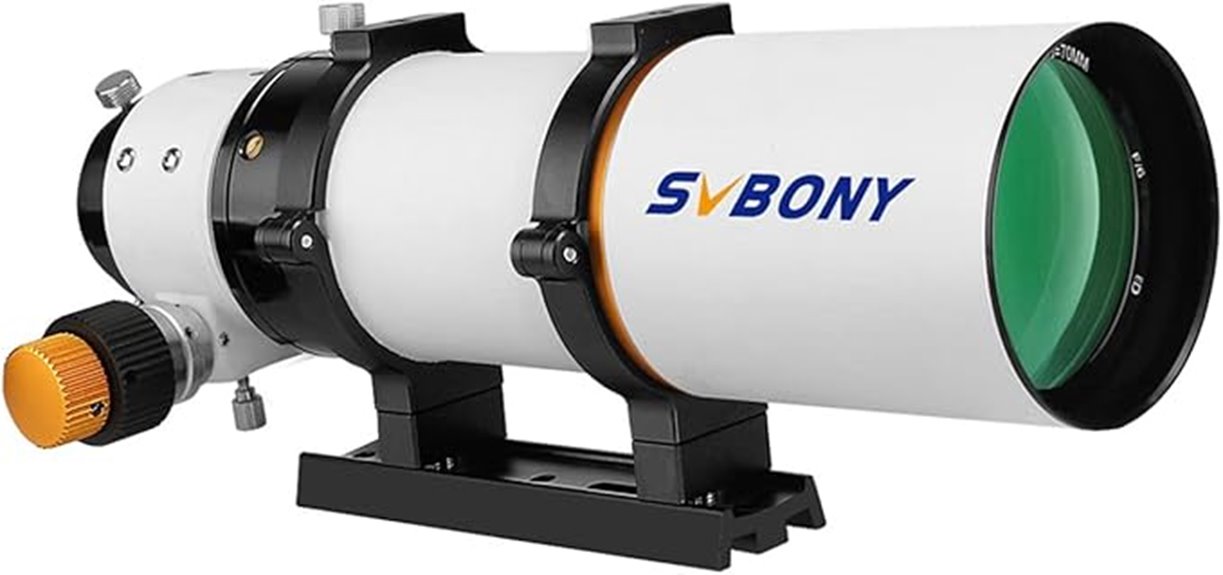
The SVBONY SV503 Portable Telescope Tube stands out as an excellent choice for astrophotographers and amateur astronomers seeking high-quality, portable optics. Its 70ED F6 optical system with ED glass (S-FPL51) virtually eliminates chromatic aberration, delivering sharp, high-contrast images. The doublet air-spaced achromatic lens is versatile, suitable for astrophotography, moon, nebulae, and galaxy viewing. Weighing just 4.88 pounds and measuring compactly, it’s ideal for travel. The 2-inch rack and pinion RAP focuser supports heavy accessories and offers precise focusing. Whether you’re a beginner or an experienced observer, this tube provides reliable performance and portability for your celestial adventures.
Best For: amateur astronomers and astrophotographers seeking a portable, high-contrast telescope suitable for both visual and photographic celestial observations.
Pros:
- Virtually eliminates chromatic aberration thanks to ED glass (S-FPL51), ensuring sharp images
- Lightweight and compact design (4.88 pounds), ideal for travel and outdoor use
- Supports heavy photographic accessories with a precise 2-inch rack and pinion RAP focuser
Cons:
- Limited to 70mm aperture, which may restrict deep-sky object detail compared to larger telescopes
- Doublet lens design might not perform as well as triplet models in certain high-contrast applications
- Smaller size could limit brightness and resolution for advanced astrophotography enthusiasts
Explore Scientific Field Flattener for Refractor Telescopes

Astrophotographers seeking sharper, distortion-free images will find the Explore Scientific Field Flattener an excellent choice, especially for refractor telescopes with focal ratios between f/5 and f/7. This device effectively reduces star distortion caused by field curvature, resulting in crisper images across the entire field of view. It features fully multi-coated optical glass to maximize contrast and light transmission. The flattener connects securely via a T-ring, requiring around 55mm (+/- 2mm) spacing from the camera sensor for ideal performance. Made in the USA, it offers reliable support, making it a valuable addition for astrophotographers aiming for professional-quality results.
Best For: astrophotographers using refractor telescopes with focal ratios between f/5 and f/7 seeking to minimize star distortion and improve image sharpness.
Pros:
- Effectively reduces field curvature for sharper, distortion-free images across the entire field of view
- Fully multi-coated optical glass maximizes light transmission and contrast
- Secure T-ring connection with the correct spacing of approximately 55mm enhances ease of use and optimal performance
Cons:
- Requires precise spacing (around 55mm ± 2mm) for optimal results, which may need careful adjustment
- Designed specifically for refractor telescopes within a certain focal ratio range, limiting compatibility with other telescope types
- May be an additional component to carry and set up, adding complexity to the astrophotography setup
SVBONY SV193 Focal Reducer for SV503 Telescope
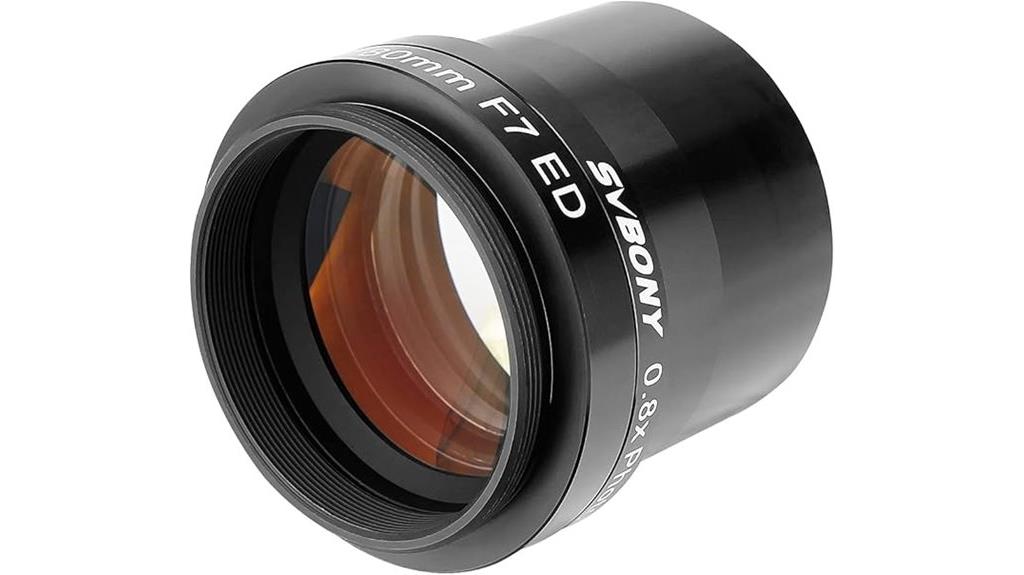
For anyone using the SV503 80mm F7 ED refractor telescope, the SVBONY SV193 Focal Reducer is an essential upgrade that enhances astrophotography. This 2-inch, 0.8x field flattener shortens the focal length, resulting in faster exposures and sharper images across the frame. It effectively minimizes star point distortion at the edges, ensuring more accurate and dazzling celestial photos. The reducer features a standard 2-inch socket at the front and M48x0.75 threading at the rear for easy camera attachment. Compatible with full-frame cameras and supporting 2-inch filters, it boosts both the convenience and quality of your astrophotography sessions.
Best For: astrophotographers using the SV503 80mm F7 ED refractor telescope seeking to improve image quality and reduce exposure times.
Pros:
- Shortens focal length by 0.8x for faster astrophotography sessions
- Minimizes star point distortion at edges for sharper celestial images
- Supports full-frame cameras and 2-inch filters for versatile use
Cons:
- Only compatible with specific SV503 models and similar refractors
- Slightly adds to the overall setup complexity and weight
- Requires proper threading and connection to ensure optimal performance
SVBONY SV193 Focal Reducer 2 Inch 0.8X Field Flattener
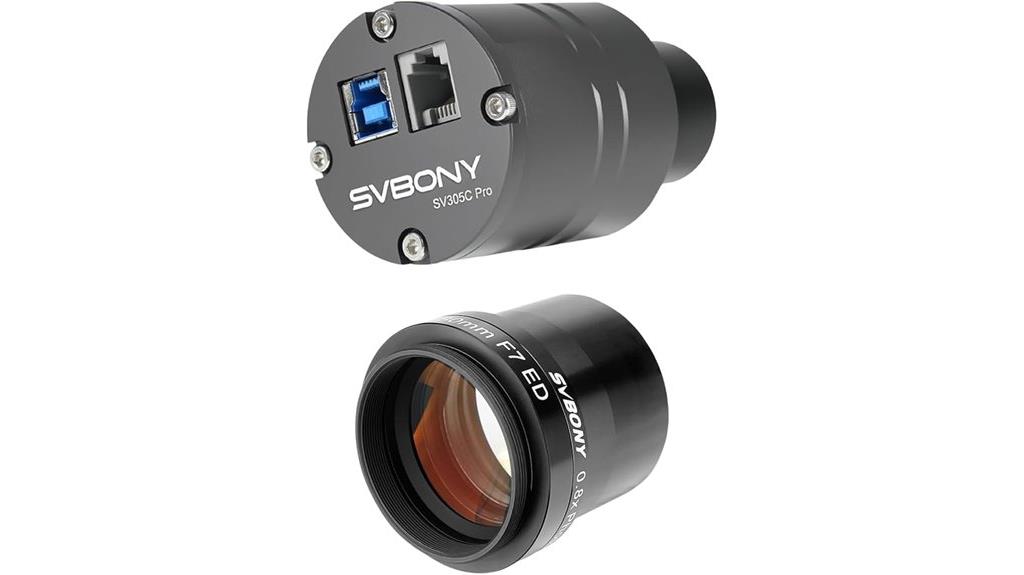
If you want crisp, distortion-free images across your entire field of view, the SVBONY SV193 Focal Reducer 2 Inch 0.8X Field Flattener is an excellent choice. It’s specifically designed for refractor telescopes, helping you achieve sharp star points from edge to edge. With a 0.8x reduction, it flattens the field and minimizes edge distortion, making it ideal for planetary and deep-sky imaging. The 2-inch front socket ensures easy connection, while the M48 threading attaches smoothly to your camera. Plus, it supports full-frame sensors and ultra-high sensitivity cameras, delivering cleaner, more detailed images with low noise even in low-light conditions.
Best For: astrophotographers and amateur astronomers seeking high-quality, distortion-free planetary and deep-sky images with their refractor telescopes.
Pros:
- Provides 0.8x focal reduction for wider field of view and improved image sharpness
- Effectively flattens field curvature and reduces edge distortion for clearer images
- Compatible with full-frame cameras and ultra-high sensitivity sensors for detailed low-light imaging
Cons:
- Designed specifically for refractor telescopes, limiting compatibility with other types
- Requires precise threading and connection, which may need additional adapters for some setups
- Slightly more expensive than basic focal reducers, reflecting its advanced optical features
SVBONY Focal Reducer for SV503 102mm ED Telescope

The SVBONY Focal Reducer for the SV503 102mm ED Telescope stands out as an essential accessory for those seeking wide-field, high-quality celestial images. This 0.8x reducer and field flattener is designed specifically for the SV503 102mm ED refractor, ensuring sharp, distortion-free star points across the entire frame. Its multi-coated optics enhance image clarity and brightness, while the durable aluminum construction guarantees longevity. With compatible connections for cameras and filters, it simplifies setup and maximizes versatility. Overall, this focal reducer markedly improves astrophotography by providing wider views, better illumination, and sharper, more detailed images.
Best For: astrophotographers and amateur astronomers using the SV503 102mm ED refractor seeking wider, sharper, and high-quality celestial images.
Pros:
- Provides a 0.8x reduction for wider sky views and improved framing.
- Multi-coated optics ensure bright, clear, and distortion-free images across the frame.
- Durable aluminum construction offers longevity and resistance to wear while maintaining lightweight handling.
Cons:
- Designed specifically for the SV503 102mm ED telescope, limiting compatibility with other models.
- May require additional adapters or accessories for certain camera setups.
- Slightly increased setup complexity for those unfamiliar with focal reducers and field flatteners.
SVBONY SV260 2″ Telescope Filter with SV503 Refractor Telescope

When considering the best options for astrophotography in light-polluted areas, the SVBONY SV260 2″ Telescope Filter paired with the SV503 Refractor Telescope stands out thanks to its multi-bandpass broadband design and high transmittance. It offers over 90% peak transmission across five wavelengths, effectively reducing light pollution while preserving true color. The filter’s OD4 light pollution cut-off isolates artificial light, enhancing the visibility of nebulae, galaxies, and star clusters. Coupled with the SV503’s flat-field design and minimal chromatic aberration, this setup delivers sharp, colorful images across the entire field, making it ideal for capturing detailed deep-sky objects from suburban locations.
Best For: Amateur astronomers and astrophotographers seeking high-quality, light-pollution-free images of celestial objects from suburban areas using a compatible refractor telescope.
Pros:
- High transmittance of over 90% across five wavelengths enhances image brightness and color accuracy.
- Effectively reduces light pollution with OD4 cut-off, ideal for urban and suburban astrophotography.
- Compatible with the SV503 refractor telescope’s flat-field design delivers sharp, distortion-free images across the entire field of view.
Cons:
- May require additional adapters or accessories for use with other telescope models.
- The filter’s specific compatibility limits its use to the SV503 refractor, reducing versatility with other telescopes.
- Premium quality comes at a higher price point compared to basic filters, which may be a consideration for budget-conscious users.
Astromania 2″ Field Flattener for Astronomy Photography

For astrophotographers seeking consistently sharp images across their entire field of view, the Astromania 2″ Field Flattener stands out as an excellent choice. Designed for refractors with f/4 to f/8, it corrects field curvature and assures sharp stars from center to edge. Made with high-quality multi-coated lenses, it delivers reliable optical performance, supporting complete aperture illumination at 2″. Weighing only 8.8 ounces, it’s lightweight and easy to handle. Its versatile back focus of -109mm allows for flexible setups, making it ideal for capturing crisp, detailed astrophotos with minimal post-processing.
Best For: astrophotographers using refractor telescopes with f/4 to f/8 seeking sharp, flat images across their entire field of view.
Pros:
- Corrects field curvature for consistently sharp stars from center to edge.
- High-quality multi-coated lenses ensure reliable optical performance.
- Supports complete aperture illumination at 2″ for optimal image quality.
Cons:
- Designed specifically for refractors with f/4 to f/8, limiting compatibility with other telescope types.
- Weighs 8.8 ounces, which may be a consideration for very lightweight setups.
- Requires additional accessories for optimal setup due to its back focus of -109mm.
SVBONY SV220 Dual-Band Nebula Filter with SV503 70mm Refractor Telescope

If you’re serious about astrophotography with your SV503 70mm refractor telescope, the SVBONY SV220 Dual-Band Nebula Filter stands out as an excellent tool. It reduces light pollution and enhances contrast, revealing intricate details of emission nebulae, planetary nebulae, and supernova remnants. Designed specifically for the SV503’s built-in field flattener, it minimizes field curvature and chromatic aberration, ensuring sharp, true-to-life images across the entire field of view. This filter allows you to shoot in light-polluted areas without sacrificing image quality, making your deep-sky imaging more vibrant, detailed, and enjoyable.
Best For: amateur and professional astrophotographers seeking to improve deep-sky imaging quality with their SV503 70mm refractor telescope, especially in light-polluted areas.
Pros:
- Effectively reduces light pollution, enhancing contrast and detail in astrophotography.
- Designed specifically for the SV503 70mm refractor with built-in field flattener, ensuring sharp, true-to-life images across the entire field.
- Improves imaging of emission nebulae, planetary nebulae, and supernova remnants by revealing intricate details.
Cons:
- May require additional filters or accessories for full-spectrum imaging.
- Compatibility limited to the SV503 70mm refractor telescope, not suitable for other models.
- The filter’s price might be higher compared to single-band filters, potentially impacting budget-conscious users.
Sky-Watcher Evolux 62ED Reducer/Flattener (0.9X)

The Sky-Watcher Evolux 62ED Reducer/Flattener (0.9X) is an excellent choice for astrophotographers seeking to improve image quality on small refractors. It reduces exposure times by 24%, making imaging more efficient, and delivers a flat field across the entire 30mm illuminated area. Designed specifically for Evolux 62mm refractors, it features a 62mm aperture, f/5.8 focal ratio, and a 360mm focal length. With built-in filter cavities, rotators, and compatible threads, it simplifies setup and guarantees sharp, consistent images. Weighing just 14 ounces, it’s a lightweight, effective tool for achieving high-quality astrophotography results with minimal fuss.
Best For: astrophotographers using Evolux 62mm refractors seeking to enhance image quality and reduce exposure times.
Pros:
- Significantly reduces exposure times by 24%, increasing imaging efficiency.
- Provides a flat field across a 30mm illuminated area for sharp, consistent images.
- Compact and lightweight design (14 ounces) for easy handling and minimal setup hassle.
Cons:
- Designed specifically for Evolux 62mm refractors, limiting compatibility with other models.
- May require precise threading and setup to ensure optimal performance.
- Limited to astrophotography applications; not suitable for visual observing.
SVBONY SV503 Refractor Telescope with Built-in Field Flattener

The SVBONY SV503 Refractor Telescope with Built-in Field Flattener stands out as an excellent choice for astrophotographers and amateur astronomers seeking sharp, distortion-free images across the entire field of view. Its flat-field correction eliminates field curvature, providing wide, crisp images of galaxies, nebulae, and star clusters. With an F/6.78 design and ED glass, it reduces chromatic aberration for true-to-life colors. The self-flat-field setup allows immediate use without extra accessories, while the dual-speed focuser ensures precise adjustments. Built with durable CNC components and stable mounting, it offers steady, high-quality observations, making it a versatile tool for both imaging and visual astronomy.
Best For: amateur astronomers and astrophotographers seeking high-quality, distortion-free images with easy setup and reliable performance.
Pros:
- Flat-field correction eliminates field curvature for wide, crisp views
- ED glass reduces chromatic aberration, ensuring true-to-life colors
- Durable CNC construction and stable mount provide steady, vibration-free observations
Cons:
- Slightly heavier than some comparable models, may require sturdy mounting equipment
- F/6.78 focal ratio may require longer exposure times for astrophotography
- Limited to 70mm aperture, which may be less suitable for deep-sky imaging compared to larger telescopes
Factors to Consider When Choosing Field Flatteners for Refractor Telescopes

When selecting a field flattener, I focus on optical compatibility, ensuring it matches my telescope’s specifications. I also consider the focal ratio and desired field of view to get sharp images across the entire frame. finally, I check mounting options and image quality goals to find a solution that fits my setup and expectations.
Optical Compatibility Requirements
Selecting a field flattener that’s compatible with your refractor telescope requires paying close attention to its optical design and physical connections. First, guarantee the flattener’s optical design matches your telescope’s focal ratio and aperture, providing ideal image correction. Verify that the threaded connection, such as M48 or 2-inch, fits your focuser or camera accessories securely. It’s also essential to confirm the back focus distance specified by the flattener, ensuring proper focus across the entire image field. Check that the optical components, like multi-coated lenses and ED glass, effectively reduce aberrations specific to your scope. Ultimately, confirm the flattener supports your camera’s sensor size and chip dimensions, avoiding vignetting or edge distortions that could compromise your astrophotography quality.
Focal Ratio Range
Choosing a field flattener that matches your telescope’s focal ratio is essential for achieving sharp, distortion-free images. Most flatteners are designed for specific focal ratios, typically between f/4 and f/8, where they deliver ideal correction. Using a flattener outside this range can lead to subpar image quality, with distortions or residual field curvature. High-quality flatteners are calibrated for particular focal ratios, ensuring maximum sharpness and minimal aberrations within those limits. If you use a flattener with a focal ratio considerably faster or slower than its intended range, its effectiveness drops sharply. To get the best results, you need to select a device compatible with your telescope’s focal ratio, ensuring proper correction and a flat, distortion-free field for your astrophotography.
Field of View Needs
A wide field of view demands a field flattener that can effectively correct field curvature across the entire imaging plane. When capturing large celestial objects like nebulae or galaxies, I need a device that guarantees sharpness from edge to edge. Focal reducers can also help expand the field, but they influence the flat-field correction required. Larger sensors demand more extensive correction to prevent edge distortions and maintain image quality. It’s essential to select a field flattener compatible with my telescope’s focal ratio and optical design, so I avoid vignetting or aberrations. The goal is to achieve a wide, flat field that preserves detail across the entire frame, making my astrophotography more detailed and professional. Considering these factors helps me choose the right flattening solution for my imaging needs.
Mounting and Threading
When evaluating field flatteners for my refractor telescope, ensuring compatibility with my setup’s mounting and threading is essential. I need to check that the flatteners have matching threads, like M48 or M54x1, to connect seamlessly with my focuser or camera. It’s also important that the device includes a T-ring or T-adapter, making attachment to my camera straightforward and secure. I look for threaded connections that support standard sizes, such as 2-inch, 48mm, or 55mm, so I can use filters and accessories without hassle. Precise alignment is critical, so I prioritize flatteners with minimal play and easy adjustment options. An adjustable or center-loading mechanism helps me position my camera accurately, ensuring stable focus and ideal image quality.
Image Quality Goals
Achieving sharp, pinpoint star images across the entire field hinges on selecting a field flattener that effectively corrects for field curvature. High image quality goals demand minimal chromatic aberration, which ED glass elements can help reduce. The level of sharpness and contrast you desire influences your choice, especially if you want maximum contrast and light transmission, often achieved with multi-coated optics. For astrophotography, producing a uniform focus from center to edges is essential to meet high standards. Additionally, ensuring flat-field correction maintains true-to-life colors and details is critical for capturing accurate, high-fidelity images. Your goal should be a flattener that balances correction, contrast, and color fidelity, helping you achieve the crisp, clear images that reveal the universe’s true beauty.
Size and Weight Limits
Choosing a field flattener that fits within your telescope’s size and weight limits is vital to guarantee smooth operation and avoid unnecessary strain on your focuser. First, check your refractor’s maximum dimensions and weight capacity to ensure compatibility. Using a flattener that’s too large or heavy can compromise balance, stability, and focus accuracy. For portable setups, opt for lightweight options to keep your system easy to handle and transport. It’s also imperative to verify that the flattener’s dimensions fit within your telescope’s optical tube or visual back, preventing attachment issues. Heavier or bulkier flatteners may require sturdier mounting solutions, which add complexity. Prioritizing size and weight compatibility helps maintain peak performance and reduces the risk of damage or misalignment during your astrophotography sessions.
Budget and Price
Field flatteners come in a wide range of prices, from budget-friendly options to premium models with advanced features. Basic models are often less expensive but may have limited back focus adjustment, which can affect compatibility with certain cameras and accessories. Higher-priced flatteners typically offer better optical coatings, more precise correction of field curvature, and improved build quality, ensuring better image quality. While it’s tempting to choose the cheapest option, it’s important to balance cost with your specific needs and compatibility with your telescope. Sometimes, promotional discounts or bundled deals can make higher-end flatteners more affordable. Ultimately, investing in a quality field flattener that matches your imaging setup provides better long-term value and improved astrophotography results.
Frequently Asked Questions
How Does a Field Flattener Affect Astrophotography Image Quality?
A field flattener considerably improves my astrophotography by reducing edge distortion and ensuring stars stay pinpoint sharp across the entire image. It corrects the curvature caused by my telescope’s optics, resulting in a flatter, more uniform field. This means I get cleaner, more professional-looking photos with minimal post-processing. Overall, it enhances image quality and makes capturing stunning, detailed astrophotos much more achievable and enjoyable.
Can a Field Flattener Be Used With All Refractor Telescopes?
Did you know over 80% of amateur astronomers use field flatteners? I can tell you, not all refractors are compatible. While many telescopes benefit from a flattener, some designs, like fast focal ratios or specialized optics, may require specific models or might not need one at all. So, I’d suggest checking your telescope’s specifications before investing in a field flattener to verify compatibility.
What Maintenance Is Required for a Field Flattener?
I make certain to clean my field flattener regularly with a soft, lint-free cloth to remove dust and fingerprints. I also check for any scratches or damage that could affect image quality. Whenever I change lenses or equipment, I gently disconnect and store it in a dust-free environment. Periodic calibration helps guarantee peak performance, and I always follow the manufacturer’s instructions for specific maintenance tips.
Are There Compatibility Issues Between Focal Reducers and Field Flatteners?
Did you know that over 60% of astrophotographers face compatibility issues between focal reducers and field flatteners? I’ve found that these components can sometimes conflict, causing vignetting or uneven illumination. To avoid this, I always check manufacturer specs and guarantee the accessories are designed to work together. Testing your setup beforehand saves a lot of frustration and gives you clearer, flatter images in the long run.
How Do You Properly Attach a Field Flattener to Your Telescope?
To properly attach a field flattener, I first guarantee it matches my telescope’s thread size. I then screw it into the focuser or camera adapter, making sure it’s snug but not overtightened. Next, I attach my camera or imaging device to the flattener, verifying everything is aligned and secured. Finally, I check the focus and field flatness before capturing images, ensuring ideal performance.
Conclusion
Choosing the right field flattener can dramatically improve your astrophotography, making stars sharper across the entire image. Did you know that using a quality flattener can reduce field curvature by up to 80%? That’s a huge difference in image clarity and detail. No matter your experience level, investing in the right accessory helps you capture stunning, professional-looking shots of the night sky. So, pick wisely, and watch your astrophotos reach new heights!