Electric compost bins for kitchen scraps vary most in capacity, counter space, and how much care they need between cycles. My best overall pick is the FoodCycler Eco 5, a 5-liter option that balances everyday capacity with a countertop-friendly format. The Reencle Prime stands out for households that want a much larger 14-liter unit, while the Ouaken 2.5L suits buyers who prioritize a smaller footprint. The main tradeoff is simple: larger bins can hold more scraps, but take up more space; compact models fit small kitchens but need more frequent use or emptying. Read on for the full comparison and guidance on choosing the right bin for your household.

Get garden gear delivered free with Prime
- Fast, free delivery on millions of items
- Prime Video, Amazon Music and more included
- Member-only deals all year
Complete the kit


Key Takeaways
- Capacity is the clearest dividing line: the Reencle Prime’s 14-liter size and GEME PRO’s 19-liter capacity serve different needs from the many 2.5- to 5-liter countertop models.
- The 4- to 5-liter range offers the broadest everyday fit: it appears across options such as the FoodCycler Eco 5, Saluna 5L, and several 4L models, giving buyers more choice without jumping to a large-format unit.
- Small bins trade room for frequency: the Ouaken 2.5L and Airthereal R500-V 2.5 L are easier to fit on a crowded counter, but provide less space for a household’s accumulated scraps.
- Similar listed capacities do not make models interchangeable: features such as a visible window, brushless motor, and one-button controls can shape day-to-day convenience, but should be weighed against the actual space and care requirements.
- Repeated model listings need careful checking: the Ouaken 4L appears twice, so shoppers should compare exact model details rather than assume separate listings indicate distinct capacity or performance.
| GEME PRO 19L Electric Kitchen Composter |  | Best for High-Volume Scrap Processing | Capacity: 19 liters | Daily processing capacity: 11 lbs | Cycle time: 6–8 hours | VIEW LATEST PRICE | See Our Full Breakdown |
| JollyOne Electric Kitchen Composter 4.5L Food Waste Compost Machine |  | Best for Mixed Food Scraps | Capacity: 4.5 liters | Dimensions: 370 × 232 × 372 mm | Power: 120V / 550W | VIEW LATEST PRICE | See Our Full Breakdown |
| Saluna 4L Electric Kitchen Composter with Visible Window |  | Best for Monitoring and Easy Cleanup | Capacity: 4 liters | Dimensions: 8.99 × 8.99 × 10.12 inches | Modes: Three composting modes | VIEW LATEST PRICE | See Our Full Breakdown |
| Ouaken 2.5L Indoor Electric Composter |  | Best Compact Pick | Capacity: 2.5 liters | Dimensions: 11.6 × 9.4 × 12 inches | Modes: Crush, Ferment, Clean | VIEW LATEST PRICE | See Our Full Breakdown |
| Airthereal R500-V Electric Kitchen Composter, 2.5 L, Gray |  | Best for Watching the Cycle | Capacity: 2.5 liters | Dimensions: 12.5 × 10 × 12.5 inches | Weight: 10 kg | VIEW LATEST PRICE | See Our Full Breakdown |
| FoodCycler Eco 5 Electric Food Recycler, 5 L, White |  | Best for Tougher Scraps | Capacity: 5 liters | Dimensions: 10.3 × 13.8 × 13.8 in | Weight: 13.6 kg | VIEW LATEST PRICE | See Our Full Breakdown |
| FRYLINE Electric Composter for Kitchen, 4L Smart Countertop Compost Bin |  | Best for Quiet Nighttime Cycles | Capacity: 4 liters | Dimensions: 16 × 12 × 15 in | Weight: 18 lb | VIEW LATEST PRICE | See Our Full Breakdown |
| Growell 3.2 L Electric Kitchen Composter |  | Best for Flexible Cycle Control | Capacity: 3.2 L | Household size: 3–4 people | Processing modes: Auto, Manual, Compost | VIEW LATEST PRICE | See Our Full Breakdown |
| Ouaken 4L Electric Kitchen Composter |  | Best for Simple, Quiet Countertop Use | Capacity: 4 L | Model: J6001A | Modes: Crush, Ferment, Clean | VIEW LATEST PRICE | See Our Full Breakdown |
| Growell 4L Electric Kitchen Composter with Brushless Motor |  | Best for Low-Maintenance Motor Design | Capacity: 4 liters | Motor type: Brushless | Color: Black | VIEW LATEST PRICE | See Our Full Breakdown |
| BEECKYNO 3L Electric Composter for Kitchen, Smart Countertop Compost Bin |  | Best for Quiet, Small Kitchens | Capacity: 3L | Power: 500W | Noise level: Under 40 dB | VIEW LATEST PRICE | See Our Full Breakdown |
| NutriChef Electric Kitchen Composter | 3 Quart Food Recycler | Food Waste Compost Bin for Countertop | 1 Button to Compost, Easy to Clean Composter Bucket | Low Noise, Odorless & Auto Clean | Grey |  | Best for Simple One-Button Use | Capacity: 3 liters | Processing time: 6–10 hours | Dimensions: 11.02 × 13.5 × 12.5 inches | VIEW LATEST PRICE | See Our Full Breakdown |
| Reencle Prime Electric Composter, 14 L, Silver |  | Best for Larger, Ongoing Scrap Loads | Capacity: 14L | Food waste capacity: Up to 2.2 lb | Processing time: 2–24 hours | VIEW LATEST PRICE | See Our Full Breakdown |
| Saluna 5L Indoor Electric Kitchen Composter |  | Best for Sensor-Guided Processing | Capacity: 5 liters | Dimensions: 9.35 × 12.77 × 16.4 inches | Material: Metal and stainless steel | VIEW LATEST PRICE | See Our Full Breakdown |
| Ouaken 4L Electric Kitchen Composter |  | Best for Faster Batch Processing | Capacity: 4L | Model: JF6001A | Waste reduction: Up to 90% in about 3 hours | VIEW LATEST PRICE | See Our Full Breakdown |
| electric compost bins for kitchen scrap | Capacity | Dimensions | Modes |
|---|---|---|---|
| GEME PRO 19L Electric Kitchen | 19 liters | 18 × 12.6 × 26.2 inches | — |
| JollyOne Electric Kitchen Comp | 4.5 liters | 370 × 232 × 372 mm | Auto, Manual, Compost, Store, Clean |
| Saluna 4L Electric Kitchen Com | 4 liters | 8.99 × 8.99 × 10.12 inches | Three composting modes |
| Ouaken 2.5L Indoor Electric Co | 2.5 liters | 11.6 × 9.4 × 12 inches | Crush, Ferment, Clean |
| Airthereal R500-V Electric Kit | 2.5 liters | 12.5 × 10 × 12.5 inches | — |
| FoodCycler Eco 5 Electric Food | 5 liters | 10.3 × 13.8 × 13.8 in | — |
| FRYLINE Electric Composter for | 4 liters | 16 × 12 × 15 in | Crush, Ferment, Clean |
| Growell 3.2 L Electric Kitchen | 3.2 L | — | — |
| Ouaken 4L Electric Kitchen Com | 4 L | — | Crush, Ferment, Clean |
| Growell 4L Electric Kitchen Co | 4 liters | — | — |
| BEECKYNO 3L Electric Composter | 3L | — | Drying, Store, Self-Cleaning |
| NutriChef Electric Kitchen Com | 3 liters | 11.02 × 13.5 × 12.5 inches | — |
| Reencle Prime Electric Compost | 14L | — | — |
| Saluna 5L Indoor Electric Kitc | 5 liters | 9.35 × 12.77 × 16.4 inches | 4, including auto-cleaning |
| Ouaken 4L Electric Kitchen Com | 4L | — | Crush, Ferment, Clean |
More Details on Our Top Picks
GEME PRO 19L Electric Kitchen Composter
The GEME PRO is the capacity-led choice here: its 19-liter chamber and stated daily processing capacity of 11 pounds suit households that produce far more scraps than a compact countertop bin can handle. Unlike the Saluna 4L and JollyOne 4.5L, it uses microbial degradation and is described as producing nutrient-rich compost, rather than simply drying and grinding scraps into pre-compost. Its 6–8-hour cycle and permanent washable filter also favor ongoing use without routine filter replacement. The tradeoff is substantial size and weight: at 42 pounds and over 26 inches tall, it is a dedicated appliance, not an easy-to-move countertop bin. I’d choose it for volume and its composting approach, but skip it if kitchen space is limited or you need a unit you can relocate easily.
Pros:- 19-liter capacity and stated 11-pound daily processing capacity accommodate more scraps than the compact options in this group.
- Microbial degradation is described as producing nutrient-rich organic compost rather than only dry pre-compost.
- Permanent washable filter avoids routine replacement-filter purchases.
- A 6–8-hour cycle and odor-control design support regular indoor use.
Cons:- At 42 pounds and 26.2 inches tall, it is bulky and difficult to relocate.
- Its large footprint may be impractical in a small kitchen.
- Requires electricity, unlike passive composting methods.
Best for: Large households and frequent home cooks who generate substantial daily scraps and want a higher-capacity appliance for indoor compost processing.
Not ideal for: Apartment cooks with limited counter or floor space, or anyone who needs a lightweight composter they can move between storage and use.
- Capacity:19 liters
- Daily processing capacity:11 lbs
- Cycle time:6–8 hours
- Reduction rate:95%
- Dimensions:18 × 12.6 × 26.2 inches
- Weight:42 lbs
- Filter:Permanent washable built-in filter
- Model number:G601N-2K
Our verdict“Choose the GEME PRO if your household needs a large-capacity electric composter and has room for a heavy, dedicated appliance.”
JollyOne Electric Kitchen Composter 4.5L Food Waste Compost Machine
The JollyOne KC-08 stands out for the kinds of scraps it is specified to handle, including meat, fish bones, and dairy. That makes it a more flexible fit for varied meal prep than the Saluna 4L, whose supplied details focus on producing dry pre-compost and do not list those tougher inputs. Its five modes add a store setting and a 30-minute clean cycle, while standard activated-carbon pellets are less tied to a proprietary replacement system than a dedicated filter format. The 4.5-liter capacity is still countertop-sized, not a match for the GEME PRO’s 19 liters, and the listed 200-gram maximum bone weight means bones need portion control. Auto cycles can take 4–8 hours, so this is not the quickest option for a full batch.
Pros:- Specifically described as processing meat, fish bones, and dairy.
- Five modes include Auto, Manual, Compost, Store, and Clean.
- The 30-minute self-cleaning mode offers a dedicated cleanup option.
- Uses standard activated-carbon pellets rather than a stated proprietary filter format.
Cons:- The 200-gram maximum bone weight limits how much fish or other bone waste can go into a batch.
- Auto processing can take 4–8 hours.
- Its 4.5-liter capacity is much smaller than the GEME PRO’s 19 liters.
Best for: Apartment cooks who want a compact electric bin that can accept a wider range of food scraps, including limited amounts of meat, fish bones, and dairy.
Not ideal for: Large households that need high daily capacity, or buyers who want short, predictable cycles and do not want to manage input limits for bones and dairy.
- Capacity:4.5 liters
- Dimensions:370 × 232 × 372 mm
- Power:120V / 550W
- Noise level:45 dB
- Modes:Auto, Manual, Compost, Store, Clean
- Filter type:Activated carbon, standard 4 mm pellets
- Maximum bone weight:200 g
- Model number:KC-08
Our verdict“Pick the JollyOne if you want a compact bin for varied scraps and can work within its batch limits and longer cycle times.”
Saluna 4L Electric Kitchen Composter with Visible Window
The Saluna 4L is a practical pick for buyers who want to see the cycle and keep cleanup simple. Its viewing window lets you check progress without lifting the lid, while the removable dishwasher-safe bucket and one-touch auto-cleaning address the messy part of routine scrap processing. Compared with the Airthereal R500-V, which also has a transparent cover, Saluna puts more emphasis on bucket removal and automated cleaning; Airthereal instead lists a cast-aluminum bucket and a stated 2–5-hour cycle. Saluna’s three modes and dual carbon filters suit regular indoor use, but its output is dry pre-compost, not finished garden soil. The fixed 4-liter capacity also makes it better for smaller households than high-volume kitchens.
Pros:- Viewing window makes it possible to monitor the cycle without opening the lid.
- Removable dishwasher-safe bucket simplifies cleanup.
- One-touch auto-cleaning reduces hands-on maintenance.
- Dual activated-carbon filters support odor control indoors.
Cons:- Produces dry pre-compost that needs further processing rather than finished soil.
- Four-liter capacity may not suit heavy cooking or larger households.
- Requires electricity to process scraps.
Best for: Small households and first-time electric-composter buyers who value visible cycle progress and a removable, dishwasher-safe container.
Not ideal for: Large households that produce scraps faster than a 4-liter chamber can accommodate, or gardeners expecting finished soil directly from the appliance.
- Capacity:4 liters
- Dimensions:8.99 × 8.99 × 10.12 inches
- Modes:Three composting modes
- Waste volume reduction:Up to 90%
- Odor control:Dual activated-carbon filters
- Bucket:Removable and dishwasher-safe
- Material:Metal and stainless steel
- Model number:Fc-385w
Our verdict“Choose the Saluna if easy cleanup and visible progress matter more than large capacity or finished compost straight from the machine.”
Ouaken 2.5L Indoor Electric Composter
For a kitchen where every inch matters, the Ouaken 2.5L offers a smaller-capacity alternative to the Saluna and JollyOne. Its 11.6 × 9.4-inch footprint is suited to countertop placement, and its below-40 dB noise level is a useful fit for homes where an appliance runs near living or sleeping areas. Crush, Ferment, and Clean modes give it more than a single processing setting, while the removable bucket and blade assembly make access for cleaning easier. The tradeoff is its 2.5-liter limit: it suits modest daily scrap loads, not a busy household’s full kitchen waste. Ferment mode creates pre-compost that needs further processing, so buyers wanting a larger bin or a finished-soil output should look at the GEME PRO instead.
Pros:- Compact 2.5-liter design takes up less counter space than the 4-liter Saluna.
- Listed noise level is below 40 dB.
- Crush, Ferment, and Clean modes offer distinct operating options.
- Removable bucket and blade assembly make cleaning access easier.
Cons:- The 2.5-liter capacity is restrictive for larger households or heavy cooking.
- Ferment mode produces pre-compost that requires further processing.
- Carbon filter lifespan is listed as up to five months, so filter upkeep is part of ownership.
Best for: One- or two-person households with limited counter space who want a quiet, small-batch appliance with accessible cleaning parts.
Not ideal for: Families and frequent cooks who generate large amounts of scraps, or anyone who expects ferment mode to produce finished compost without further processing.
- Capacity:2.5 liters
- Dimensions:11.6 × 9.4 × 12 inches
- Modes:Crush, Ferment, Clean
- Noise level:Below 40 dB
- Waste volume reduction:Up to 90%
- Carbon filter lifespan:Up to 5 months
- Model number:JF6011A
- Color:White
Our verdict“Choose this Ouaken for quiet, small-batch countertop processing, but move up to a larger model if your kitchen produces scraps in volume.”
Airthereal R500-V Electric Kitchen Composter, 2.5 L, Gray
The Airthereal R500-V pairs a small 2.5-liter chamber with a transparent glass cover, making it the clearest choice for buyers who want to watch scraps as they dry and grind. Its one-button operation is simpler than the Ouaken’s three modes, and the cast-aluminum bucket is dishwasher-safe for cleanup. Airthereal also lists a 2–5-hour cycle, which can be shorter than the JollyOne’s stated 4–8-hour Auto range, though timing varies with the amount of waste. Both compact models reduce scrap volume rather than offering the GEME PRO’s microbial composting approach. Airthereal’s own details note that odors may still occur during cycles, so its biodegradable carbon filters should not be read as a guarantee of odor-free operation. The 2.5-liter capacity also favors light daily use.
Pros:- Transparent glass cover lets users monitor processing without opening the unit.
- One-button operation keeps the controls simple.
- Dishwasher-safe cast-aluminum bucket makes cleanup easier.
- Listed cycle time is about 2–5 hours, depending on waste volume.
Cons:- At 2.5 liters, it is better suited to smaller scrap loads than the Saluna or JollyOne.
- Odors may still occur during cycles despite the activated-carbon filters.
- Cycle length varies with the amount of waste.
Best for: Small households who want a straightforward drying-and-grinding appliance, a visible cycle, and a dishwasher-safe bucket.
Not ideal for: Buyers who need high capacity, guaranteed odor-free operation, or an appliance that produces nutrient-rich compost rather than reduced-volume scraps.
- Capacity:2.5 liters
- Dimensions:12.5 × 10 × 12.5 inches
- Weight:10 kg
- Cycle time:2–5 hours, depending on waste volume
- Waste volume reduction:Up to 90%
- Cover:Transparent glass
- Bucket:Dishwasher-safe cast aluminum
- Filter:Biodegradable activated carbon
- Warranty:3 years
Our verdict“Pick the Airthereal R500-V if you want simple, visible processing in a small batch and can accept variable cycle times and possible odors.”
FoodCycler Eco 5 Electric Food Recycler, 5 L, White
The 5-liter removable bucket and one-touch operation make the FoodCycler Eco 5 a straightforward fit for cooks who want to collect scraps near the prep area and run a batch without much fuss. Its standout distinction is a grinding system described as handling pits, peels, and bones, giving it a broader stated range of scraps than the Growell 3.2 L, which emphasizes adjustable processing rather than tougher inputs. A refillable carbon filter helps manage kitchen odors, though it adds upkeep. The main limitation is what comes out: the product is described as producing reduced-volume material, not finished compost, so gardeners should expect further processing before using it in soil. Its 13.6 kg weight also makes it less convenient to move than a small countertop bin.
Pros:- 5-liter removable bucket can be positioned near food preparation.
- One-touch operation keeps routine use simple.
- Refillable carbon filter helps absorb odors.
- Grinding system is described as handling pits, peels, and bones.
Cons:- Processed scraps are reduced in volume but are not described as finished compost.
- The carbon filter needs refilling and maintenance.
- At 13.6 kg, it is heavy for an appliance that may need frequent repositioning.
Best for: Home cooks who regularly handle varied scraps, including items such as pits and bones, and want a removable bucket for meal prep.
Not ideal for: Gardeners seeking finished compost straight from the appliance or anyone who needs a light unit to move around the kitchen.
- Capacity:5 liters
- Dimensions:10.3 × 13.8 × 13.8 in
- Weight:13.6 kg
- Color:White
- Material:Plastic
- Filter:Refillable carbon filter
- Model:Eco 5 (071593)
Our verdict“Choose the FoodCycler Eco 5 if scrap range and a larger removable bucket matter more than lightweight handling or ready-to-use compost.”
FRYLINE Electric Composter for Kitchen, 4L Smart Countertop Compost Bin
The FRYLINE pairs a 4-liter capacity with a stated noise level below 40 dBA, making it a better match for open-plan kitchens or households that prefer to run a cycle while others are nearby. Its described process reduces waste volume by up to 90% within three hours, a faster stated cycle than the Growell 4L’s 4–6-hour Auto range. Auto-cleaning and dishwasher-safe components also put routine cleanup ahead of the simpler one-touch approach of the FoodCycler Eco 5. The tradeoff is a notably heavy 18-pound metal body, which is less appealing if counter space is shared or the unit must be stored between uses. The filter is rated for 1,000 hours, so odor control also brings a recurring replacement task.
Pros:- Stated waste-volume reduction of up to 90% within three hours.
- Noise level is listed below 40 dBA.
- Detachable bucket is dishwasher safe.
- Auto-cleaning and replacement alerts support routine maintenance.
Cons:- At 18 pounds, it is heavy to move or put away.
- Carbon filter replacement is required after 1,000 hours.
- Its 16 × 12 × 15-inch footprint may be substantial for a crowded counter.
Best for: Households that want a relatively quiet countertop cycle, quick stated processing, and dishwasher-safe parts for cleanup.
Not ideal for: People who need a lightweight appliance to move or store, or buyers who want to avoid periodic carbon-filter replacements.
- Capacity:4 liters
- Dimensions:16 × 12 × 15 in
- Weight:18 lb
- Material:Metal
- Noise level:Below 40 dBA
- Modes:Crush, Ferment, Clean
- Filter life:1,000 hours
Our verdict“Pick the FRYLINE if quiet operation and a short stated cycle outweigh its heavy build and filter upkeep.”
Growell 3.2 L Electric Kitchen Composter
The Growell 3.2 L stands apart for its Auto and Manual processing modes: Auto adjusts the cycle to waste moisture, while Manual lets the user select a run from one to ten hours. That flexibility is more useful for varied loads than the FoodCycler Eco 5’s one-touch simplicity, though the smaller 3.2-liter capacity calls for restraint when adding scraps. Its sealed system and activated-carbon filter address indoor odor control, and a removable, top-rack dishwasher-safe bucket makes cleanup less hands-on. A 30-minute Clean mode adds another maintenance aid. The output is still pre-compost and needs further processing before garden use, so it does not replace a finishing composting step. Its 12- or 24-hour storage modes help with timing, but do not change that limit.
Pros:- Auto mode adjusts processing time to the moisture in the scraps.
- Manual mode offers selectable cycles from one to ten hours.
- Removable inner bucket is top-rack dishwasher safe, with a dedicated Clean mode.
- Brushless motor is rated for more than 30,000 hours.
Cons:- Finished material is pre-compost and needs further processing before garden use.
- The 3.2-liter capacity and overfill guidance limit batch size.
- Auto processing can take up to eight hours.
Best for: Households of three to four people that want adjustable processing, odor control, and a dishwasher-safe inner bucket.
Not ideal for: People who routinely collect large batches or expect dried output to be ready for direct use in soil.
- Capacity:3.2 L
- Household size:3–4 people
- Processing modes:Auto, Manual, Compost
- Manual processing time:1–10 hours
- Auto processing time:Up to 8 hours
- Waste-volume reduction:Up to 90%
- Storage modes:12 or 24 hours
- Warranty:3 years
Our verdict“Choose this Growell if cycle control and easier bucket cleanup matter more than larger batch capacity or finished compost.”
Ouaken 4L Electric Kitchen Composter
Ouaken’s 4L model keeps its appeal focused: a detachable, dishwasher-safe bucket, a carbon filter, and noise listed below 40 dBA. That makes it a practical everyday alternative to the FRYLINE, which also claims quiet operation but adds auto-cleaning and a heavier metal build. Ouaken’s Crush, Ferment, and Clean modes offer more than a basic single-button cycle, while the stated reduction of up to 90% matches the volume-reduction claim on the Growell 4L. There are two important operating caveats: the bucket should be emptied before each cycle to avoid longer runs and clumping, and repeated processing of material may cause fan or blade malfunctions. Those limits make it less forgiving for users who want to batch scraps or rerun partly processed output.
Pros:- Detachable bucket is dishwasher safe.
- Noise level is listed below 40 dBA.
- Carbon filter supports odor control.
- Crush, Ferment, and Clean modes provide multiple functions.
Cons:- The bucket should be emptied before each cycle to reduce clumping and longer run times.
- Repeated processing may cause fan or blade malfunctions.
- Filter life is listed as up to five months, adding a recurring replacement task.
Best for: Countertop users who want a quiet 4-liter bin with a dishwasher-safe bucket and are willing to empty it before each cycle.
Not ideal for: People who want to process large accumulated batches or routinely rerun material for additional reduction.
- Capacity:4 L
- Model:J6001A
- Modes:Crush, Ferment, Clean
- Noise level:Below 40 dBA
- Waste reduction:Up to 90%
- Carbon filter life:Up to 5 months
- Bucket:Detachable and dishwasher safe
- Color:White
Our verdict“Choose the Ouaken for quiet, straightforward batches and easy bucket washing, but skip it if you need to reprocess or stockpile scraps.”
Growell 4L Electric Kitchen Composter with Brushless Motor
This Growell 4L combines a brushless motor with dual activated-carbon filters, making it a stronger fit for buyers prioritizing quieter, lower-maintenance operation than the FRYLINE’s more explicitly timed three-hour cycle. The LED touch panel and visible window give users a clear way to select modes and watch processing, while Auto and Manual cycles cover different levels of control. Its stated Auto run takes four to six hours; Manual runs from one to six hours. The 4-liter capacity and claimed reduction of up to 90% place it in the same everyday batch class as Ouaken’s 4L model, but this Growell adds a three-year warranty. The output still needs further fermentation before soil use, and filters need replacement about every three months. Odor control can also vary with food type and load.
Pros:- Brushless motor is designed for quieter, lower-maintenance operation.
- Dual activated-carbon filters and a sealed design support odor control.
- Visible window and LED touch panel make cycle monitoring and mode selection easier.
- Three-year manufacturer warranty.
Cons:- Standard dried output requires further fermentation before soil use.
- Activated-carbon filters need replacement approximately every three months.
- Odor control may vary depending on the type and amount of food scraps.
Best for: Buyers who want a 4-liter unit with a brushless motor, visible cycle monitoring, and a longer stated warranty.
Not ideal for: Gardeners who want ready-to-use compost or households unwilling to replace filters regularly and manage variable odor performance.
- Capacity:4 liters
- Motor type:Brushless
- Color:Black
- Auto processing time:4–6 hours
- Manual processing time:1–6 hours
- Odor control:Dual activated-carbon filters
- Features:LED touch panel, visible window, auto-clean, fermentation mode
- Warranty:3 years
Our verdict“Pick this Growell if a brushless motor, visible processing, and warranty coverage matter more than filter-free upkeep or ready-to-use compost.”
BEECKYNO 3L Electric Composter for Kitchen, Smart Countertop Compost Bin
The BEECKYNO’s 3L capacity suits a couple or small household that wants to handle everyday scraps without giving up much counter space. Its under-40 dB operation is a useful distinction from compact machines where a processing cycle can compete with conversation or quiet hours. Compared with the larger Reencle Prime, this model takes less scrap at once and processes it into dry pre-compost rather than using the listed aerobic microbial approach. A 12-hour Store mode offers some flexibility if a cycle cannot start right away, but it is not a reason to leave scraps sitting indefinitely. The dishwasher-safe, nano-ceramic-coated bucket should make sticky residue easier to manage; the tradeoff is replacing the carbon filter every two to three months and keeping batch size modest.
Pros:- 3L size fits the stated needs of a two- to three-person household
- Under-40 dB operation is suited to indoor kitchen use
- 12-hour Store mode provides a short window to collect scraps
- Dishwasher-safe nano-ceramic-coated bucket helps simplify cleanup
Cons:- Limited 3L capacity means larger households may need frequent cycles
- Scraps should be processed within 12 hours to limit odor
- Carbon filter replacement is listed every two to three months
Best for: One- or two-person households seeking a quiet countertop composter with an easy-to-clean bucket and short-term scrap storage.
Not ideal for: Families or frequent cooks who accumulate more than a 3L batch, or anyone who needs to leave scraps longer than the 12-hour storage window.
- Capacity:3L
- Power:500W
- Noise level:Under 40 dB
- Odor storage duration:12 hours
- Filter life:2–3 months
- Bucket material:Double-layer nano-ceramic-coated cast aluminum
- Modes:Drying, Store, Self-Cleaning
Our verdict“Choose the BEECKYNO for quiet, small-batch kitchen scrap processing and easier bucket cleanup, but skip it if your household needs larger batches or longer storage.”
The NutriChef is aimed at buyers who want a straightforward routine: add scraps and start processing with one-button operation, rather than choosing among several named modes. Its stated 6–10 hour cycle handles common scraps such as vegetable peels, coffee grounds, and eggshells, a quicker and more defined window than the Reencle Prime’s listed 2–24 hours. At 3 liters, though, it has less room than the Saluna 5L for households that collect scraps across several meals. The removable, dishwasher-safe parts support easier maintenance, while the PP and ABS construction keeps the design practical rather than emphasizing a coated metal bucket like the BEECKYNO. The product description calls operation low-noise and odorless but gives no decibel level or filter replacement interval, so buyers seeking quantified maintenance details may prefer a better-documented option.
Pros:- One-button operation avoids a complicated mode-selection routine
- Listed 6–10 hour processing time gives a defined cycle window
- Dishwasher-safe removable components simplify cleaning
- Compact dimensions suit kitchens with limited counter space
Cons:- 3L capacity may be restrictive for families or frequent meal prep
- No specific decibel figure is provided for its low-noise claim
- Filter life and replacement interval are not specified
Best for: Small-household cooks who want a compact composter with a simple start button and dishwasher-safe removable parts.
Not ideal for: High-volume kitchens that need a larger batch capacity, or buyers who require a published noise level and filter replacement schedule.
- Capacity:3 liters
- Processing time:6–10 hours
- Dimensions:11.02 × 13.5 × 12.5 inches
- Weight:20.1 pounds
- Material:Polypropylene and ABS
- Operation:One-button control
- Cleaning:Removable, dishwasher-safe components
Our verdict“Pick the NutriChef if you value simple controls and easy-clean parts over larger batch capacity or detailed noise and filter specifications.”
Reencle Prime Electric Composter, 14 L, Silver
With a 14L capacity and stated handling of up to 2.2 pounds of food scraps, the Reencle Prime stands apart from compact batch machines such as the BEECKYNO and NutriChef. It makes more sense for households that generate scraps steadily and want room to collect more before processing. Its aerobic microbial decomposition differs from the drying-and-grinding approach described for several other bins here, while the three-layer filter system is designed to manage odors during countertop use. The listed cycle range spans 2–24 hours, so buyers should not treat the shortest time as a guaranteed result for every load. Operation as low as 28 dB is a strong fit for shared living spaces, though it still requires electricity and a larger footprint than the 3L alternatives. A starter pack, shovel, and carbon filter are included to get the system started.
Pros:- 14L capacity accommodates more accumulated scraps than the 3L BEECKYNO or NutriChef
- Listed food waste capacity is up to 2.2 pounds
- Three-layer filtration is designed for odor control
- As-low-as-28 dB operation and included starter accessories
Cons:- Processing time varies widely from 2 to 24 hours
- Requires electricity for operation
- Larger capacity can take more counter space than compact alternatives
Best for: Families or frequent home cooks who need a larger countertop capacity and prefer a microbial decomposition system over small-batch drying.
Not ideal for: People with very limited counter space or buyers who want a fixed, consistently short cycle time.
- Capacity:14L
- Food waste capacity:Up to 2.2 lb
- Processing time:2–24 hours
- Food waste reduction:Up to 90%
- Noise level:As low as 28 dB
- Odor control:Three-layer filter system
- Included accessories:Carbon filter, compost starter pack, shovel
Our verdict“Choose the Reencle Prime if your household produces larger, ongoing scrap loads and can accommodate its footprint and variable processing time.”
Saluna 5L Indoor Electric Kitchen Composter
The Saluna offers 5L capacity without stepping up to the Reencle Prime’s 14L size, making it a middle ground for households that outgrow a 3L bin but do not need a large-capacity unit. Its humidity sensor is the defining feature: it helps guide the drying cycle around the scraps’ moisture, rather than relying only on a fixed routine. Smart Storage Mode also lets users collect scraps before starting a cycle, a useful contrast with the BEECKYNO’s stated 12-hour storage limit, though no specific storage duration is supplied for the Saluna. The visible window and LED display add at-a-glance feedback, and the removable dishwasher-safe bucket supports cleanup. The tradeoff is that it produces dry pre-compost, not finished compost, and a 5L chamber may still mean frequent cycles in busy kitchens.
Pros:- 5L capacity sits between compact 3L models and the 14L Reencle Prime
- Humidity sensor helps adjust processing to scrap moisture
- Smart Storage Mode supports collecting scraps before a cycle
- Dishwasher-safe removable bucket and auto-cleaning mode ease upkeep
Cons:- Output is dry pre-compost rather than finished compost
- 5L capacity may require frequent cycles in higher-volume kitchens
- No processing-time range or noise figure is supplied
Best for: Small- to medium-sized households wanting more capacity than a 3L composter, with sensor-guided drying and convenient scrap collection.
Not ideal for: High-volume households needing a much larger batch, or buyers expecting finished compost directly from the machine.
- Capacity:5 liters
- Dimensions:9.35 × 12.77 × 16.4 inches
- Material:Metal and stainless steel
- Modes:4, including auto-cleaning
- Features:Humidity sensor, LED display, visible window, activated carbon filtration
- Removable bucket:Dishwasher-safe
- Food waste volume reduction:Up to 90%
Our verdict“The Saluna is a good fit for buyers who want sensor-guided processing and a moderate 5L batch size, provided they are comfortable finishing the composting process elsewhere.”
Ouaken 4L Electric Kitchen Composter
The Ouaken’s standout advantage is its stated roughly three-hour processing time, which gives it a clear speed distinction from the NutriChef’s 6–10 hour cycle and the Saluna’s unspecified timing. High-temperature drying, grinding, and cooling reduce scrap volume by up to 90%, producing a more compact result for disposal or later use; this is still not a claim that the machine makes finished compost. Its 4L capacity offers more room than the 3L BEECKYNO, though it remains a batch-size compromise beside the 5L Saluna. Crush, Ferment, and Clean modes provide different functions, and the detachable dishwasher-safe bucket helps with cleanup. The carbon filter is listed for up to five months, a longer stated interval than the BEECKYNO’s two to three months, but it still requires replacement when its service life ends.
Pros:- Listed processing time is about three hours
- 4L capacity offers more room than the 3L BEECKYNO and NutriChef
- Carbon filter service life is listed as up to five months
- Detachable dishwasher-safe bucket supports easier cleanup
Cons:- 4L capacity may be small for high-volume kitchens
- Carbon filter still needs replacement after its stated service life
- High-temperature processing reduces and dries scraps but does not establish that output is finished compost
Best for: Busy cooks who want a faster, roughly three-hour processing cycle, a 4L batch size, and a detachable dishwasher-safe bucket.
Not ideal for: Households that need capacity beyond 4L or buyers who expect the output to be finished, garden-ready compost.
- Capacity:4L
- Model:JF6001A
- Waste reduction:Up to 90% in about 3 hours
- Noise level:Below 40 dBA
- Modes:Crush, Ferment, Clean
- Carbon filter life:Up to 5 months
- Bucket:Detachable and dishwasher-safe
Our verdict“Choose the Ouaken if quicker batch processing matters more than maximum capacity and you are comfortable with dry, reduced scraps rather than finished compost.”
How We Picked
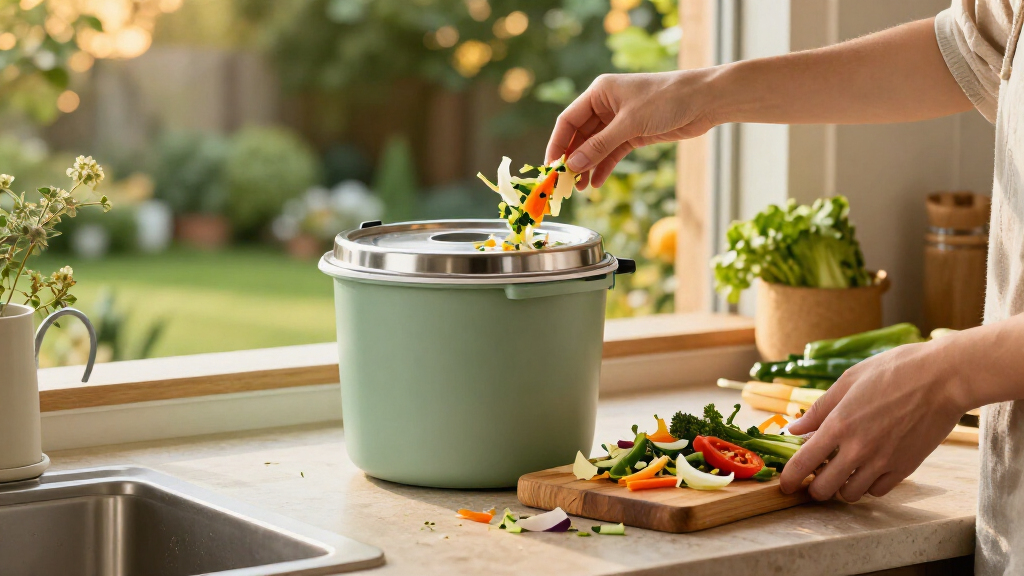
I compared these 15 listed electric compost bins around the decisions that matter in a kitchen: usable capacity, likely counter footprint, ease of operation, cleaning and upkeep, and the relevance of distinguishing features. I gave weight to whether a model’s stated size fits a plausible household routine, and whether its listed features address a practical need rather than simply add another specification. Since product names and listings do not establish every performance detail, I avoid treating unsupported claims about processing speed, odor control, noise, or output as proven.
The ranking favors models that appear to balance everyday capacity and kitchen practicality, then separates large-capacity choices from compact and feature-led alternatives. The 5-liter FoodCycler Eco 5 takes the overall position for its middle-ground capacity; the larger Reencle Prime and GEME PRO make more sense when volume outweighs counter space. Smaller models rank for specific space or simplicity needs, while similarly sized choices are distinguished by identifiable features. The two Ouaken 4L entries are treated as the same stated size, not as evidence of different performance.
Factors to Consider When Choosing Electric Compost Bins For Kitchen Scraps
Before choosing a model, I would match its capacity and routine to the way scraps actually build up in your kitchen. A bin that sounds convenient on paper can become awkward if it occupies your best counter space or needs more attention than you want to give it.
Match capacity to your household’s scrap routine
Capacity should reflect how often you cook and how many people contribute scraps, not just the number on the product name. A smaller 2.5- to 3-liter unit can suit a one- or two-person household that runs it often, while a 4- to 5-liter model leaves more room between cycles. Large formats such as the 14-liter Reencle Prime or 19-liter GEME PRO may suit heavier kitchen waste, but their size can be excessive for occasional scraps. A common mistake is buying the biggest bin available without checking where it will sit. Think about the amount of waste you produce across several days and whether you want to run a cycle frequently or collect more first. Capacity alone does not tell you how quickly a machine processes scraps, so check the maker’s operating instructions before relying on a particular schedule.
Measure counter space, clearance, and access
Measure the intended location, including the space needed to open the lid, remove the bucket, or reach controls. A compact capacity does not automatically guarantee a small footprint, and larger models may compete with appliances you use every day. Leave room for airflow and follow the manufacturer’s placement guidance rather than wedging a unit between cabinets. Think about whether you can carry the inner container to a sink without awkward turns or lifting. If your counter is crowded, the smaller listed capacities may be easier to accommodate, while a large household may prefer to dedicate a stable spot to a higher-capacity unit. Checking dimensions before purchase is more reliable than judging fit from liters alone.
Know what the machine does—and what it does not
Electric food recyclers process scraps, but the word “compost” can lead buyers to expect finished garden compost straight from the machine. Processing methods and the resulting material vary, so read the manufacturer’s description and directions for using or disposing of the output. Do not assume that every type of food waste is accepted; bones, liquids, oils, or especially fibrous scraps may have limits. Those details affect whether a bin suits your cooking habits more than a general claim about convenience. If you plan to use the processed material on plants, check whether it needs further curing or mixing first. The right choice is the one whose accepted inputs and output match your intended routine.
Compare controls and useful features with care
Features matter when they remove a real inconvenience. The Saluna 4L’s visible window may help you check contents without opening the bin, while the Growell 4L listing calls out a brushless motor and the NutriChef emphasizes one-button operation. Those labels are useful starting points, not proof of a particular noise level, lifespan, or ease of cleaning. Confirm what each feature does in the product documentation and whether it changes the tasks you perform. A simple control scheme can help a first-time buyer, but it does not compensate for a capacity that is too small or a footprint that does not fit. Prioritize features tied to your own habits over a longer feature list.
Plan for cleaning, filters, and routine upkeep
Maintenance affects whether an electric bin remains convenient after the novelty wears off. Check whether the bucket is removable, which parts can be washed, and whether the unit uses replaceable filters or other consumables. A claim such as “auto clean” does not necessarily mean the machine needs no manual cleaning, so read the care instructions before buying. Consider where you will wash the bucket and store any replacement parts. A unit with a manageable cleaning routine may be a better fit than a larger model that creates more upkeep than your household wants. Make sure replacement parts are available and that their upkeep fits your willingness to maintain the appliance.
Decide when larger capacity is worth the space
Paying more for a bigger format only makes sense if it solves a recurring problem, such as a full bin before you are ready to run it. A high-capacity unit can reduce how often you need to empty or manage scraps, but it also claims more permanent kitchen space. If your household produces modest waste, a mid-size model may offer a more practical balance. Buyers who cook heavily or share a kitchen may value capacity over a compact profile. Avoid choosing based on a single busy meal; consider your ordinary week and seasonal changes in cooking. For households unsure about their needs, a middle-capacity option is often a safer starting point than the largest or smallest model.
Frequently Asked Questions
Is a 2.5-liter electric compost bin large enough for a household?
It can be enough for one or two people who produce a modest amount of scraps and are comfortable running the machine regularly. A household that cooks most meals at home may fill a 2.5-liter bin quickly, making a 4- or 5-liter model more convenient. Capacity is only one part of fit: check the unit’s dimensions and operating instructions as well. If you are uncertain, track your usual scraps for a few days before choosing. That gives you a better estimate than guessing from household size alone.
Does an electric food recycler make finished compost for a garden?
Not necessarily. Products use different processes, and the material they produce may need further curing or another step before it is suitable for garden use. Follow the specific machine’s instructions for handling its output rather than assuming it is ready-to-use compost. If gardening is your main goal, check what the manufacturer says about the processed material and which scraps are accepted. The appliance can still help manage kitchen waste, but its output should not be treated as identical to finished compost without supporting instructions.
Should I choose a 4- or 5-liter model instead of a larger unit?
A 4- or 5-liter model is a practical middle ground for many kitchens because it provides more room than the 2.5-liter options without the stated 14- or 19-liter capacity of the largest picks. Choose a larger unit if your household regularly produces more scraps than a mid-size bin can hold or you want to collect more between cycles. The tradeoff is a bigger appliance footprint and a dedicated spot on the counter. Compare actual dimensions, not capacity alone, before deciding. Your cooking routine and available space should drive the choice.
What should I check before buying if odor or noise is a concern?
Look for the manufacturer’s instructions on ventilation, filter care, placement, and operating conditions, and verify any odor or noise claims in the model’s documentation. Product names alone cannot confirm how quiet a machine will be in your kitchen or how well it will manage smells. Filters may require periodic replacement, so check availability and upkeep requirements. Placement can also matter: avoid putting a unit where its operating sound will interrupt sleep or conversation. If those issues are especially sensitive for you, prioritize clear documentation and a suitable location over capacity.
Are two listings for the same 4-liter model necessarily different products?
No. This roundup includes the Ouaken 4L Electric Kitchen Composter twice, and the repeated name and capacity do not by themselves establish a different version. Check the model number, included parts, controls, dimensions, and seller listing details before treating them as separate choices. Differences in a listing may reflect packaging or a seller variation rather than a change to the machine. Compare the exact product information and warranty terms attached to the listing you plan to buy. If the details match, it is sensible to treat the entries as the same option.
Conclusion
For most kitchens, I would start with the FoodCycler Eco 5 as the best overall: its 5-liter capacity sits between the compact models and the large-format units. The Ouaken 2.5L is my pick for a small kitchen or a buyer who wants a compact option, while the Reencle Prime is the best premium-style choice for households that need substantially more capacity and have room for it. For beginners, the NutriChef is worth a look for its stated one-button operation, provided its 3-quart capacity suits your routine. If you want a visible contents check, consider the Saluna 4L with Visible Window; if you need the largest listed capacity, compare the Reencle Prime and GEME PRO against your available space. My final advice is to verify dimensions, accepted scraps, cleaning steps, and output guidance before choosing.