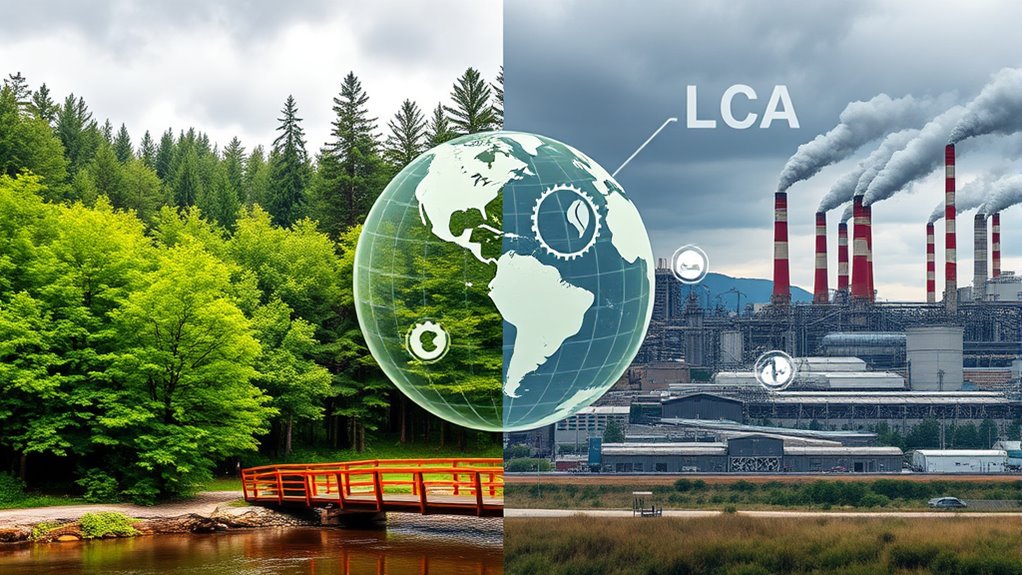

LCA, or Life Cycle Assessment, evaluates the entire product lifecycle, covering impacts like water use, land, and energy, while carbon footprinting focuses solely on greenhouse gas emissions. LCA provides detailed insights into multiple effect categories and hotspots for improvement, helping you develop eco-friendly strategies. Carbon footprinting offers a quick, clear measure of emissions. Both tools are valuable, and if you continue exploring, you’ll understand how they complement each other for sustainable decision-making.
Key Takeaways
- LCA analyzes the full product lifecycle and multiple impact categories; carbon footprinting focuses solely on greenhouse gas emissions.
- LCA provides detailed insights into environmental impacts, while carbon footprinting offers a quick, quantifiable measure of GHG emissions.
- LCA supports holistic eco design strategies; carbon footprinting helps set and track specific emission reduction targets.
- LCA requires extensive data collection across the supply chain; carbon footprinting is more straightforward and emission-specific.
- Combining both methods offers a comprehensive understanding for informed sustainability decision-making.
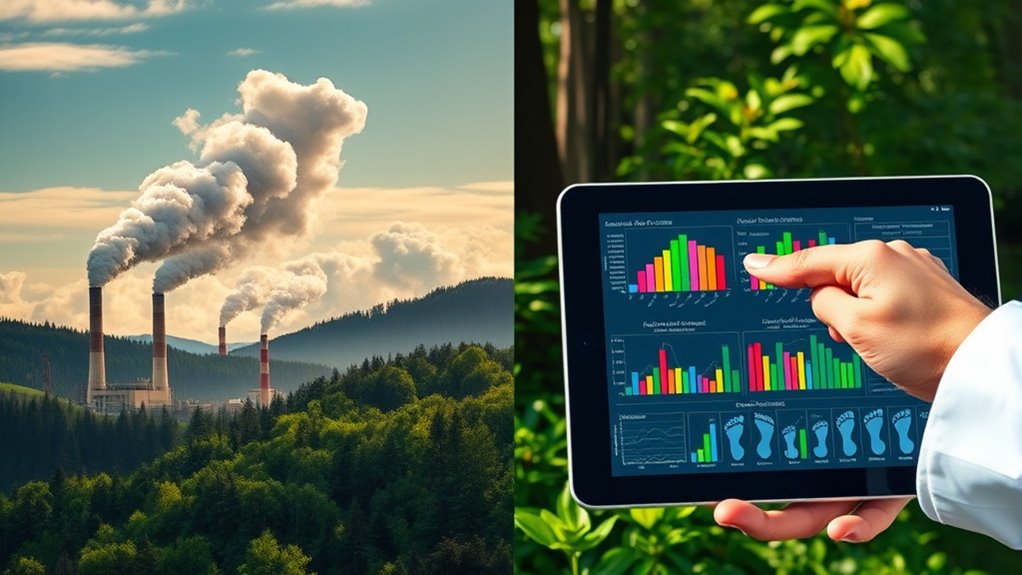
When evaluating the environmental impact of a product or activity, two common approaches are Life Cycle Assessment (LCA) and carbon footprinting. Both methods help you understand the broader implications of your choices, but they do so differently. LCA examines the entire life cycle of a product—from raw material extraction through manufacturing, distribution, use, and disposal. It provides a detailed supply chain analysis that reveals where the most significant environmental impacts occur. This thorough view enables you to identify hotspots within your supply chain and develop targeted eco design strategies. For example, if the evaluation shows that raw material extraction contributes heavily to emissions, you might seek alternative materials or improve sourcing practices. Similarly, if manufacturing is a major impact point, designing products for easier recycling or lower energy use can make a difference. Additionally, adopting a methodical approach ensures systematic testing and evaluation throughout the product’s life cycle, leading to more accurate assessments.
Carbon footprinting, on the other hand, zeroes in specifically on greenhouse gas emissions. It quantifies the total carbon dioxide equivalent emissions associated with a product or activity, often expressed in units like kilograms or tons of CO2e. While it’s more straightforward and easier to communicate, it doesn’t offer the same depth of insight into other environmental impacts like water use or land degradation. Nonetheless, it’s valuable for setting clear reduction targets and tracking progress over time. When comparing products or evaluating the effectiveness of eco design strategies, carbon footprinting provides a quick snapshot of how your efforts translate into tangible emissions reductions.
Both approaches also influence your decision-making process. If you’re aiming for a thorough sustainability strategy, integrating LCA with carbon footprinting gives you a fuller picture. LCA helps you understand where to focus efforts across the entire supply chain, ensuring your eco design strategies are holistic and effective. Meanwhile, carbon footprinting guides you in prioritizing actions that yield the most significant greenhouse gas reductions. Together, these methods enable you to align your environmental goals with practical steps, balancing detailed analysis with manageable metrics.

Garvee 20000 BTU Dual Zone WIFI Mini Split AC/Heating System, 20 SEER2 2 Zone 9000+9000 BTU Ductless Split Air Conditioner with Pre-Charged Condenser, Not Include Copper Tube Line Set, 208-230V
Perfect for Multiple Rooms: Equipped with 1 outdoor 20,000BTU condenser and 2 indoor (9000BTU + 9000BTU) air handlers...
As an affiliate, we earn on qualifying purchases.
Frequently Asked Questions
How Do LCA and Carbon Footprinting Differ in Scope?
You see that LCA covers the entire lifecycle, from raw material extraction to disposal, evaluating various impact categories like resource use and emissions. In contrast, carbon footprinting focuses specifically on greenhouse gas emissions associated with a product or activity. While LCA provides a broader scope across multiple impact categories, carbon footprinting zeroes in on carbon emissions, helping you understand and reduce your climate impact more directly.
Can a Product Have a Low Carbon Footprint but High LCA Impacts?
Yes, your product can have a low carbon footprint but high LCA impacts because of emission trade-offs. For example, it might emit fewer greenhouse gases during production but cause significant environmental damage elsewhere, like water use or resource depletion. These impacts affect the overall product impact, highlighting that a low carbon footprint doesn’t always mean the product is environmentally friendly across all sustainability aspects.
What Industries Benefit Most From Using LCA Versus Carbon Footprinting?
You benefit most from using LCA in industries like agriculture and manufacturing because it provides a extensive, clear-cut picture of environmental impacts beyond just carbon footprints. By analyzing agricultural practices and manufacturing efficiency, you can identify specific hotspots, optimize processes, and make meaningful improvements. This detailed data helps you develop smarter, sustainable strategies, ensuring your operations are not only eco-friendly but also economically efficient and environmentally effective.
Are There Standardized Guidelines for Conducting LCA and Carbon Footprinting?
Yes, there are standardized protocols and certification standards for conducting LCA and carbon footprinting. You should follow guidelines like ISO 14040 and ISO 14044 for LCA, ensuring consistency and reliability in your assessments. For carbon footprinting, standards such as the Greenhouse Gas Protocol provide clear frameworks. Adhering to these standardized protocols and certification standards helps you produce credible, comparable results that meet industry and regulatory requirements.
How Do Regional Differences Affect LCA and Carbon Footprint Results?
Regional variations substantially affect LCA and carbon footprint results because local factors like energy sources, climate, and transportation impact emissions. Data localization is essential, as using generic data can misrepresent regional environmental impacts. You need to tailor assessments to specific regions to guarantee accuracy, accounting for regional variations in resource use, manufacturing practices, and policies. This approach helps you make more informed, region-specific decisions for sustainability improvements.

Senville 28000 BTU Dual Zone Mini Split Air Conditioner Heat Pump, 2 Ton, Works with Alexa, White
PERFECT FOR MULTIPLE ROOMS: Comes with multiple indoor air handlers for individual rooms and a single outdoor unit....
As an affiliate, we earn on qualifying purchases.
Conclusion
Understanding the difference between LCA and carbon footprinting helps you make better eco-friendly choices. Did you know that a product’s entire lifecycle can produce up to 90% of its environmental impact? By using LCA, you gain an all-encompassing view, while carbon footprints focus on specific emissions. Both tools are essential for reducing your environmental impact—so start analyzing your choices today and make more sustainable decisions for a greener future.

COSTWAY 18k Dual 2 Zone Mini Split Air Conditioner, 22 SEER2 7000 BTU+ 7000 BTU, 208-230V, Wifi Enabled Multi Zones Mini Split AC Heat Pump Full Set, Ductless Energy Star
Multi-room Cooling Solution: Designed to cool any corner of your home, this 18000 BTU 2 zone (7000 BTU+7000...
As an affiliate, we earn on qualifying purchases.

ROVSUN 2 Zone 20000 BTU (9K/9K) Mini Split AC/Heating System, 23 SEER2 Dual Zone Ductless Wall Mounted Air Conditioner with Pre-Charged Condenser, Heat Pump & 25Ft Line Set, 208-230V
All-in-One Solution for Multiple Rooms: This product comes with multiple indoor air handlers and individual controllers for each...
As an affiliate, we earn on qualifying purchases.