
TL;DR
A report by Amateur Gardening describes two Japanese winter pruning methods that gardeners can adapt: sukashi, which thins selected branches to create open space, and momiage, which removes previous-year pine needles by hand. The report recommends studying each tree first, making selective cuts and avoiding shears for pine-needle removal.
Amateur Gardening has published guidance on two Japanese winter pruning methods—sukashi, which opens space by selectively thinning branches, and momiage, which removes older pine needles by hand. The techniques offer UK gardeners an alternative to simply cutting trees back to a uniform outline, but the report stresses that each tree should be studied before pruning begins.

Get garden gear delivered free with Prime
- Fast, free delivery on millions of items
- Prime Video, Amazon Music and more included
- Member-only deals all year
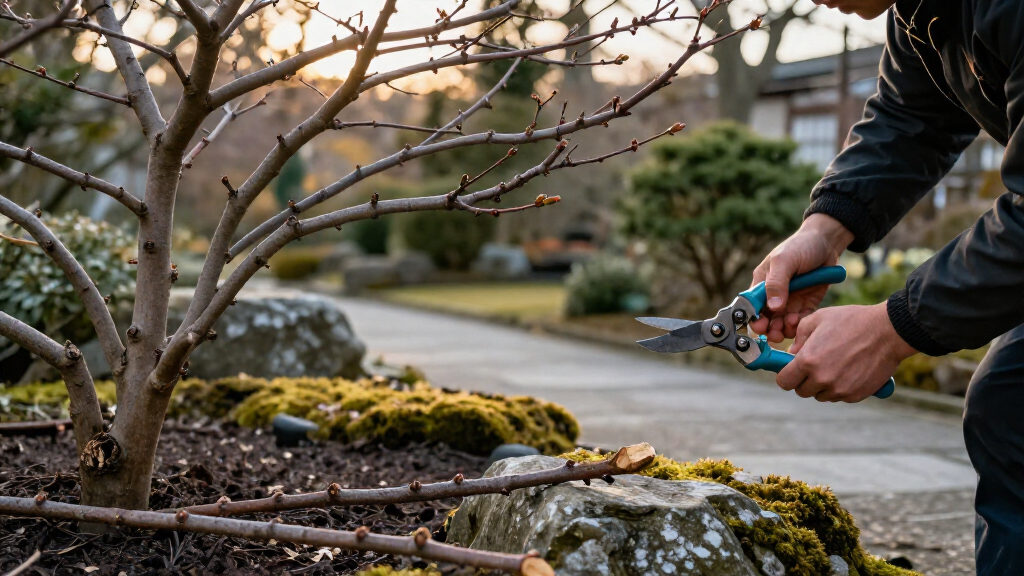
Tokyo-based arborist Isaki Kasahara, COO of Toshi Landscape Inc., describes sukashi as pruning to create “see-through space” within a tree. Rather than trimming the outside into an even shape, the gardener identifies and removes selected branches. The report says the method is used on deciduous trees such as Japanese maples after their leaves fall, with a general window of November to February.
Kasahara advises starting with dead, crossing and inward-growing branches, as well as vigorous water shoots. Cuts should be made at a fork rather than partway along a branch, where a stub may remain. He also cautions against removing too much from one area: thinning should be distributed across the tree rather than leaving a hollow interior. The Japanese Garden Society likewise advises studying the plant before cutting to determine the intended shape.
Momiage is specific to pines and involves removing needles from the previous year by hand while leaving the current year’s needles at branch tips. Kasahara says this allows light to reach lower branches. The report places the work from late autumn into winter and names Scots pine (Pinus sylvestris), Japanese white pine (Pinus parviflora) and black pine (Pinus nigra) as examples found in UK gardens. It advises removing crowded branches at their base before taking off old needles, and says not to use shears for the needles.
Selective Cuts Shape Light and Space
These methods focus on how branches and needles affect the tree’s structure, not on reducing every plant to a neat outer shape. For gardeners, that means pruning decisions can influence how light reaches the interior and lower branches, while preserving a tree’s form. The report presents the techniques as options for appropriate garden trees, not as a requirement to prune every winter.
The practical cautions matter because mistakes can change a tree’s appearance. Leaving stubs may prompt new shoots or remain visible, while thinning heavily in one place can leave an unbalanced or hollow-looking crown. Taking time to assess the tree and removing material selectively is the central advice; the desired result depends on the plant and the setting.
Popular right now

Dyson V9 Motorbar Cordless Vacuum

Samsung 65-Inch S90H OLED 4K Smart TV Bundle with HW-B630F Soundbar, Subwoofer, and Screen Cleaner (2026)

Dyson V8 Cyclone Cordless Vacuum
As an affiliate, we earn on qualifying purchases.
A Longstanding Japanese Pruning Practice
The report says sukashi is associated with the Japanese idea of “ma,” or space and interval, and traces the term to Kyoto. It cites the garden-making manual Sansui narabi ni yagyo no zu, from the Muromachi period (1336–1573), as an early source using the verb sukasu, meaning to thin out.
Kasahara describes different forms for different settings: gosho-sukashi for palace grounds, machiya-sukashi for small Kyoto townhouse gardens, and tera-sukashi around temple halls. The report also places momiage in a seasonal cycle for pines, alongside spring midori-tsumi, when new shoots are snapped off by hand. These details provide background to the techniques; the article’s practical advice concerns how they may be adapted to UK gardens.
““Sukashi means pruning a tree to create ‘see-through space’ within it.””
— Isaki Kasahara, Tokyo-based arborist and COO of Toshi Landscape Inc.
Tree Suitability and Results Vary
The report does not offer a single pruning plan suitable for every tree, nor does it specify how much material to remove from a particular specimen. Species, condition, size and desired shape will affect what should be cut, so its seasonal windows and examples are general guidance rather than a tree-by-tree prescription. The report also does not provide measured evidence comparing outcomes from these methods with other pruning approaches.
Its advice on which pine needles to remove allows room for personal preference: one UK gardener quoted in the report removes only downward-pointing needles to neaten twig ends. The guidance does not establish that this choice is necessary for tree health. Gardeners uncertain about a tree’s condition or the correct cuts may need advice specific to that plant.
Assess Trees Before Winter Work
The next step for gardeners considering the methods is to inspect trees before making cuts, identify dead or crossing growth, and decide what shape to preserve. For sukashi, the report’s suggested period runs through winter, roughly November to February; for momiage, it describes work from late autumn into winter. Gardeners should pause during the work to view the tree from different angles and avoid removing too much from one area.
The article sets out general methods rather than a schedule for any specific garden. Whether sukashi or momiage is appropriate will depend on the individual tree, and the report gives no further follow-up or outcome data.
Key Questions
What is sukashi pruning?
Sukashi is selective thinning that creates open, see-through space within a tree. It differs from shearing, which trims branches to an even outer outline.
When can gardeners try sukashi?
The report gives a general window of November to February for deciduous trees such as Japanese maples, after leaf fall. Timing can depend on the tree and local conditions.
What does momiage do to a pine?
Momiage removes needles from the previous year by hand, leaving current-year needles at the branch tips. The report says this allows light to reach lower branches.
Can I use shears for momiage?
The report’s advice is to remove needles by hand, not with shears. It also recommends removing crowded branches at their base before taking off old needles.
What should I avoid when trying sukashi?
Do not start cutting without studying the tree, leave branch stubs, or thin only one area. The report recommends making cuts at a fork and thinning evenly across the tree.
Source: amateurgardening.com