
If you’re aiming to make your home smarter by 2025, I recommend exploring Thread-enabled devices like smart plugs, sensors, and controllers that support Matter for seamless, local control. Products such as the Eve Energy Outlet, Aqara sensors, and Onvis buttons work well with hubs like Home Assistant Green or Apple TV. These devices prioritize security and privacy while offering fast, reliable connectivity. Keep exploring to discover how these innovations can transform your smart home experience.
Key Takeaways
- Thread-enabled devices like TP-Link Tapo P125M and Onvis Smart Plug offer fast, reliable local control with future-proof Matter support.
- Smart plugs, sensors, and scene controllers utilizing Thread ensure seamless automation, privacy, and cross-platform compatibility in smart homes.
- Multi-protocol hubs such as Home Assistant Green and Matter Smart Home Hub facilitate integrated control of Thread, Zigbee, and Matter devices.
- Compact, secure, and future-ready designs with over-the-air updates keep Thread devices compatible and advanced through 2025.
- Ecosystem integration with Apple HomeKit, Google, and Alexa enhances smart home capabilities using Thread for better responsiveness and reliability.
TP-Link Tapo P125M 3-Pack Smart Plug Mini

If you’re looking to upgrade your smart home with reliable, future-proof devices, the TP-Link Tapo P125M 3-Pack Smart Plug Mini is an excellent choice, especially because it supports the Matter protocol. Its compact design prevents outlet blocking, and UL certification guarantees safety. With 15A/1800W capacity, you can control devices like lamps, fans, or Christmas lights easily via app or voice commands using Siri, Alexa, Google Assistant, or Samsung SmartThings. Setup is quick with Bluetooth onboarding, and local LAN control keeps your devices running even during internet outages. This pack offers a practical, versatile way to enhance your smart home ecosystem.
Best For: smart home enthusiasts seeking a reliable, future-proof, and versatile solution to control multiple devices seamlessly across various platforms.
Pros:
- Supports Matter protocol for broad compatibility with Apple Home, Alexa, Google, and SmartThings.
- Compact, flame-retardant design prevents outlet blocking and ensures safety.
- Local LAN control maintains device operation during internet outages.
Cons:
- Limited to 2.4 GHz Wi-Fi network, which may affect connectivity in congested environments.
- No built-in battery or backup power feature.
- Requires a smartphone app or voice assistant for control, which may involve additional setup time.
Onvis Smart Button, Scene Controller for Apple HomeKit

The Onvis Smart Button stands out for its versatile control options, making it ideal for homeowners who want seamless scene management with minimal effort. With five keys supporting single, double, and long presses, you can trigger up to 15 scenes per button, controlling smart bulbs, plugs, and more. Compatible with Apple HomeKit and supporting Thread and Bluetooth, it offers flexible setup and reliable connectivity. Its compact, wireless design allows easy placement using double-sided tape or magnetic strips. All data stays local and encrypted, ensuring privacy. Requires a Thread-enabled Apple hub, like Apple TV 4K or HomePod, for ideal operation.
Best For: homeowners and smart home enthusiasts seeking a versatile, privacy-focused scene controller that easily integrates with Apple HomeKit and offers flexible placement options.
Pros:
- Supports up to 15 scenes per button with multiple press types for comprehensive control
- Compatible with Thread and Bluetooth, ensuring reliable connectivity with Apple devices
- All data is stored locally with end-to-end encryption, guaranteeing privacy and security
Cons:
- Requires a Thread-enabled Apple hub like Apple TV 4K or HomePod for optimal performance
- Limited to Apple HomeKit ecosystem, not compatible with other smart home platforms
- May have a learning curve for users unfamiliar with scene setup and automation configurations
Onvis Matter Over Thread Smart Plug (4 Pack)
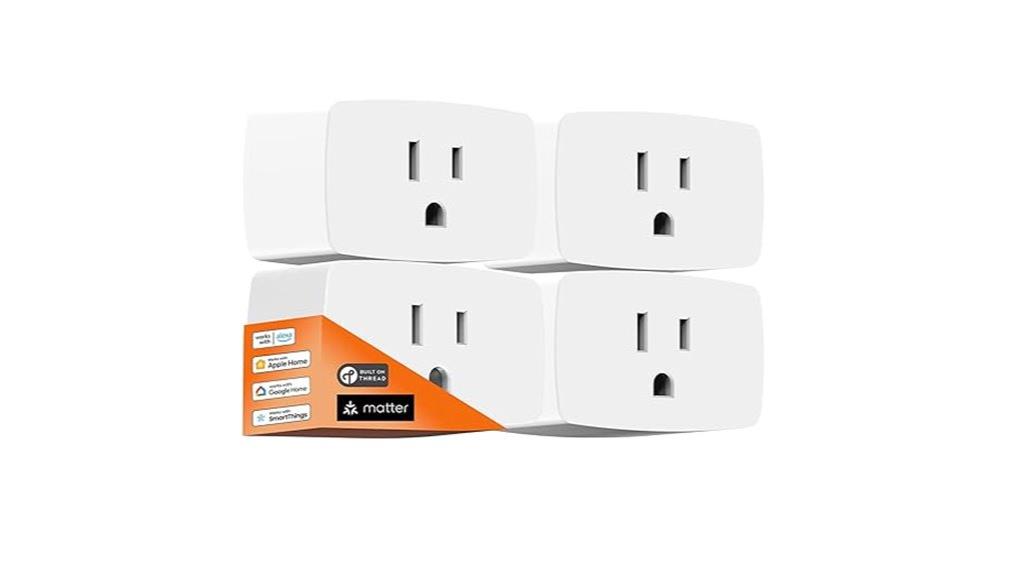
The Onvis Matter Over Thread Smart Plug (4 Pack) stands out for its seamless compatibility with all major smart home platforms, making it an excellent choice for anyone looking to create a unified, reliable home automation system. Certified with Matter, it works effortlessly with Apple Home, Alexa, Google, and SmartThings, ensuring smooth integration. Its Thread technology enhances responsiveness, allowing remote control even during internet outages via HomePod mini or Apple TV. The compact design saves space, and the app lets you set schedules and routines. Plus, it operates locally without cloud reliance, keeping your data secure. Grouping and sharing features make managing multiple devices simple and user-friendly.
Best For: homeowners seeking a reliable, secure, and versatile smart plug that integrates seamlessly with multiple smart home platforms and maintains local control during internet outages.
Pros:
- Fully compatible with Apple Home, Alexa, Google Home, and SmartThings thanks to Matter certification.
- Operates locally without cloud dependency, ensuring privacy and secure data handling.
- Thread technology provides quick responsiveness and reliable control even during internet disruptions.
Cons:
- May require a compatible hub or device (like HomePod mini or Apple TV) for remote control via Thread.
- Compact design might limit the size of devices plugged into adjacent outlets.
- App features are limited to scheduling and automation, with no advanced energy monitoring.
Linkind Matter Smart Plug (4 Pack)
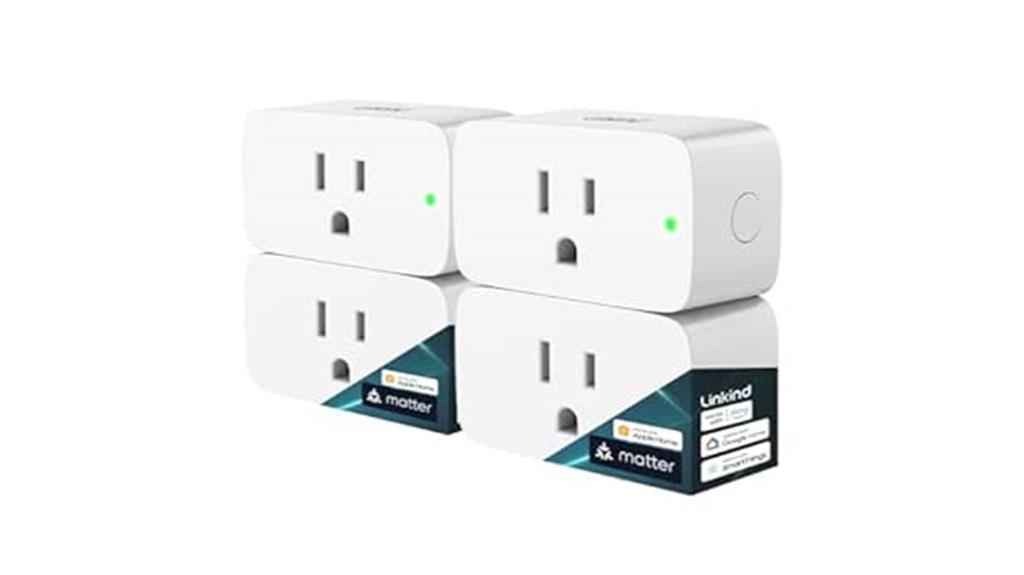
Looking to upgrade your smart home with reliable, versatile control? The Linkind Matter Smart Plug (4 Pack) is a fantastic choice. It works seamlessly with Apple Home, Siri, Alexa, Google Assistant, SmartThings, and AiDot, thanks to its Matter certification. You can control it directly via compatible platforms without juggling multiple apps. Setup is simple—just one step with Matter, and once connected to LAN, it communicates directly, even offline. Use the app remotely to turn devices on or off from anywhere. Plus, it supports voice commands, scheduling, and safety features like overload protection, making it a smart, safe addition to any home.
Best For: homeowners seeking a reliable, easy-to-use smart plug compatible with multiple platforms and capable of offline control.
Pros:
- Seamless integration with Apple Home, Alexa, Google Assistant, SmartThings, and AiDot thanks to Matter certification.
- Easy setup with direct LAN communication, enabling offline control without internet.
- Supports scheduling, timers, and safety features like overload protection for versatile and safe operation.
Cons:
- Only supports 2.4GHz Wi-Fi networks, which may limit compatibility in some setups.
- Requires a Matter-certified hub for full Apple Home, Alexa, and Google Home integration; direct control via AiDot app is an alternative.
- Compact design may limit the number of outlets used in crowded power strips or outlets.
Home Assistant Green Smart Home Hub
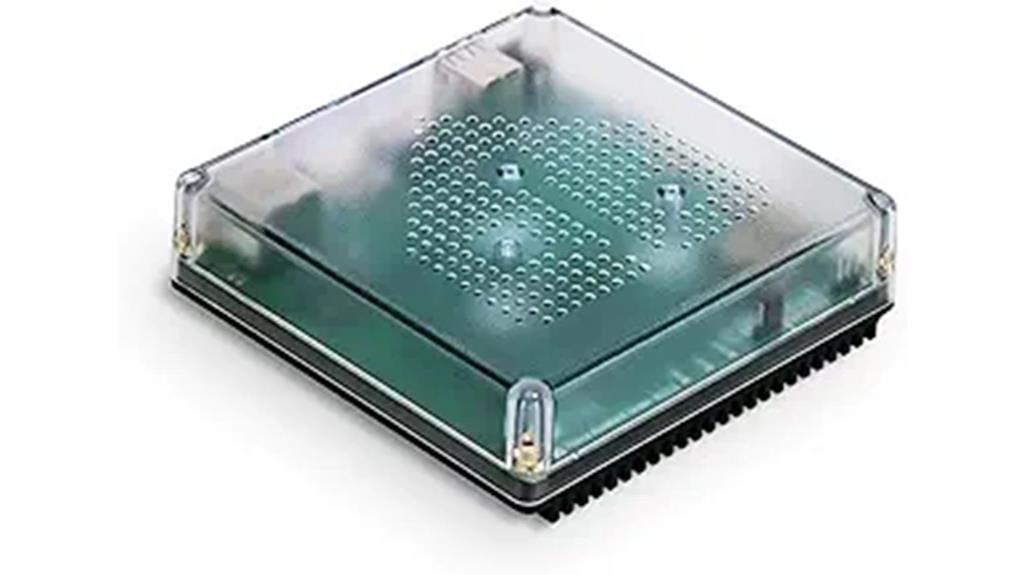
If you want a simple, reliable way to centralize your smart home devices, the Home Assistant Green Smart Home Hub stands out as an excellent choice. It’s compact, fanless, and silent, making installation effortless—just connect the power supply and Ethernet cable. With a quad-core processor, 32GB storage, and 4GB RAM, it’s optimized for seamless automation. It supports Z-Wave, Zigbee, and Thread via USB expansion, giving you flexibility to connect various protocols. Plus, all data stays local, ensuring privacy, while its low power consumption makes it energy-efficient. Overall, it’s a straightforward, powerful hub for creating a smarter, more integrated home.
Best For: those seeking a simple, reliable, and energy-efficient smart home hub with easy setup and comprehensive protocol support.
Pros:
- Easy plug-and-play setup with pre-installed Home Assistant software
- Supports multiple smart home protocols via USB expansion (Z-Wave, Zigbee, Thread)
- Local data storage ensures privacy and security
Cons:
- Limited storage capacity may restrict extensive device integrations over time
- No built-in Wi-Fi, relying solely on Ethernet for connectivity
- Slightly higher cost compared to DIY or less integrated solutions
Matter Smart Home Hub, Thread & Tuya Zigbee 3.0

For anyone seeking a versatile smart home hub that bridges multiple protocols, the Matter Smart Home Hub with Zigbee and Thread support stands out. It controls Tuya Zigbee 3.0 devices and verified Zemismart (Blindsmart) products, integrating them into Matter-certified systems with a border router. The hub works across platforms, letting you manage devices via Google Home, Apple Homekit, and more, with QR codes for easy sharing. It supports remote control through popular apps and voice commands with Siri or Google Assistant. Compact and lightweight, it’s designed for home or small office use. While some compatibility limitations exist, it offers a solid option for expanding your smart home ecosystem.
Best For: smart home enthusiasts seeking a versatile, multi-protocol hub to integrate Zigbee, Thread, and Matter devices across various platforms with remote and voice control capabilities.
Pros:
- Supports multiple protocols including Zigbee, Thread, and Matter for broad device compatibility.
- Enables control via popular third-party platforms like Google Home and Apple Homekit with QR code sharing.
- Compact design suitable for home or small office environments with remote access and voice command support.
Cons:
- Not all Zigbee devices are compatible; control is optimized with verified devices only.
- Requires a Matter border router for full Matter integration, adding to setup complexity.
- Customer ratings suggest mixed experiences, possibly due to device compatibility issues.
Eve Energy Smart Plug with App & Voice Control

The Eve Energy Smart Plug with App & Voice Control stands out as an ideal choice for homeowners prioritizing privacy and reliable local control. It operates without cloud dependency, ensuring your data stays private through local communication. This Matter-enabled plug works seamlessly across Apple Home, Alexa, Google Home, and SmartThings, supporting remote control and automation. Designed for indoor use, it handles up to 15A and 1800W, connecting via Thread and Matter protocols for stability. Easy to set up, it offers voice commands and automation, making your smart home more efficient and secure while respecting your privacy.
Best For: homeowners seeking a privacy-focused, reliable smart plug that easily integrates with multiple smart home platforms for remote control and automation.
Pros:
- Supports local communication with no cloud dependency, ensuring privacy and data security
- Compatible with major platforms like Apple Home, Alexa, Google Home, and SmartThings via Matter and Thread protocols
- Easy to set up and use, with voice control and automation capabilities
Cons:
- Limited to indoor use only, with an IP00 protection rating
- Requires compatible hub devices such as Apple TV, HomePod, or SmartThings Hub for full functionality
- Only supports 15A current and 1800W, which may not suit high-power appliances
X1 Apple Home Key Tap to Unlock Smart Keyless Door Lock
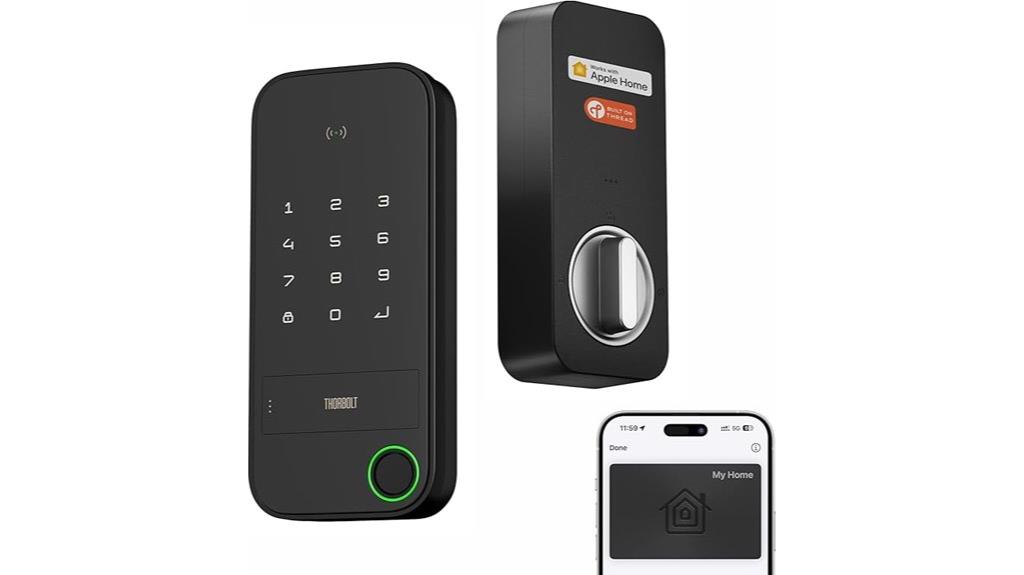
The X1 Apple Home Key Tap to Access Smart Keyless Door Lock stands out as an ideal choice for homeowners who want seamless, secure access control integrated with their Apple devices. It supports Apple Home Key, Thread, and HomeKit, allowing quick tap-to-access with an iPhone or Apple Watch even without power or network. The lock offers multiple unlocking methods, including fingerprint, passcodes, Siri, and traditional keys, all secured with encryption. Easy to install on standard doors, it’s weatherproof and battery-powered for up to a year. Manage users and monitor activity via the app, making it a reliable, future-proof smart lock for modern homes.
Best For: homeowners seeking a seamless, secure, and Apple ecosystem-compatible keyless lock with easy installation and reliable smart features.
Pros:
- Supports Apple Home Key, Thread, and HomeKit for effortless integration and control.
- Quick tap-to-unlock via NFC with iPhone or Apple Watch, even during power or network outages.
- Easy DIY installation on standard doors with up to a year of battery life.
Cons:
- Requires a Thread-enabled Apple hub for remote access beyond 33 feet.
- Limited to 50 users and 100 passcodes, which may be insufficient for large households or businesses.
- Dependence on batteries means periodic replacement is necessary to maintain functionality.
Eve Door & Window (Matter) Smart Contact Sensor

If you’re looking to enhance your smart home with reliable, privacy-focused devices, the Eve Door & Window (Matter) Smart Contact Sensor stands out. It provides real-time open or closed status for doors and windows, enabling automation and activity alerts. Its advanced Thread network ensures strong, stable connectivity, while support for Matter over Thread guarantees interoperability with multiple platforms like Apple Home, Alexa, Google Home, and SmartThings. Battery-powered and easy to install, it emphasizes privacy with no cloud dependency or tracking. This sensor is perfect for seamless, local control, making your home smarter and more secure in 2025.
Best For: homeowners seeking a reliable, privacy-focused smart contact sensor to enhance security and automation for doors and windows.
Pros:
- Supports multiple smart home platforms including Apple Home, Alexa, Google Home, and SmartThings for versatile integration
- Uses advanced Thread and Matter technology for robust, stable, and future-proof connectivity
- Emphasizes privacy with no cloud dependency or tracking, ensuring local control and data security
Cons:
- Requires a compatible hub and recent iOS or Android device for setup and operation
- Battery life may need monitoring, as it is battery-powered with a 2-year warranty but can vary with usage
- Limited to indoor mounting, not suitable for outdoor or harsh weather environments
Eve Energy (Matter) 2 Pack Smart Plugs

For anyone seeking a reliable way to control multiple devices seamlessly across different smart home ecosystems, Eve Energy (Matter) 2 Pack Smart Plugs stand out as an excellent choice. These smart plugs are compatible with Apple Home, Alexa, Google Home, and SmartThings, making integration effortless. With support for Thread network technology and a quick setup process, they offer stable, extended connectivity. You can control your devices via app or voice, schedule on/off times, or automate routines based on presence. Plus, they prioritize privacy by keeping data local and don’t rely on cloud services, ensuring your home’s security and performance.
Best For: homeowners and smart home enthusiasts seeking reliable, cross-platform control of multiple devices with privacy-focused, easy-to-install smart plugs.
Pros:
- Compatible with Apple Home, Alexa, Google Home, and SmartThings for versatile integration
- Supports Thread network technology for stable, extended connectivity and reliability
- Keeps user data local with no cloud dependency, enhancing privacy and security
Cons:
- Requires a Thread Border Router for operation, adding a setup step for some users
- Only available in a 2-pack, which may be more than needed for small setups
- Compatibility depends on specific hub or device requirements, potentially limiting use with older systems
Linkind Matter Smart Light Bulb (6 Pack)
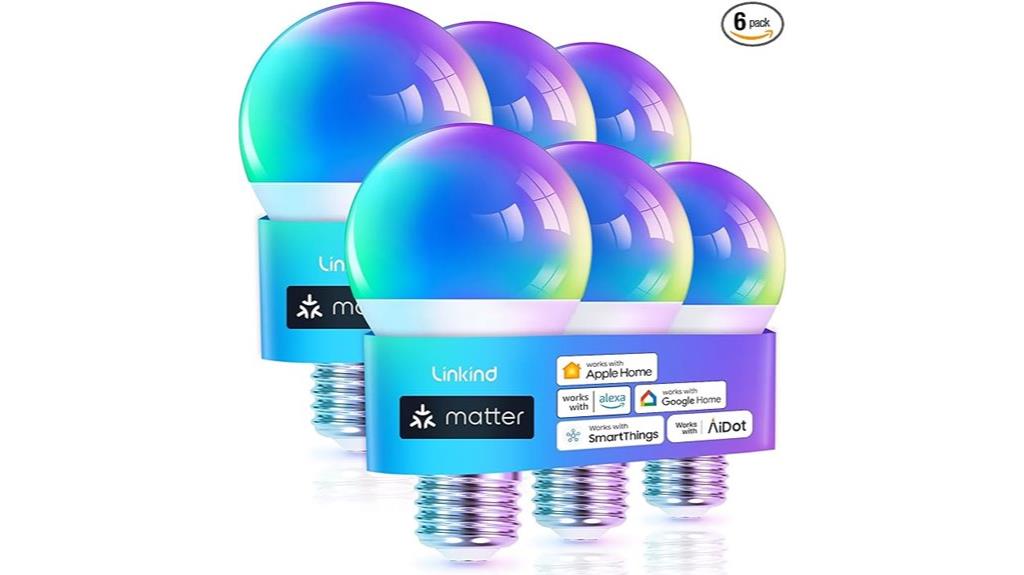
With support for the Matter standard and compatibility with major voice assistants like Alexa, Siri, and Google Assistant, the Linkind Matter Smart Light Bulb (6 Pack) stands out as an ideal choice for anyone looking to simplify smart home control. It connects via 2.4GHz WiFi and works seamlessly with platforms like Apple Home, SmartThings, and AiDot. The bulbs offer millions of colors, dynamic scenes, and music sync, allowing for personalized ambiance. Energy-efficient at just 9W, they provide bright, high-quality lighting with a lifespan of about 22 years. Control is easy through apps, and group management enhances convenience—all without needing traditional dimmers.
Best For: smart home enthusiasts seeking versatile, energy-efficient lighting that integrates seamlessly with major voice assistants and smart platforms.
Pros:
- Supports Matter standard for broad compatibility without multiple apps
- Offers millions of colors, dynamic scenes, and music sync for customizable ambiance
- Energy-efficient with a long lifespan of around 22 years
Cons:
- Only compatible with 2.4GHz WiFi networks; not functional on 5GHz networks
- Not compatible with traditional dimmer switches
- Requires stable WiFi and IPv6 routers for optimal performance
Eve Energy Outlet (Matter) Smart Outlet & Power Meter

The Eve Energy Outlet (Matter) stands out as an ideal choice for those seeking reliable, local-control smart outlets that seamlessly integrate into their existing ecosystems. It offers individual control of two outlets via app, voice, or automation, making managing lights and appliances simple. Built on Thread network technology, it guarantees stable, robust connectivity without a hub, provided you have a Thread Border Router. Compatibility spans Apple, Alexa, Google, and SmartThings platforms, all while maintaining 100% privacy with no cloud dependency. Quick to set up and UL-certified, it’s a secure, efficient addition to any modern smart home aiming for seamless control and energy monitoring.
Best For: smart home users seeking reliable, local-control outlets with seamless integration into Apple, Alexa, Google, or SmartThings ecosystems, prioritizing privacy and energy monitoring.
Pros:
- Supports Thread network technology for stable, hub-free connectivity
- Compatible with multiple major smart home platforms including Apple, Alexa, Google, and SmartThings
- Ensures 100% privacy with no cloud dependency and local control
Cons:
- Requires a Thread Border Router for Thread network functionality, which may add initial setup complexity
- Only supports two outlets per device, limiting control options for larger setups
- Needs compatible hub or border router for full functionality, potentially increasing cost or setup steps
Aqara Door and Window Sensor P2

If you’re looking to upgrade your home security with a reliable, wirelessly connected sensor, the Aqara Door and Window Sensor P2 stands out. It supports native Matter over Thread, ensuring seamless integration with major ecosystems like Apple Home, Google Home, Amazon Alexa, and Samsung SmartThings. Its high-precision Hall sensor detects open and closed states, sending instant alerts to your phone. Easy to install with adhesive backing, it’s powered by a long-lasting CR123A battery. Plus, it supports local automations, so it can trigger actions like adjusting thermostats or activating cameras without cloud dependence. This sensor makes your home smarter and more secure effortlessly.
Best For: homeowners seeking a reliable, easy-to-install smart sensor to enhance security and automate home functions across major smart home ecosystems.
Pros:
- Supports native Matter over Thread for seamless ecosystem integration
- High-precision Hall sensor for accurate open/closed detection
- Easy installation with adhesive backing and long-lasting CR123A battery
Cons:
- Requires a separate Matter Controller & Thread Border Router for full functionality
- Compatibility limited to specific hubs like Apple TV 4K, HomePod mini, and others
- Battery life varies based on connection stability and app usage
Aqara Smart Hub M100 for Home Automation

For anyone looking to create a reliable and versatile smart home hub, the Aqara Smart Hub M100 stands out as an excellent choice. It supports multi-protocol home automation, acts as a Matter Controller, and functions as a Thread Border Router, managing up to 20 Zigbee and 20 Thread devices. Compatible exclusively with Aqara Zigbee and Thread devices, it integrates seamlessly with Apple HomeKit, Alexa, IFTTT, and Home Assistant. Its local automation capabilities ensure quick responses even without internet. With a flexible USB-A port for power and Wi-Fi 6 connectivity, it offers stable, secure performance, making it a solid foundation for a future-proof smart home setup.
Best For: smart home enthusiasts seeking a reliable, multi-protocol hub that seamlessly integrates Aqara devices with popular ecosystems like Apple HomeKit, Alexa, and Home Assistant.
Pros:
- Supports multi-protocol automation with Zigbee and Thread, offering broad device compatibility.
- Ensures quick, local automation responses without relying on internet connectivity.
- Features a flexible USB-A power port and Wi-Fi 6 for stable, secure, high-speed connectivity.
Cons:
- Compatible exclusively with Aqara Zigbee and Thread devices, limiting third-party device support.
- Requires a separate 5V⎓0.5A power adapter, which is not included.
- First available in 2025, indicating it is a new product with limited long-term user reviews.
Factors to Consider When Choosing Thread‑Enabled Smart Home Devices

When choosing Thread-compatible smart home gadgets, I evaluate how effectively they integrate into my current ecosystem and their energy requirements. I also examine their dimensions and appearance to guarantee they merge effortlessly, along with robust security capabilities to safeguard my privacy. Finally, I focus on devices that are simple to configure and install for a smooth experience.
Compatibility With Ecosystems
Choosing Thread-enabled smart home devices requires careful attention to their compatibility with your existing ecosystem. These devices are designed to work smoothly with multi-protocol platforms like Apple HomeKit, Google Home, Amazon Alexa, and SmartThings. To integrate them properly, you’ll often need a Thread border router or hub, such as an Apple HomePod mini or Amazon Echo. Devices supporting the Matter protocol over Thread can operate across different ecosystems without multiple apps or bridges, offering greater flexibility. However, not all Thread devices are compatible with every platform, so verifying device and hub support is essential for seamless integration. Cross-platform compatibility lets you control and automate devices through your preferred ecosystem, making your smart home more versatile and user-friendly.
Power and Connectivity Needs
Selecting the right Thread-enabled smart home devices involves considering their power sources and connectivity needs to guarantee reliable performance. First, check if the device supports the Thread protocol for low-latency, dependable mesh networking with other devices. Confirm that your Wi-Fi network is IPv6 compatible, as Thread devices usually need IPv6 routers to function properly. Determine if a Thread Border Router is necessary for connecting to your preferred smart home ecosystem or control platform. Power requirements matter too—decide whether batteries suit your setup or if direct AC power is better, depending on installation and usage. Finally, evaluate the device’s connectivity range and mesh capabilities to ensure seamless coverage across your entire home. Balancing these factors helps optimize reliability and performance.
Device Size and Design
The size and design of Thread-enabled smart home devices play a crucial role in how easily they integrate into your living space. These devices are typically compact and streamlined, making them unobtrusive and easy to place anywhere. Sensors often measure less than an inch, while hubs are around four inches, ensuring minimal footprint. Many are lightweight, weighing just a few ounces, with integrated antennas and circuitry that keep them unobtrusive. Their minimalist aesthetics and low-profile designs help them blend seamlessly with home decor. The small form factor also makes installation simple, allowing for stacking or fitting into tight spaces like outlets. Overall, thoughtful sizing and sleek designs ensure these devices enhance your home without disrupting its visual harmony.
Security and Privacy Features
When evaluating Thread-enabled smart home devices, prioritizing security and privacy features is crucial to safeguard your data and guarantee peace of mind. These devices emphasize local communication, keeping your data within your home network, which enhances privacy. Many support end-to-end encryption, protecting your information during transmission from interception. Since Thread devices operate without cloud dependency, they reduce exposure to remote hacking risks. Firmware updates are often delivered over-the-air with built-in security measures, maintaining device integrity. It’s also essential to verify that your device doesn’t store or track user data externally, giving you full control over your information. Prioritizing these features ensures your smart home remains both secure and private, letting you enjoy the convenience of Thread technology without compromising your personal data.
Setup and Installation Ease
Choosing a Thread-enabled smart home device becomes much easier when you prioritize setup and installation features that simplify the process. Look for devices with clear, step-by-step instructions to guide you through installation without frustration. Wireless onboarding methods like Bluetooth or NFC are game changers—they eliminate the need for complex wiring and make setup faster. A user-friendly app or interface that walks you through configuration helps even non-technical users get devices up and running quickly. Compatibility with existing hubs or controllers is also essential, as it reduces extra hardware and setup steps. Additionally, automatic network detection for Wi-Fi or Thread connections ensures seamless integration into your smart home ecosystem. These features make setup straightforward, saving time and minimizing headaches.
Future Update Support
Future update support is crucial because it guarantees your Thread-enabled devices stay secure, functional, and compatible as technology evolves. Manufacturers regularly release firmware updates that enhance security, fix vulnerabilities, and improve device performance. These updates also ensure your devices stay compatible with new smart home platforms and protocols, extending their lifespan. Support for future updates means you won’t have to replace devices prematurely, as firmware can add new features or refine existing ones over time. Staying current with updates helps protect your home from emerging threats and keeps your smart home ecosystem seamless. When choosing Thread-enabled devices, it’s essential to verify that the manufacturer commits to ongoing updates, ensuring your investment remains valuable and your home stays smarter in the years to come.
Frequently Asked Questions
How Does Thread Improve Smart Home Device Connectivity?
Thread improves smart home device connectivity by creating a reliable, low-latency mesh network that connects all your devices seamlessly. I’ve found it makes my smart home more responsive because each device communicates directly with others, reducing delays and congestion. Plus, it’s energy-efficient and secure. With Thread, I don’t worry about weak spots or dropped connections, making my smart home setup more stable and easy to expand over time.
Which Devices Are Compatible With Multiple Smart Home Ecosystems?
Many smart home devices are compatible with multiple ecosystems, making integration easier. I look for products supporting standards like Zigbee, Z-Wave, and Thread, ensuring they work with hubs like SmartThings, Hubitat, or Apple HomeKit. Brands like Eve, Philips Hue, and Nanoleaf often offer cross-platform compatibility. This approach lets me create a seamless smart home experience, regardless of which ecosystem I choose or expand into in the future.
What Security Features Are Common in Thread-Enabled Devices?
Think of thread-enabled devices as a fortress, protecting your smart home. They often include robust security features like end-to-end encryption, secure boot processes, and regular firmware updates. Many also have device authentication and network segmentation to prevent unauthorized access. These layers of security work together to keep your data safe and your smart home environment secure, giving you peace of mind in your connected life.
Can Thread Devices Operate Without a Central Hub?
Yes, Thread devices can operate without a central hub. They form a mesh network, meaning each device connects directly to others, allowing for seamless communication even if one device fails. This setup makes them more reliable and scalable. I love this feature because it reduces reliance on a single point of failure and simplifies setup, making my smart home more resilient and easier to expand over time.
How Energy-Efficient Are Thread-Enabled Smart Home Devices?
Thread-enabled smart home devices are highly energy-efficient because they use low-power wireless communication, which reduces energy consumption. I’ve noticed they consume less power compared to traditional Wi-Fi or Zigbee devices, helping me save on energy bills. Plus, their efficient communication means my devices stay connected longer without draining batteries quickly. Overall, I find Thread devices a smart choice for anyone wanting to make their home greener and more sustainable.
Conclusion
If you’re looking to upgrade your home, choosing Thread-enabled devices makes a real difference. Imagine controlling your lights and appliances seamlessly with just a tap or voice command—like a recent user who automated their entire living room for energy savings and convenience. Investing in these devices guarantees a more reliable, secure, and future-proof smart home. Don’t wait—embrace Thread technology now and enjoy smarter, simpler living in 2025 and beyond.